Home » Jazz Articles » Album Review » String Trio of New York with Paul Kane: Intimations
String Trio of New York with Paul Kane: Intimations
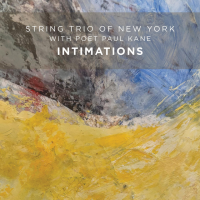
Although guitarist James Emery remains the only link to the group's origins, bassist John Lindberg having left after River of Orion and a series of successors to violinist Billy Bang having come and gone over the decades, the current configuration proves more than capable of building on the trio's storied legacy—now with Emery's compositions at the fore. Rob Thomas handled the violin duties on River of Orion and continues to excel here, with lyrical passages and fleet excursions galore, while the most recent addition, bassist Tony Marino, is similarly multifaceted, offering rock-solid support or nimble improvisations throughout the record. Drummer/percussionist Thurman Barker adds rhythmic potency to a number of the cuts. As for Emery, he is clearly in top form, with astonishingly fluid runs on the breakneck-paced "Pursuit of Happiness" and a delightfully spunky solo on "Blues for Seligmann," the only two tracks that do not feature Kane. These pieces readily evoke the spirit of STNY of old, with airtight rapport and fearless imagination in abundance.
As strong as the trio is on its own, Kane's presence clearly brings another valuable dimension to the music. Integrating several of his own poems in addition to three original translations of the work of 14th-century Persian poet Hafiz of Shiraz, Kane becomes a true equal in the ensemble, seamlessly joining his insights to the group's melodic and improvisatory flights. The folksy opener, "Down Home Tone Poem," first featured on Emery's Transformations (Between the Lines, 2003), gently gives way to Kane's "Aubade," a quiet rumination on the break of dawn, with the group augmenting Kane's patient delivery while leaving plenty of space for reflection. Kane's unhurried style allows Emery, Thomas and Marino ample opportunities for apt interjections or commentary, as on "Black Diamond/Shadows," in which Emery and Thomas weave lithe passages through and around Kane's lines, complementing but not obstructing him.
Kane's translations of Hafiz are potent and paradoxical, capturing intertwined spiritual and earthly yearnings, and "EPedal/Ghazal 151" is an ideal vehicle, with a subtle groove augmented by Barker's toms and well-placed percussion supporting Kane's mysterious pursuit of "the steeps and descents of love's desert." Just as compelling, "In a Secret Place/Ghazal 373" provides a disarmingly lovely opening to another reflection on the intensity of spiritual devotion. Kane delves into the complexity of these poems with reverence and more than a hint of whimsy, doing justice to the Sufi master's unique vision.
Perhaps most impressive is the album's closer, "Denouement/Seven Catastrophes in Four Movements," a 13-minute extravaganza of dynamic improvisation built around Kane's tribute to "Catastrophe Theory," an approach to complex systems which stresses the importance of collapse in societal and biological organisms. Alongside Kane's fractured observations on chaos and impermanence, the musicians' contributions echo and magnify these musings, threatening to devolve completely but yet finding new ways to cohere. The beauty lies in the music's celebration of indeterminacy and ever-unfolding possibility, which renders Kane the perfect collaborator for this unique ensemble, fortunately back together after a too-long hiatus.
 FOLLOW Troy Dostert
and get notified whenever a new article published.
FOLLOW Troy Dostert
and get notified whenever a new article published.
A passionate listener and reviewer of all things jazz-related, with particular emphasis on anything that challenges expectations and boundaries.
Track Listing
Down Home Tone Poem/Aubade; Black Diamonds/Shadows; E Pedal/Ghazal 151; Flutter By, Butterfly/On Earth; The Pursuit of Happiness; In a Secret Place/Ghazal 373; Blues for Seligmann; Insouciant/Ghazal 179; Denouement/Seven Catastrophes in Four Movements.
Personnel



Additional Instrumentation
Paul Kane: poetry, translations, readings.
Album information
Title: Intimations | Year Released: 2025 | Record Label: Self Produced
About James Emery
Tags
PREVIOUS / NEXT

Become a Sustaining Member

Since 1995, All About Jazz has championed jazz as an art form and supported the musicians who create it. Over three decades, it has grown into one of the world's leading jazz resources, serving hundreds of thousands of readers, musicians, presenters and industry professionals each month.
Help Build the Future of All About Jazz
Your support helps us continue building All About Jazz for the next generation—expanding our editorial coverage, preserving jazz history, developing new community features and creating better ways to discover the music and the people behind it.
Become a sustaining member for as little as $20 per year and you'll immediately enjoy an ad-free experience along with access to subscriber features and future articles for a full year.
Together, we're not simply sustaining All About Jazz—we're building its future. Thank you for being part of the journey.