Home » Jazz Articles » Live Review » Dave Douglas and Keystone: Columbus, February 5, 2011
Dave Douglas and Keystone: Columbus, February 5, 2011
Lincoln Theatre
Columbus, Ohio
February 5, 2011
It seemed somehow fitting that composer Dave Douglas' presentation of Spark Of Being (Greenleaf Music, 2010) be held in the aftermath of the blizzard of 2011. The audience for this retelling of Mary Shelley's Frankenstein, which begins and ends with a sailing ship frozen in the ice of the North Pole, had traveled to the Lincoln Theatre through huge drifting snows, with trees and power lines splintered by a monstrous ice storm.
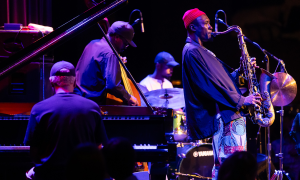
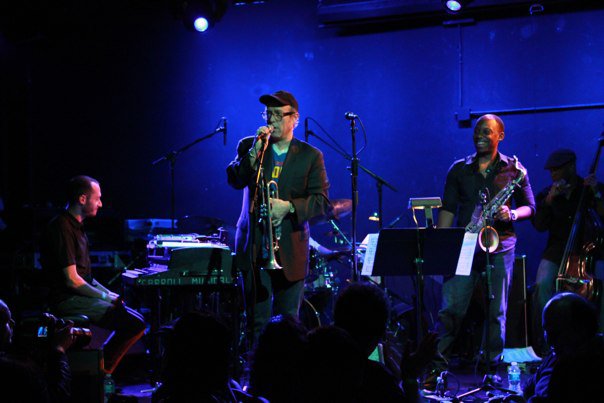
The trumpeter and his electric sextet (minus one) were concluding a tour presenting his soundtrack to Spark Of Being, a film by Bill Morrison that is a reinterpretation of Mary Shelley's gothic tale. Morrison remade the film from archival and found film, splicing together often damaged and distressed footage to create a being not unlike the beast itself. Dwarfed by the huge movie screen, Douglas and his Keystone band of Adam Benjamin (Fender Rhodes piano), Marcus Strickland (tenor saxophone), Brad Jones (Ampeg baby bass), and Gene Lake (drums) performed in the left corner of the stage. The sextet was missing its sound generator, turntablist DJ Olive, whose wife had recently given birth to their child. The symbolism of Dr. Frankenstein exclaiming, "it's alive!" wasn't lost as soundboard technician Jeff Countyman filled in with samples and the "dead" sounds DJ Olive had resurrected for the soundtrack.
Douglas formed his Keystone band to play music for silent film, but not in the classic drumroll pratfall, or wah-wah crying visual interpretations more recently favored by Bill Frisell's Buster Keaton soundtracks. Douglas' music tends to stand alone, moving the focal length inward for a much wider view.
In concert, Keystone managed the disciplined sequence of the twelve parts of the film by playing music that recalls Miles Davis electric years, but with a more strict, self-governed approach. Like Davis, Douglas is a lyrical player, seemingly always defaulting to beautiful sounds. His trumpet growl or flutter was always in service of the visual, and his frequent use of his trumpet mute seemed to differentiate the human voice from the mechanical. Throughout the evening, the leviathan on stage was drummer Gene Lake. His titanic eruptions were a pot constantly boiling. In the creation scene, Lake went toe-to-toe with a drum machine, and as the film displayed the laboratory exploding, he could barely be contained. Throughout, Douglas and Strickland acted as the keepers of the flame, stating the main musical themes of the evening. Adam Benjamin's electric piano, with its atavistic sound lingering somewhere in the past, evoked modernism yet sounded like a primitive (in 2011 terms) device.
As the film portrayed Shelley's foreboding 1818 tale of science and the misappropriation of technology, Douglas experimented with his 21st century tools: samples, musical apps and electronics, with the same apprehension Dr. Frankenstein had toward electricity. But whereas Dr. Frankenstein's hubris didn't allow him to appreciate his undertaking, Douglas surely does. Keystone's mastery of this technology and material maintained the film throughout.
Photo Credit
Simon C.F. Yu
 FOLLOW Mark Corroto
and get notified whenever Mark has a new article published.
FOLLOW Mark Corroto
and get notified whenever Mark has a new article published.
Mark misses his dogs Louie & Freddy, but endeavors daily to find and listen to new and interesting sounds.
About Dave Douglas

Tags
PREVIOUS / NEXT

Become a Sustaining Member

Since 1995, All About Jazz has championed jazz as an art form and supported the musicians who create it. Over three decades, it has grown into one of the world's leading jazz resources, serving hundreds of thousands of readers, musicians, presenters and industry professionals each month.
Help Build the Future of All About Jazz
Your support helps us continue building All About Jazz for the next generation—expanding our editorial coverage, preserving jazz history, developing new community features and creating better ways to discover the music and the people behind it.
Become a sustaining member for as little as $20 per year and you'll immediately enjoy an ad-free experience along with access to subscriber features and future articles for a full year.
Together, we're not simply sustaining All About Jazz—we're building its future. Thank you for being part of the journey.