Home » Jazz Articles » Album Review » The Birdland Big Band: Storybook—The Music Of Mark Miller
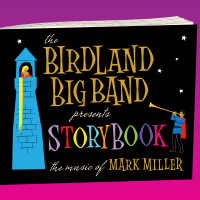
The Birdland Big Band: Storybook—The Music Of Mark Miller
Birdland's original, long defunct basement club at "The Jazz Corner of the World" (Broadway and 52nd) now occupies a bigger mid-town area, bounded on the north by Jazz at Lincoln Center (60 St.) and, on the south, by the "new" Birdland (44th St). Start at 52nd St., walk 8 blocks in either direction, and you are there. But which direction? Is there a significant difference? Some observers have suggested that big band music from the north references the genius of Duke Ellington, whereas the sounds to the south are aligned with the swing of Count Basie. Yet "Storybook," the eponymous title of the album's first track, sounds like something else entirely.
Miller—much of whose "schooling" was on the road as trombonist-composer with the Minneapolis-based jazz group, The Motion Poets—has constructed a brilliant sonic gateway that owes as much to Bach and Bartok as to Ellington or Count Basie. Starting with a stately 3-note descending motif, the composition builds on that figure with rich harmonies and vibrant dynamics, answered by an ascending counter-melody played by the lower brass. Soon, the entire sequence is repeated, with the addition of creative commentary from Brandon Lee's flugelhorn. After a sharply articulated, vigorously syncopated version of the primary motif, Nathan Childers' alto sax assumes the narrator's role, commenting on the action while guiding the story to a high-pitched, purposeful finale.
The foregoing sketch is far from essential to an appreciation of the piece's ingenious construction and flawless execution. Miller's use of powerful countermelodies, contrasting but continually crescendoing textures, and logical yet suspenseful motivic development all contribute to the piece's unique design.. If "tension and release" is the key to aesthetic composition and the listener's response, "Storybook" takes it to another level, blurring the line between classical music and jazz while offering an epiphanic "cleansing" experience for the listener.
The intensity doe not let up with Kenny Barron's infectious "Water Lily." Unlike earlier recorded versions that are slower and light-spirited, the tune here is taken at a driving tempo with accompaniment by piano and drums that borders on the intrusive (likely due to an over-hot audio mix-down). Besides an inventive piano solo by Kenny Ascher, the piece showcases the commanding artistry of saxophonist Troy Roberts, whose closing cadenza balances impressive pyrotechnics with satisfying musical taste. Next, the standard, "Tenderly," lightens the mood with a sprightly version of a waltz that, with the notable exception of Bill Evans' up-tempo version, usually receives the slow, reflective reading of Rosemary Clooney or the even slower 4/4 versions by Sarah Vaughn and Billie Holiday. Miller's arrangement exhibits remarkable attention to detail, replete with spiraling flutes that simulate butterflies to complement the spring setting for vocalist Nicole Zuraitis. Brief solos by Sam Dillon (t.sax) and Raul Agraz (trpt) fit seamlessly with the colorful seasonal mix.
Miller's own "Chorale and Alleluia" is as contemplative and celebratory as its title might suggest. It features the percussive thunder of Chris Smith, who will also be critical to the driving samba rhythm of Chick Corea's "Spain." Tom Harrell's "Sail Away" is an inviting melody launched without affectation by Glenn Drewes' reassuring flugel. After band director David DeJesus' soprano sax has taken control of the cruise, Mark Miller resumes his storytelling by, in effect, shutting off the engine (i.e., piano, bass, drums) and allowing only the sounds of wind and water for several choruses—the pulse of the band sans rhythm section.
It is tempting to continue with a play-by-play analysis if only to identify the soloists in an ensemble with no weak links. The Birdland Band is "deep" with talent, each player capable of assuming solo duties on any given night. Take, for example, "WTF," in which trombonist/composer Miller resumes the cruise with a witty trombone exchange between James Burton III and Sara Jacovino, one that recalls the musical conversations between trombonists J.J. Johnson and and Kai Winding.
The last third of the program is cued up by the standard "Close Your Eyes," which opens with Zuraitis close to the mic as she fashions a soft, pitch-perfect, improvised chorus before yielding to an Ascher piano solo that swings with the sure- fingered authority of Wynton Kelly. Following a good-humored, equally swinging turn by bass trombonist, James Borowski, Zuraitis re-enters for an "out" chorus that soon becomes "far-out," her voice rising in pitch and volume to the level of a Maynard Ferguson set-closer. It works because the vocalist implants herself in the trumpet section, rising to a powerful climax. Finally, we receive a healthy reminder that "swing" does not require a thing except a ride cymbal and a hi-hat. (If only audio engineers could figure out a way to include the shimmer of a Zildjian in their mastering of live sounds.)
Rodrigo's "Concierto de Aranjuez" and Corea's "Spain" are among the more "honest" jazz versions as they avoid orchestral instruments (French horns, double reeds, tympani, etc.) as well as electronic devices (Fender Rhodes, phaser boxes, onboard modulating effects). The result is a focus that remains fixed on the music, not the gear. And then there is the memorable close-out for "Spain"—an ascending Miller bass-line that, in effect, resolves a sparking, fractious debate between big band and drums, then between sections within the ensemble.
"The DoubleDown," the last track of the regular program, evokes a Sunday night gospel meeting with its inviting singalong melody in ¾. The primary preacher is Ron Wilkins, whose heated testifying on plunger-muted trombone produces a meditative bass solo by Noriko Ueda. But rather than exit quietly, the congregation is led back by saxophones to the main theme, then a sudden stop and lift to a new key for a final testament by Mark Miller's emphatic postlude on trombone.
Church is out, but the congregation's spirits crave more action. "Nonsense," an original shuffle-rhythm blues composed by Miller and Zuraitis, answers the need to sustain the sense of play embedded in every true storybook. Zuraitis delivers a nonsensical lyric in the strongest musical terms, conversing over stop-time chords with Ron Wilkins' vocal trombone. Next, she handles "vocalese" lines in tight unison with tricky instrumental figures. Finally, there is a vocal exchange, over pedal- tone bass, between the entire band and its girl singer, who has the last word: "Nonsense? Whatever, just get out!."
Small wonder that, after hearing a call like that, fans of live music are setting aside Friday nights to just get out and head for Birdland, where the Big Band starts at 5:30 p.m.
 FOLLOW Samuel Chell
and get notified whenever a new article published.
FOLLOW Samuel Chell
and get notified whenever a new article published.
Sam Chell is a champion of the composers of the American Songbook and the musicians who keep it alive.
Track Listing
Storybook; Water Lily; Tenderly; Chorale And Alleluia; Sail Away; WTF;; Close Your Eyes;; Concierto De Aranjuez; Spain; The Doubledown; Nonsense;.
Personnel
David DeJesus
saxophone
The Birdland Big Band
band / ensemble / orchestra
Mark J Miller
trombone
Nicole Zuraitis
vocalsAdditional Instrumentation
David DeJesus: musical director;. Nicole Zuraitis: vocals; Nathan Childers, David DeJesus: alto sax; Troy Roberts, Sam Dillon: tenor sax; Jason Marshall: baritone sax; David DeJesus, Sam Dillon, Nathan Childers: flutes; Raul Agraz, John Walsh, Brandon Lee, Glenn Drewes, Max Darché: trumpets; Mark Miller, James Burton III, Ron Wilkins, Sara Jacovino, James Borowski: trombones; Kenny Ascher, Adam Birnbaum: piano; Noriko Ueda: bass; Chris Smith: Chris Smith.
Album information
Title: Storybook—The Music Of Mark Miller | Year Released: 2025 | Record Label: Birdland Records
About David DeJesus
Tags
PREVIOUS / NEXT

Become a Sustaining Member

Since 1995, All About Jazz has championed jazz as an art form and supported the musicians who create it. Over three decades, it has grown into one of the world's leading jazz resources, serving hundreds of thousands of readers, musicians, presenters and industry professionals each month.
Help Build the Future of All About Jazz
Your support helps us continue building All About Jazz for the next generation—expanding our editorial coverage, preserving jazz history, developing new community features and creating better ways to discover the music and the people behind it.
Become a sustaining member for as little as $20 per year and you'll immediately enjoy an ad-free experience along with access to subscriber features and future articles for a full year.
Together, we're not simply sustaining All About Jazz—we're building its future. Thank you for being part of the journey.