Home » Jazz Articles » In the Artist's Own Words » The Most Beautiful Thing
The Most Beautiful Thing
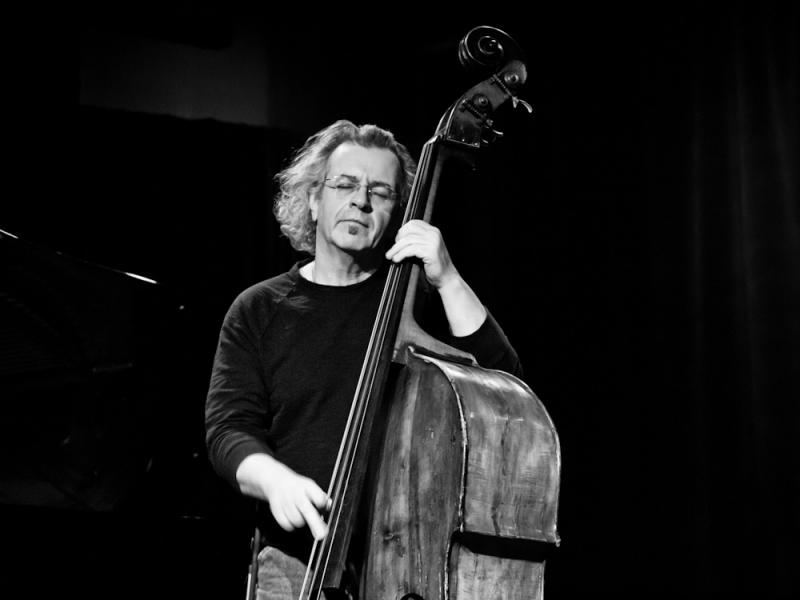
If we accept "Sound" as our most objective definition it leaves enormous room for consideration and application of the Subjective, in my mind a very good thing.
Albert Einstein, an extremely interesting cat, once said: "The most beautiful thing we can experience is the mysterious." The first time I read this its impact was immense. The little I knew about him said he was one of the greatest minds of the late 19th through the mid twentieth centuries, maybe the greatest. At what level does Albert Einstein find mystery! ? Not only that, mystery is where he experiences beauty. What happens once it is found/understood, no longer a mystery? ... on to the next beautiful mystery,(my conclusion). Hard to imagine how far out that must be, although I do now believe I erred in imagining a vertical strata of non-mystery and mystery. Enter the great bassist Buddy Catlett, I am honored to call Buddy friend and mentor, additionally we lived in the same neighborhood for years and would often hang out, play two basses and talk. Talking was mostly me being enthralled listening to his tales. For most of my life I was a sucker for a good story, add to that Buddy's were all true! One can only shut up and listen. He would reel off stories of being on the road with cats maybe a generation older than him. They'd say things like: Your ear will take you so far and then you have to add some science. (Imagine!) Then your ear will improve, then add more science, then your ear will improve, then... etc. etc. Science is obviously slang for theory but what an interesting choice of words. All these great minds and hearts working through similar processes, searching to uncover mystery, find beauty.
From Essentials of Spontaneous Prose by Jack Kerouac
"Center of Interest: Begin not from preconceived idea of what to say about image but from the jewel center of interest in subject of image at the moment of writing, and write outwards swimming in sea of language to peripheral release and exhaustion-Do not afterthink except for poetic or P.S. reasons. Never afterthink to "improve" or defray impressions, as, the best writing is always the most painful personal-wrung out tossed from the cradle warm protective mind-tap from yourself the song of yourself, blow!-now! your way is the only way-"good' -or "bad"-always honest, (ludicrous) spontaneous, "confessional" interesting, because not "crafted." Craft is craft."
It is not a stretch of my imagination to hear Albert Ayler independently and simultaneously inventing this same thought, applying it to sound. These very sentiments certainly inform a great deal of my process other than preparation. In particular the way I act on standards in the Matthew Shipp Trio and how I conceive form when it is not a given.
Form: for several decades now popular discussions concerning form have at their core some moral high ground, both sides claiming sanctity... there is none, there is no moral component to form whatsoever or even the lack there of, this was never an interesting avenue and certainly has no relevance.
Artists in other areas have inspired me regarding form. Let's take a look at the painter Jacob Lawrence the world claimed him as an expressionist, he experienced his form as dynamic cubism. Here again is a phrase that simply stopped me in my tracks. What could be a more defined form than a cube? It is solid and static. Dynamic, used as an adjective, defined by Dictionary (version 2.2.1): "(of a process or system) characterized by constant change, activity, or progress; (of a person) positive in attitude and full of energy and new ideas; Physics of or relating to forces producing motion. Often contrasted with static." I would add dynamic also implies a flow, somehow liquid. It is absolutely genius that Jacob Lawrence could not only conceive of a style based on seemingly opposing concepts but could act on it in such a spectacularly realized manner.
An artist working in sound should take note.
Although I have notes for several other areas this particular system seems complete.
These recordings were chosen for their relevance and to give the listener context within the breadth of my recorded chronology: Matthew Shipp Trio, Root of Things (Relative Pitch Records); Floating Ice, Michael Bisio/Matthew Shipp (Relative Pitch); Matthew Shipp Art of the Improviser (Thirsty Ear); Brian Groder, Reflexology (Latham Records); Ivo Perelman, The Other Edge (Leo); Blood Trio Understory (Not Two Records); My Brother, Gary Hassay/Michael Bisio (Konnex); Zebulon, Duets with Joe McPhee (CIMP) Travel Music (MJB); 2011 Undulations (Omnitone); Bob Nell Trio, Soft and Bronze (Plechmo); In Seattle (Silkheart).
 FOLLOW Michael Bisio
and get notified whenever a new article published.
FOLLOW Michael Bisio
and get notified whenever a new article published.
Michael Bisio is double bass player, composer and bandleader.
About Michael Bisio

Tags
PREVIOUS / NEXT

Become a Sustaining Member

Since 1995, All About Jazz has championed jazz as an art form and supported the musicians who create it. Over three decades, it has grown into one of the world's leading jazz resources, serving hundreds of thousands of readers, musicians, presenters and industry professionals each month.
Help Build the Future of All About Jazz
Your support helps us continue building All About Jazz for the next generation—expanding our editorial coverage, preserving jazz history, developing new community features and creating better ways to discover the music and the people behind it.
Become a sustaining member for as little as $20 per year and you'll immediately enjoy an ad-free experience along with access to subscriber features and future articles for a full year.
Together, we're not simply sustaining All About Jazz—we're building its future. Thank you for being part of the journey.