Home » Jazz Articles » Album Review » Hazel Leach / Composers' Orchestra Berlin: Postcard Collection
Hazel Leach / Composers' Orchestra Berlin: Postcard Collection
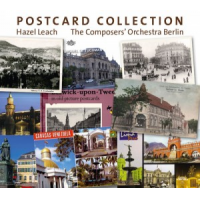
The last three cards are, in fact, addressed to precincts in Deutschland including No. 5, "Bonn," and arguably the most intriguing of them all, No. 2, labeled "Berlin 1929," wherein the COB turns back the clock, as it were, summoning the spirit of pre-war Berlin to ring down the curtain with a seductive waltz that brings to mind music from Kander and Ebb's Broadway smash (and later film) Cabaret. Leach wrote and signed that card, as she did all the others, affirming once again that she is one of Europe's—and the world's—more erudite sculptors of contemporary big-band jazz.
About the rhythmically pleasing opener, "Postcard 10 Caracas," Leach writes that "the composer and pianist Claudia Calderon has translated the traditional harp rhythms of Venezuelan folk music into her piano style," which is rather confusing given that Calderon is not listed as the pianist here and the booklet notes that "all compositions are by Hazel Leach." As pianist Fee Stracke is among the soloists, it must be assumed that he (or she), and not Calderon, is at the piano, as is the case on "Postcard 11 Tucuman" and "Postcard 8 Lima." The other soloists on "Caracas" are drummer Tom Dayan and trumpeter Aaron Schmidt-Wiegan.
The dark-hued "Tucuman" slows the tempo considerably, sauntering sternly behind its featured artist, tenor saxophonist Tian Korthals, before the light shines again on "Postcard 7 Berwick upon Tweed," whose dancing melody gives way to a sunny statement by alto saxophonist Ruth Schepers before the ensemble grasps the reins and ushers the steed across the finish line. "Postcard 8 Lima" is another rhythmic delight, its easygoing nature enhanced by trombonist Anne Dau's purposeful solo. "Postcard 9 Kalavrita" opens with an air of mystery before easing into a tango-like dance with Israeli overtones (based, Leach writes, on "the nine-beat pattern of rebetika music") whose earnest soloists are clarinetist Mieke Goosmann and violist Katja Braun.
"Schlabendorf am See" is dense and deliberate, marching (one should say waltzing) leisurely behind decorous statements by Schmidt-Wiegan, Korthals and violinist Daniel Friedrichs. "Postcard 5 Bonn," Leach's "personal homage to Beethoven," uses a moderate tempo and overlapping phrases to underscore brief solos by pianist Heiko Kulenkampff and guitarist Daniel Meyer. That leads to "Berlin 1929," a salute to the city's pre-war dance halls whose clear-eyed soloists are Goosmann and trumpeter Nikalous Neuser. It's a provocative coda to an album whose myriad facets may seem challenging to some listeners but should abundantly reward those whose hearts and minds are attuned to new approaches and ideas.
 FOLLOW Jack Bowers
and get notified whenever a new article published.
FOLLOW Jack Bowers
and get notified whenever a new article published.
A former newspaper writer / editor who has been writing about jazz for more than forty years.
Track Listing
Postcard 10 Caracas; Postcard 11 Tucuman; Postcard 7 Berwick Upon Tweed; Postcard 8 Lima; Postcard 9 Kalavrita; Postcard aus Schlabendorf am See; Postcard 5 Bonn; Postcard No. 2: Berlin 1929.
Personnel

Hazel Leach
composer / conductor
The Composers' Orchestra Berlin
band / ensemble / orchestraHazel Leach: leader, composer, arranger; Aaron Schmidt-Wiegand: trumpet (1-7); Nikolaus Neuser: trumpet (8); Meike Goosmann: sopranino recorder, clarinet (3, 5, 8); Ruth Schepers: alto sax (1-7); Tian Korthals: tenor sax (1-7); Markus Busch: baritone sax, bass clarinet (1-7); Anne Dau: trombone (1-7); Janni Struzyk: tuba (1-7); Daniel Friedrichs: violin (1-7); Claudia Autuori: violin (1, 2, 4); Matthias Leupold: violin (3-7); Raphael Armin: violin (8); Katja Braun: viola (1-7); Susanne Paul: cello (1-5); Frederico Malverde: cello (6, 7); Martin Klenk: cello (8); Fee Stracke: piano (1, 2, 4); Heiko Kulenkampff: piano (3, 5-7); Daniel Meyer: guitar (1-7); Dirk Strakhof: bass; Tom Dayan: drums, percussion.
Album information
Title: Postcard Collection | Year Released: 2018 | Record Label: JazzHausMusik
About Hazel Leach
Tags
PREVIOUS / NEXT

Become a Sustaining Member

Since 1995, All About Jazz has championed jazz as an art form and supported the musicians who create it. Over three decades, it has grown into one of the world's leading jazz resources, serving hundreds of thousands of readers, musicians, presenters and industry professionals each month.
Help Build the Future of All About Jazz
Your support helps us continue building All About Jazz for the next generation—expanding our editorial coverage, preserving jazz history, developing new community features and creating better ways to discover the music and the people behind it.
Become a sustaining member for as little as $20 per year and you'll immediately enjoy an ad-free experience along with access to subscriber features and future articles for a full year.
Together, we're not simply sustaining All About Jazz—we're building its future. Thank you for being part of the journey.