Home » Jazz Articles » Album Review » Myra Melford & Tanya Kalmanovitch: Heart Mountain
Myra Melford & Tanya Kalmanovitch: Heart Mountain

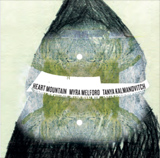
There is absolutely no reason why jazz, specifically improvised music, cannot and should not be listened to with the same degree of concentration that is expected of classical music. The music that Melford and Kalmanovitch make is extremely taut and highly transparent, exposing the players' personalities. That this music requires something of the listener only reinforces the fact of its compressed intensity.
Indeed, Heart Mountain is actually easier to follow than other recent spontaneous improvisational releases such as Francois Carrier's Noh (Ayler, 2007) or Russ Lossing's Metal Rat (Clean Feed, 2006). The reasons for this include the brevity of the tracks, and hence their directness, and the presence of only two players, creating a clarity of sound. Mostly though, it is due to Kalmanovitch's lines, which have a strong forward logic allowing them to sing in their own way, as Melford effortlessly interacts in both leading and responding roles.
Stylistically, Kalmanovitch, a relative newcomer to the New York City jazz scene, mixes the freedom (of both rhythm and line) of Mat Maneri with the steely intensity of tone of Mark Feldman. Melford has been exploring all manner of music as jazz since the early nineties, maintaining a strong presence through her own and others' bands.
The music reflects the common backgrounds of Kalmanovitch and Melford, both of whom have classical training and have done extensive research on the music of India. Each track is thrilling in its own way, and listening to the two women create in real time is a wonderful experience.
One can hear the players working in the present moment, passing ideas back and forth, leading and following. At times it is quite clear how a particular idea is developed, as on "The Kid on the Mountain," where Kalmanovitch states the theme alone, after which Melford enters with variations on this theme, both then playing while maintaining contact with the theme's attributes. At the opposite extreme is the abstract "Anthracite," with its plucked piano and violin strings.
"Annapurna" marks a radical departure with the use of the harmonium, which signals the presence of tracks that have titles based on places in India rather than Alberta, Canada. However, these tracks do not use scales or rhythms of classical Indian music and thus do not sound particularly Indian.
The title track feels like a summation of the experience of playing together and features a certain lushness and romanticism that leads wonderfully to "Kailash," a traditional melody, the treatment of which is overtly beautiful.
Heart Mountain is an emotionally resonant album that hopefully signals more to come from this phenomenal duo.
Track Listing
Cave and Basin; Three Sisters; Medicine Lake; Pika; Sulphur; Hoodoo; Babel; Kaligandhaki; Indefatigable; Into a Gunnysack and into the Kootenay River; The Kid on the Mountain; Athabasca; Annapurna; Daulaghiri; Wapama; Tueeulala; Anthracite; Heart Mountain; Kailash.
Personnel

Myra Melford
pianoMyra Melford: piano, harmonium; Tanya Kalmanovitch: viola, violin.
Album information
Title: Heart Mountain | Year Released: 2007 | Record Label: Perspicacity Records
About Myra Melford
Tags
PREVIOUS / NEXT

Become a Sustaining Member

Since 1995, All About Jazz has championed jazz as an art form and supported the musicians who create it. Over three decades, it has grown into one of the world's leading jazz resources, serving hundreds of thousands of readers, musicians, presenters and industry professionals each month.
Help Build the Future of All About Jazz
Your support helps us continue building All About Jazz for the next generation—expanding our editorial coverage, preserving jazz history, developing new community features and creating better ways to discover the music and the people behind it.
Become a sustaining member for as little as $20 per year and you'll immediately enjoy an ad-free experience along with access to subscriber features and future articles for a full year.
Together, we're not simply sustaining All About Jazz—we're building its future. Thank you for being part of the journey.