Home » Jazz Articles » Live Review » Ostrava Days 2025
Ostrava Days 2025
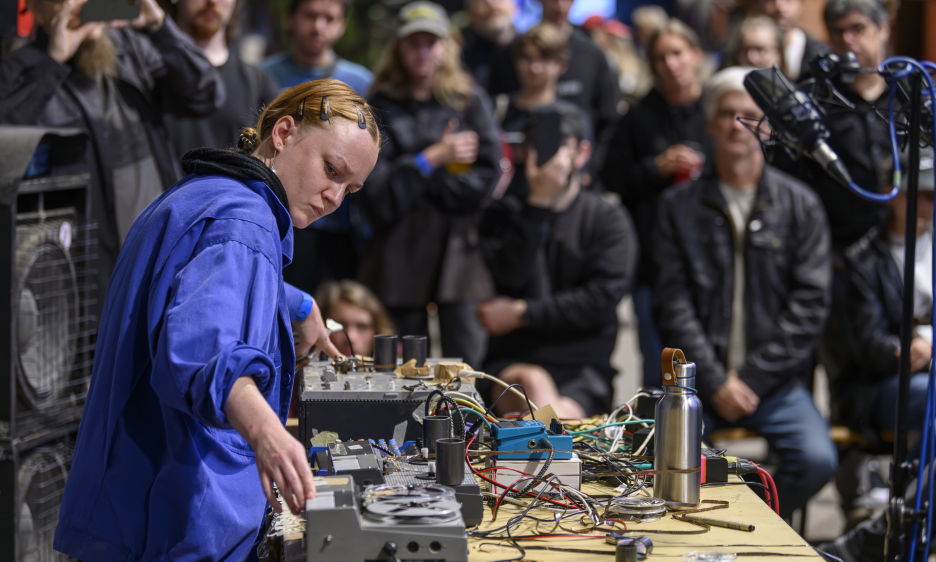
Courtesy Martin Popelar
Ostrava, Czech Republic
August 21-30 2025
Close to the beginning of this moderne music festival in the old coal-mining capital of Czechia, its Minimarathon Of Electronic Music is an inevitable highlight of each edition. Lordy knows what a full-on marathon would be like, but this mini-version is substantial enough, spanning 2pm until 1am. Often itinerant, this time it rears its tape-heads up in a new venue (new since the preceding 2023 Ostrava Days edition), another converted coal-mining building, now known as Futureum, blessed with multi-levelled brick chambers, dusty and undeveloped, for hardcore subterranean authenticity. The audience had to squat on stone steps, with limited sightlines, although some punters ended up with lucky plastic chairs. This was a good sacrifice for hearing now-time electronic or electroacoustic sounds, in what might be described as one of their natural environments. As multiple spaces were used to facilitate the ongoing performance schedule, there was a modern ground floor room, next to the venue's café, which offered a more conventional location, complete with surrounding windows. The long day featured 13 performances, with a later into-the-night after-programme fringe.
Richard Grimm and Patrik Herman had one 3D printer between them, couched on a foam bed, resting on a table, avoiding micro-vibrations in the room, just like a turntable. Luckily they also had a laptop each (plus bonus keyboard), to channel the real-time live murmurings, tickings and dronings of the printer, which had been rigged in Prague to perform just like a musical instrument. Here was an example of radical tinkering that made sounds to justify its driving concept, and to ultimately allow the audience not to be too distracted by the means of production, even if visions of 3D lethal armaments and yummy edibles were floating amidst their rear minds.
A few months following the festival, the Polish electroacoustic specialist Gerald Lebik departed this plane, suddenly and somewhat young. His parting set here involved resonant thrums, developing a gently tight quake in the ears, low ribbons of bent matter. Development was deliberately slowed, but there was some manifestation of a subtle climax in the ambient enclosure, layers of chirrup creeping up to whooshing, then a bullrush rustle, capped by fuzz-scuzz pattering. The audience was fully immersed.
Down the stone steps, the NYC string players of The Mivos Quartet performed "Nemiesta," by the Slovakian composer Miroslav Tóth, a multi-sectioned work that climaxed so frequently that is sounded like it was persistently ending, only to move onwards towards either somnolent rests or heightened percussive strafe-bursts. In this location the strings took on a brutalist character that made a massive sonic change when compared to the usually acoustically-refined location for such music.
Bilwa describes himself as a conceptual artist who plays with sound. He had a laptop, and the sides of his skull were shaven. On this occasion Bilwa played his "13" piece. Layered droning was interspersed with clicks and multi-level tones, at high volume, resonating beautifully around yet another subterranean concrete haunt.
The jazziest section of the programme featured Luan Gonçalves (upright bass) and Mikuláš Mrva (live electronics), known together as Mušhuššu. Gonçalves is a Brazilian living in Prague, who appears to be improvising, sending his matter to Mrva, who snatches instantaneously to mutate via his electro-stacks. They began with an extremely faint presence, with softly-grained bowing and vestigial electronic interventions. An ambient hum pervaded, growing as the bass provided greater movement, but the pair cannily decided to never really deliver the oft-expected climactic wrenching, restraining themselves remarkably into a very inward-looking sparseness.
The greatest set of the day, and also one of the festival's total stand-outs, was given by the Lithuanian tapestress Augustė Vickunaitė, across the way in The National Museum Of Agriculture, a looming warehouse of lost human soil-and-soul-threshing. She uses old-school reel-to-reel tape machines to sew together her churning, ever-evolving 'scapes. Vocal snatches escaped their tape universes, amidst disruptive noise outbursts, rising out of an otherwise relaxed sonic mire, with metronomic tweaks. Sudden surges dominated, pseudo-glitch-beats running door-knocking repeats, with slo-mo reel manipulations, Vickunatė being extremely fingers-on. She was actually scratching with the reels, producing an owl-howlin' shock of a scuzz-blast. Helloween tape-imprisoned children repeated rhymes, while a core rhythm developed and enveloped, obsessive and oppressive, as Vickunaitė walked out across the concrete space, pulling her tapes out from their reels, in the old school tape-loop manner, yanking out the longest stretch of magnetic ribbon ever witnessed onstage (or off), before reeling herself back in towards the machines, arm-pull by arm-pull.
This strengthened evening run continued with the Japanese guitarist Kazuhisa Uchihashi, although he was very removed from his self-built axe, reducing his instrument to what looked like a lone pick-up, bowed for effects, sounding like a sliding erhu fiddle, with looped percussion arriving from somewhere. Uchihashi favoured extreme distress and abrasiveness, mimicking sensitive vocal tones, using foot-pedals and tipping in some sly humour.
Conversely, Jean-Philippe Gross emanated a deep seriousness. He's one of those no-input mixer dudes, like Toshimaru Nakamura, delirious with feedback potentials. He made brutalist, isolated attacks of maximal punch, heavy blows to the surrounding space. Deliberately courting a lack of imagination, he doggedly pummelled the gathering's lugholes to powerful one-dimensional effect, ending with a firework-display crack-out.
Powerstanz completed the night, a younger generation duo of aggressive electronic beat-confronters, amalgamating many of the styles already heard during the evening, but moving their gear centrally, dimming the lights and facing each other for a headbanging summation of engorged sonic attack. Their names are Ipek Odabasi and Utku Tavil.
Flipping back two days to the opening Starting Line event, matters were moodier and more restrained, although still set within the Futrureum rooms. There were smaller set-ups, with solo performers, and a generally atmospheric aura. There was a mini-focus on the work of Peter Ablinger, another composer who had recently fled this corporeal realm, just a few months before this festival, with which he had been persistently connected. His 2020 piece "Against Nature" was performed by Erik Drescher on multiple flutes (based around recorded toad-burps, enhanced by empty bottles and old extracted organ pipes), but the room was so overpopulated that your scribe elected to experience the proceedings in the connecting corridor just next to the high gallery. This actually lent a very specific concentrated nature to the performance, not ideal, but with its own focus on sound rather than vision. Transitory space from a radiator perch, comings and goings of the audience, either mesmerised or tedioused-out. Overtones decayed for even longer along this concrete small bowel.
Just before, there was keyboardist Jenn Mong playing British composer James Layton's new "Having Never Known A Piano," with shades of harpsichord, sympathetically ghosting, extensions pointing out gurgle-dark bass tones. Next was a trombone and bass duo, offering Zijie Huang's "Superfluous," with a pointed forcefulness, apparently needing a conductor, just the pair of them, each also armed with bass drums, mute and skating bow helping lend hard hits a savage power. Straight after: a string quartet for Ján Podracký's "Requiem For A Civilian," marred by the novelty device of the players and goaded audience stamping their feet, military left-right, throughout the piece. Two bows on the cello helped alleviate this pain.
Over at the Museum Of Agriculture, the Ensemble Of Futurist Noise Intoners built on what is becoming a small tendency, of recreating the innovative intonarumori instrumentation of Luigi Russolo. Transporting these delicate beasts can be problematic. Eight works were performed, including Ablinger's "Weiss/Weisslich 17s," but the superior stretch arrived via Phill Niblock's closing "Game Set Match" global premiere, which was well worth waiting for, with its expected palette of drones and tones, augmented by a laptop wateriness, making gentle repetitions with sustain. This was a long night festival ignition that heralded the oncoming musical mass over the next ten days.
Triple Hall Karolina is the festival's main performing space, a cavernous converted coal-processing plant, and a wonderful setting for the Ostrava Days in-house orchestra and its ensemble satellite Ostravská Banda. This latter variable line-up group presented an evening of smaller-instrumentation pieces, chamber works in the largest chamber possible.
The visiting Canadian saxophone quartet Quasar (from Montréal) joined the Ostravská Banda. They played their countryman Gordon Williamson's "Breathing Room" (2019), with Jean-Marc Bouchard's baritone out front, his three compadres spread strategically, to set up a sparse-noted call-and-response. Mouthpieces were removed for duck- calling purposes. Ultimately, the saxophonists lined up frontally, the composition being one of those demonstration-type works, dry and brittle overall.
"Oru," by Timothy Page (from Chicago), arrived next, for sinfonietta and electronics, including piano, viola, violins, cello, bass, harp, trombone, bassoon, French horn and percussion. Balls of wool and small rocks formed part of this ritual piece, with the instruments democratically equal, none highlighted. Detail was paramount, the work finishing with conductor Bruno Ferrandis being tied-up in wool, as rocks rolled, and paper ocarinas puffed up. Despite all of these extra touches, the music itself contained no massive substance.
The Czech composer Jakub Rataj's "Countermass" had a bass clarinet lead, with Martin Adámek, invested with a determined pace, a marked percussion punctuation governing the rest of the players, who existed in more abstract quarters. A flow of tiny details was produced, with scything accordion, making swift passes, through the miasma, trombone rising up as a distinctive element, its solo never letting up amidst the individualist percussion parts.
On the following evening, the Quasars presented their own concert at The University Of Ostrava, presenting six mostly recent works. Claude Vivier's "Pulau Dewata" (1977) revolved around a rhythmic unity, with sharp, insistent strikes, from out of ranks of punchy precision and steely togetherness, with close-firing repeats. Szymon Golec's "Dreambody" worked through multiple short phases, cramming in ideas, maintaining tones, making plopped fingerings, producing overtones and rhythmic playfulness, all within seven minutes. Matthew Huang Mailman delivered his "Do Not Derail The Train Of Thought," which aimed headlong towards a palpitating, full-charge conclusion. Luboš Mrkvička's piece was simply named "Saxophone Quartet," with periodic swellings, rousings of the horned beast, out of a balanced environment of slow-blowing waves. To conclude, there was Snežana Nešić's "Quatre Graffitis pour le début du temps," sounding like unto the World Saxophone Quartet, lolloping lowly, with the baritone flapping and cutting, waddling up to some keening high tones.
Following an intermission, the same campus concert room hosted vocaliser Christopher Butterfield and pianist Daan Vanderwalle for a programme that set Erik Satie and Kurt Schwitters side-by-side. The French composer's song-piano "Socrate" is one of his lesser-heard pieces from 1919, while the sound-poem "Ursonate" (1923-1932) is the key work from the Dadaist quill of the German artist. The veteran Canadian composer Butterfield immersed himself in the totality of this word-phonetics universe, aptly balancing each minute "Ursonate" syllable into a flow of askew lines, pauses, outbursts and subtle rushes of spurted exclamations. His was a hypnosis veil, a lulling of the witnesser's cerebral grasp, a flotation towards the half-asleep boundary of cognition. Far areas were navigated.
Another day later, and we found ourselves in the familiar reality of the Triple Hall, and another spread of global premiere compositions to be interpreted by the often- augmented Ostravská Banda. Robert Karpay's "Deep Summer Nocturne" loved its dense strings, in a bowed rush, making quiet pauses, followed by a lyrical continuance. Martin Klusák gave us "Maják," with its fairly obvious stormcloud start, metal sheets flapping, with harp, percussion, French horn, trumpet, bassoon and tuba. It cleared its decks for a whistling backdrop, slow surges added to low drones, with a heightening susurrus, graduating to breaking storm-waves. "Assemblage: Trace/Mobile" (Alex Mincek, of NYC's Wet Ink Ensemble) featured ten players, with piano, flute, trumpet, cello, three violins, twinned percussion, alto saxophone and bass clarinet. Strings were dampened, piano was stark, making halting blows, allowed to decay, as its clusters grew closer together. Activities accelerated, like a line of ukulele plectrum-scratchers. Christian Wolff's global premiere of "The Blue Stairs" (2022) attracted attention, with percussionist Chris Nappi featured prominently and conducted by Petr Kotík. It wasn't as remarkable as anticipated, with its quickened, light- grained string parts making a semi-circle circuit, spread with percussion details. The closing premiere by Luboš Mrkvička provided a more suitable lift, "For Large Ensemble, Part G" emanating exotic flamboyance, immediately full-up and full-on, making a repeating cyclic progress, highlighting different sections in turn, low horns, then flutes and oboes, with strings pulsing in the middle.
The Long Night isn't as long as it used to be, a couple of festivals back, although it still runs from 5pm until 1am, but no longer through the night until the next noon. It opened in the somewhat unsuitable confines of the formal University campus hall, but then crossed the square to the shabby old Hotel Palace, which was way more suited to extended hanging out. Happening on the festival's penultimate evening, The Long Night allows folks to recover in time for the early activities of the closing concert.
The first work was the most dramatic, with Petr Cigler's "Awake!" boasting three tubas, three French horns, vibraphone and other percussion. Its slowly pulsing dronescape (there were quite a few of such stretching vistas during this '25 edition), ultimately given a heart-attack resolution by a gunshot firing off at its conclusion, along with a single-strike metal clash-out. This was followed by compositions from Petr Kotík, György Kurtág and Christopher Butterfield, the latter's new "Madame Wu Said... " being a 45-minute odyssey featuring violinist Conrad Harris, along with piano and cello. Its multi-phased bursts of thematic moments provided arrhythmic nuggets, as the string players set off in dialogue, with a see-saw motion of sturdy driving. The piano was silent for an extended stretch. Softly, it initiated an exchange with Harris, taking a measured stroll. Then, the piano raced on headlong, on its own, before the strings took the reins once again.
Following the move to the old Hotel Palace kitchen space, a series of solo, duo and tiny group sets began, mostly fleeting in nature. There were immersive pieces for accordion, clarinet, saxophone (Daniel Troszok mesmerisingly interpreting Paolo Griffin's "The Purpose Of An Empty Room"), then a return to accordion, followed by viola. The informality of the situation lent a different aura to the proceedings, like another variant on the presentation of the Electronic Minimarathon, although brighter and less mineshaft- steeped.
Ostrava Days closed out back in the Triple Hall, with the full Grand Finale of the Ostrava New Orchestra. Most of the programme consisted of global premieres. Longest title of the festival: "A Sound, A Narrow, A Channel, An Inlet, The Straits, The Barrens, The Stretch Of A Neck," by Canadian composer Annesley Black. Amidst her spatially arranged players, we could hear a field full of rustling crops, sustained, with very low drum punctuations, taking a slow beat as the higher strings entered. A sparse event— process ensued, a responding bark, then a rousing, swirling, growing, with jets of action, the orchestra's rear and side sections awakening, forming a strings, reeds and middle-brass enclave, hardening into a portentous presence.
Next, Ian Davis (from NYC) gave his "Concerto For Piano And Orchestra," sounding lyrical and less porcupined, as its title might suggest. Following the Black work, this represented a smoother excursion, with purified horns, flowing strings and chiming percussion. The piano was joined by cimbalom, in an unusual touch, working together with bass clarinet, the composition progressively becoming more captivating.
The Swedish composer Lisa Streich's "Meduse" found a bold strength swooping up out of subtle foundations, topped by a muted trumpet solo, but cossetted by sensuous shimmers of string softness. A slow pendulum swung towards a wackily cut-up circus-evoking section, then into unlikely Arvo Pärt terrain, and onwards for a John Zorn-ed collage slice-up, with exotic bells and trinkles, shades of a military march, then a dirge-like Gavin Bryars phase, the piece emanating a magpie nature in its co-opting of stylistic extremes, detuned, like a slow rocking chair, snoozing into another drone, as it swelled and rumbled.
 FOLLOW Martin Longley
and get notified whenever a new article published.
FOLLOW Martin Longley
and get notified whenever a new article published.
Martin Longley also writes for Jazzwise, Songlines, Downbeat, We Jazz, Qwest TV, The New York City Jazz Record & The Brooklyn Rail
Tags
PREVIOUS / NEXT

Become a Sustaining Member

Since 1995, All About Jazz has championed jazz as an art form and supported the musicians who create it. Over three decades, it has grown into one of the world's leading jazz resources, serving hundreds of thousands of readers, musicians, presenters and industry professionals each month.
Help Build the Future of All About Jazz
Your support helps us continue building All About Jazz for the next generation—expanding our editorial coverage, preserving jazz history, developing new community features and creating better ways to discover the music and the people behind it.
Become a sustaining member for as little as $20 per year and you'll immediately enjoy an ad-free experience along with access to subscriber features and future articles for a full year.
Together, we're not simply sustaining All About Jazz—we're building its future. Thank you for being part of the journey.