Home » Jazz News » Music Industry
For Musicians Broadway is the Pits

WHO could forget the great overture to A Chorus Line? First there's that infectious hop-step vamp from the song “One." Then come some of the show's most familiar melodies: “I Hope I Get It," “Nothing," “What I Did for Love." Finally the orchestra swings back for a rousing half-chorus of “One" that would make even gouty musical- theater-phobes want to leap to their feet with excitement.
Oh, wait -- “A Chorus Line" doesn't have an overture. At least not one you'll hear at the Gerald Schoenfeld Theater when the $8 million revival opened one Thursday night.
Back in 1975, a month before the original production's debut, Marvin Hamlisch did write a Chorus Line overture like the one described. But the director, Michael Bennett, and the show's other creators decided not to include it, fearing it would destroy the illusion that the audience was watching an actual audition as the lights went up. Instead a lone rehearsal piano banged out the dance routines, while the rest of the orchestra, which began playing later, was masked in the pit by a big black scrim.
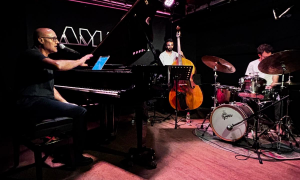
Thanks in part to A Chorus Line, the Broadway orchestra and the Broadway overture would rarely emerge from that obscurity again. The Chorus Line revival's 17-piece ensemble is not even in the pit this time; it's in a room backstage, hooked up to the sound system. And traditional overtures -- several minutes long, made up of melodies heard later in the show and played by an orchestra before the curtain goes up -- are similarly disappearing.
An unscientific survey of 30 recent, current or forthcoming Broadway musicals reveals that only 7 (including The Producers, Wicked, Spamalot and The Color Purple) have an old-fashioned overture. Another seven have a musical prologue too brief to qualify or, like Chicago and The Drowsy Chaperone, place the overture after some initial dialogue, a handy way to keep audiences from talking through it. The remaining 16 -- from the long-running Rent to the recent Martin Short: Fame Becomes Me to this fall's Spring Awakening -- have no overture at all, instead starting cold with a song or scene or high- concept opening number that establishes the evening's conceits rather than its melodic contours.
What happened?
For Fame Becomes Me, which has 22 songs that could easily have been fashioned into a catchy opening medley, the decision was made by the clock. Scott Wittman, the show's director, co-lyricist and co- conceiver said, “We wanted to get to the bar at Angus by 10."
Audience stamina (and union work rules) can certainly make a four- minute overture seem a waste of precious time, but years ago it was almost required. From the modern musical's infancy in the 1920's through the so-called Golden Years in the 1940's and 1950's, audiences expected to sample a pu pu platter of great tunes, winningly arranged, as the lights dimmed from three-quarters to half and pink spotlights warmed the curtain. Andr Bishop, artistic director of Lincoln Center Theater, remembers listening intently to overtures when he attended musicals with his parents in that era -- he's now 56 -- and “priding ourselves on spotting what would be the hit song from the show." It didn't always take much detective work because, in those days, Broadway songs were often pop hits before the shows began.
That era is long gone, but there was always more to the overture than the pleasure of the music itself. Practically, it provided a buffer for latecomers; dramatically, it helped to effect a mood transition from the outer world of commerce and cabs to the imaginary world about to be created onstage. It might hint at crisp sophistication (those four bright exclamation points at the start of My Fair Lady) or exotic doings (the pentatonic Orientalia of The King and I) or the possibility of louche women (the wild trumpet orgy of Gypsy). It could establish instantaneously the tone of the material, whether emotional (South Pacific), comical (Bye Bye Birdie) or satirical (Candide). In the case of the overture to Candide, that brilliant jack-in-the-box of musical surprises, it might do so better than the show itself.
But as musical theater grew away from operetta and aspired to be more like modern drama, and as its emphasis switched to storytelling instead of mere razzmatazz, the overture (which composers loved to write) began to seem out of place. For a few decades more sophisticated musicals occasionally finessed the matter with overtures that accompanied choreographed action, like Richard Rodgers's “Carousel Waltz" and Frank Loesser's “Runyonland" ballet at the start of Guys and Dolls. By the mid-1970's, though, a theatrically daring show like A Chorus Line could dispense with the overture altogether. Defying its name in 1975 Pacific Overtures had only a wee prelude.
The emergence in the 1980's of pop operas, like Cats and Miss Saigon, in which the songs were secondary to the brand, made stand-alone overtures seem even further off-message. (The brief musical sequence at the start of Les Misrables, which reopens on Broadway next month, serves mostly to accompany the famous advertising emblem of the waif Cosette, projected on a scrim.) More recently even traditionally conceived, melody-stuffed shows like Hairspray get straight to the action; its first song is preceded only by a 16-bar riff. The Wedding Singer is even more impatient: the curtain rises with the cast already dancing.
It's partly a matter of the shows' pop roots. “Rock 'n' roll melodies played by a Broadway pit band without the vocals will often sound cheesy," said Marc Shaiman, the composer and co-lyricist of both Hairspray and Fame Becomes Me. Mr. Shaiman is one of the most tuneful of today's Broadway songwriters, but tunefulness, it seems, no longer justifies what's often seen as an indulgence.