Home » Jazz Articles » Album Review » Jon Hassell: Music Is Invisible (Pentimento Volume Three)
Jon Hassell: Music Is Invisible (Pentimento Volume Three)
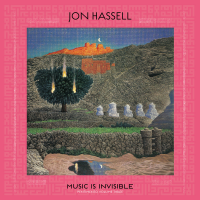
This was a method born out of thoughtful revisionism as much as necessity. From 2015 on, Hassell experienced problems in live performances, having to resort to electronics and samplers rather than his original instrument. Eventually, he was forced to retire from touring altogether. A strategy by which he could scour through his personal archive of audio tapes, DATs, videotapes, and sound files amounting to gigabytes of recorded rehearsals for reassembling and overdubbing, would bypass this obstacle, while kick-starting a late renaissance. The universe had other plans. Hassell passed away in 2021, leaving the two volumes of Pentimento as a parting gift. Originally planned as a single release, the project was split into consecutive releases. Instead of being shelved, Listening to Pictures' outtakes were reworked for its follow-up, Seeing Through Sound (Ndeya, 2020). After five years of waiting, the first proper posthumous release—excluding the second and third discs of Jon Hassell: City: Works of Fiction (Expanded Edition) (All Saints Records, 2014), repackaged as Further Fictions (Ndeya, 2023)—was announced.
Pentimento's third volume should not sound entirely unfamiliar, though. It comprises an elegantly edited concert from London, played at St John At Hackney Church on May 23rd, 2015—the band's final live date. In his final years, Hassell collaborated with a consistent lineup of alchemists, adept at reconstructing the Fourth World in 21st-century California, where the musician operated. The band included Rick Cox on guitar, synths, electronics, and the "recording studio" (aside from this nod to Brian Eno, Cox was essential to the group, sharing with Hassell co-writing and production credits), and John von Seggern on drums, bass, and electronics. Their interplay congealed into this release. Music Is Invisible (Ndeya, 2026) and ..."it always seems to be about telling you a secret." The quote from Federico Fellini's And the Ship Sails On in the liner notes hints at the enchanting allure of the album, from its first sonic textures it becomes clear the secret is a clandestine jungle—an aural environment to adapt to. Layers show through layers of the thicket.
At times, it is hard to believe we are listening to a trio—captured by Arnaud Mercier—for all the sound beckoning in the immersive nocturnal landscape of "Blue Ba-Ya." That opening 11-minute piece meanders hazily in between discharges of live and sampled horn, piano chords, and occasionally boggling bass. Three minutes into the track, the relaxed six-note melody on trumpet becomes muddled by dub-step shuffles, glitches, and reversed instrumental passages—again, all this by a legion of three. The rampantly plucked guitar revs it up to a busy opener, heavy on shifts in acoustic pressure establishing the record's grammar: phrases for proximity, grandeur, congestion, and repose. Jeff Rona, responsible for the studio mix and co-production, began his work on the record back when Hassell could still approve of his interventions. Having creatively improved on the original 8-channel multi-tracks, Rona hides away the creases typically pushed to the front in live albums. This too proves to be a close reading of the composer's intent. Despite the fact that most live performances leave no room for the pedantic stratigraphy achieved by means of pentimento-ism, for Hassell "everything either came together perfectly in the moment, or it got thrown away"—sums up von Seggern.
And yet, naive genre blending was never a side effect for Hassell. Vernal Equinox (Ndeya, 2020) was borne by the eclectic alloy of world folklores. Music Is Invisible is a Fourth World's representative species. In his lecture from 2013, Hassell concocts the image of several canvases—jazz, techno, classical. Upon each, only a partial picture can be captured. Ingredients are meant to dissolve. Bottom layers ought to come through. The second track serves as a good example of his fluid, layered painting style. "Club Gris-Gris" revels in the playful confusion. With a trumpet call piercing through a rectangular pulse and shimmer, the slight delay allows the soundscape to catch up and steadily fade in crackles. A timid piano accompanies this buzz to the exit. In "Broadway Boogie-Woogie," the instrument makes a return, spurting out a jittery piano rag. The hiccuping tune pieces its melody from isolated notes, apparently oblivious to the expanding synth background that forces itself upon the speakers—the actual narrator for the story. Percussive samples hold the hectic, rickety pace, eventually dying down altogether, rather than segueing to the "Electric Forest."
With his debut, as well as with Earthquake Island (Shanachie, 1978), Hassell opened up a gateway to an imaginary Global South mediated through the West's hi-tech gadgetry. Nowhere is this augmented fusion as vividly explored as on the final track. Here, the listener is thrown once more into a primordial habitat composed of percussive samples of muted conga drums, "scanned" by the measured breathing of the processed trumpet—a lone cartographer walking through a bush of ghosts. It is an ever-shifting environment, which—halfway through its 16-minute running time—swallows the explorer up. Overcome at that point with rhythms, asynchronous beats, chirps, and buzzes, the initially untroubled horn player finds himself ambushed, growing desperate, fending off the encroaching "forest" of alien sounds. One last gust—a far cry from a trumpet roll call—cuts through the night's canopy before the composition ends. Some listeners might recall the applause that drowned out this scenery. The rest will be left in the wilderness.
Precisely because the Pentimento series turned out to be a rejuvenation cut short, approaching the 2015 performance as the ultimate installment of the trilogy is akin to abridging the final year's creativity burst even more. Each former collaborator speaks of vast archives containing decades' worth of unheard material: ready to be spliced, overlaid, and collaged into cerebral-albeit-visceral soundscapes for "vertical listening." Anticipating further releases from the amassed cache, let Music Is Invisible (Pentimento Volume Three) be like an otherworldly debut from the future's ancient land.
 FOLLOW Maciej Stasiowski
and get notified whenever a new article published.
A jazzophile, although open to all sort of cross-pollinations with rock, ambient, new classical.
Track Listing
Blue Ba-Ya; Club Gris-Gris; Broadway Boogie-Woogie; Electric Forest.
Personnel


Album information
Title: Music Is Invisible (Pentimento Volume Three) | Year Released: 2026 | Record Label: Ndeya
About Jon Hassell
Tags
PREVIOUS / NEXT


Become a Sustaining Member

Since 1995, All About Jazz has championed jazz as an art form and supported the musicians who create it. Over three decades, it has grown into one of the world's leading jazz resources, serving hundreds of thousands of readers, musicians, presenters and industry professionals each month.
Help Build the Future of All About Jazz
Your support helps us continue building All About Jazz for the next generation—expanding our editorial coverage, preserving jazz history, developing new community features and creating better ways to discover the music and the people behind it.
Become a sustaining member for as little as $20 per year and you'll immediately enjoy an ad-free experience along with access to subscriber features and future articles for a full year.
Together, we're not simply sustaining All About Jazz—we're building its future. Thank you for being part of the journey.