Home » Jazz Articles » Album Review » Christy Doran, Imran Khan: Disambiguation
Christy Doran, Imran Khan: Disambiguation
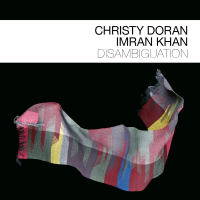
On Disambiguation, that language enters the gently shifting gravity of Imran Khan's tabla. Doran does not attempt to inhabit Indian music or treat it as an exotic annex to his own vocabulary. He allows its rhythmic imagination to disturb his habits, loosening the scaffolding beneath his phrasing until melody emerges restored. Traces of Irish music also surface, drawn from sounds heard in his childhood home and encountered anew decades later. Memory moves here as an active intelligence, revising the present from somewhere beneath it. The traditions carried by both musicians become currents within a single speculative body, rooted deeply enough to risk becoming unmoored.
The title piece establishes that body through Doran's jangling guitar, whose open resonance invites the tabla into immediate, fiery conversation. A country inflection flashes across the strings before the melody reaches further backward, toward a folk antiquity belonging to no settled archive. One senses an undiscovered songbook dreaming itself into existence, its blank pages already crowded with harmonic implications. Doran seems to excavate the composition while performing it, releasing chords that have spent centuries waiting inside the wood. Khan answers by giving each discovery a pulse and a horizon. Their dialogue unfolds through mutual provocation, with every gesture altering the significance of what came before. The music feels fresh because its age cannot be measured. Its beauty bears the marks of having traveled through hands, circuits, inherited melodies, and unnamed rooms of attention.
That sense of ancestral motion deepens in "Ode to Johnny Doran," where tenderness widens the spaces between events. The piece enters a territory mapped through emotional pressure, each phrase opening an interior distance that cannot be translated into geography. Doran's lines linger without settling, holding memories whose original circumstances have vanished while their charge remains fiercely present. When Khan enters, the tabla does more than establish regularity. It gives time permission to continue. Rhythm becomes an act of release, carrying private remembrance beyond the enclosure of the self.
"The Day They Came" turns that inwardness toward play. Its rhythmic charm carries a bright, mischievous grace, inviting the listener into motion without dictating the steps. Doran and Khan display an astonishing ease here, yet the ease contains constant negotiation. A guitar figure tilts the floor; the tabla restores equilibrium by inventing a new center. Their delight comes from refusing to secure the ground for long. Beneath the whimsy lies an intricate intelligence, agile enough to conceal its labor and generous enough to make difficulty sound welcoming.
With "Continuum V," the electric guitar opens a more futuristic chamber within the album. Its mid-tempo movement grants each detail an unusual clarity, allowing small decisions to acquire architectural force. Doran's tone glows from somewhere between circuitry and nerve, while Khan articulates a rhythmic field whose boundaries keep quietly migrating. Each musician appears attuned to an interior mechanism within the other, anticipating impulses before they become audible. Their rapport turns difference into propulsion. The continuum promised by the title emerges as a living exchange between distinct forms of knowledge, one carried through voltage and the other awakened through skins.
Khan steps fully into the foreground on "Taal Pravaah," the album's sole composition not written by Doran. His solo tabla piece is less an interlude than a revelation of the rhythmic consciousness animating the entire project. Patterns divide and reassemble with lucid authority. Accents produce hidden corridors; resonance enlarges them. Khan's mastery resides partly in the way he transforms precision into spiritual amplitude, drawing the listener toward a self that has not yet acquired a name. The performance seems to understand that rhythm precedes biography. Before we know who we are, something within us is already counting.
"Mantra on an Irish Stream" carries that intuition into stranger terrain. Doran begins alone, turning time and place into unstable materials that bend beneath contemplation. Reversed apparitions and digital enhancements drift through the guitar, loosening causality until an ending can appear to remember its own beginning. Khan's percussion eventually seems to generate Doran retroactively, as though the guitarist were emerging backward from a story the tabla has already told. The familiar geometry of a heroic journey collapses. Instead of advancing toward revelation, the piece approaches the instant before descent, that suspended threshold where consciousness has not yet decided whether the unimaginable constitutes danger or birth.
The pressure released there ignites "Haute Savoie," the set's most energetic performance. Frenzy gathers without sacrificing coherence, assuming the agency of a creature that knows its strength and has no appetite for conquest. Doran's guitar surges through the piece with muscular radiance as Khan shapes velocity into articulate motion. Their command is thrilling because it never closes around the music. Control remains porous, receptive to accident and sudden redirection. The duo sustains an extraordinary tension between abandon and exactitude, revealing virtuosity as the capacity to remain lucid inside combustion.
"Dark Slender Boy" draws the arc toward an almost hymnal intensity, with the suggestion of raga voiced through distortion and intimate devotion. The guitar carries worship to the edge of language, where proclamation dissolves into vibration. Khan's presence gives that vibration an earthly axis, though the piece keeps leaning toward a border beyond which names lose their authority. Its final poise contains neither surrender nor triumph. Doran and Khan hold the music at the brink with closed eyes, trusting the radiance pressing against them from an unseen direction.
The title Disambiguation finally reveals a beautiful mischief. Identity does not become clearer through the removal of uncertainty. It deepens as its borders grow permeable and its histories begin speaking through one another. Doran's many lives gather here without forming a retrospective, while Khan continually redirects their momentum toward futures unavailable to either musician alone. An old vocabulary discovers fresh organs of perception. Tradition escapes the museum of itself and resumes its unfinished labor upon the human nervous system.
Doran's ear for detail remains astonishing throughout, yet detail never becomes decoration. Each inflection opens another dimension within the composition, and Khan meets those openings with rhythmic intelligence of rare suppleness. Together, they make music whose intricacy produces freedom, whose rigor produces wonder. Their musicianship shines because it reaches beyond virtuosity toward a more difficult achievement: the creation of a shared consciousness that belongs wholly to neither player.
 FOLLOW Tyran Grillo
and get notified whenever a new article published.
Music writer, singer, translator, scholar.
Track Listing
Disambiguation; Ode to Johnny Doran; The Day They Came; Continuum V; Taal Pravaah; Mantra On An Irish Stream; Haute Savoie; Dark Slender Boy.
Personnel


Album information
Title: Disambiguation | Year Released: 2026 | Record Label: Between the Lines
About Christy Doran, Imran Khan
Tags
PREVIOUS / NEXT
Become a Sustaining Member

Since 1995, All About Jazz has championed jazz as an art form and supported the musicians who create it. Over three decades, it has grown into one of the world's leading jazz resources, serving hundreds of thousands of readers, musicians, presenters and industry professionals each month.
Help Build the Future of All About Jazz
Your support helps us continue building All About Jazz for the next generation—expanding our editorial coverage, preserving jazz history, developing new community features and creating better ways to discover the music and the people behind it.
Become a sustaining member for as little as $20 per year and you'll immediately enjoy an ad-free experience along with access to subscriber features and future articles for a full year.
Together, we're not simply sustaining All About Jazz—we're building its future. Thank you for being part of the journey.