Home » Jazz Articles » Live Review » Magnus Ostrom at Solstice Arts Centre, Navan, Ireland
Magnus Ostrom at Solstice Arts Centre, Navan, Ireland
Solstice Arts Centre
Navan, Ireland
September 20, 2013
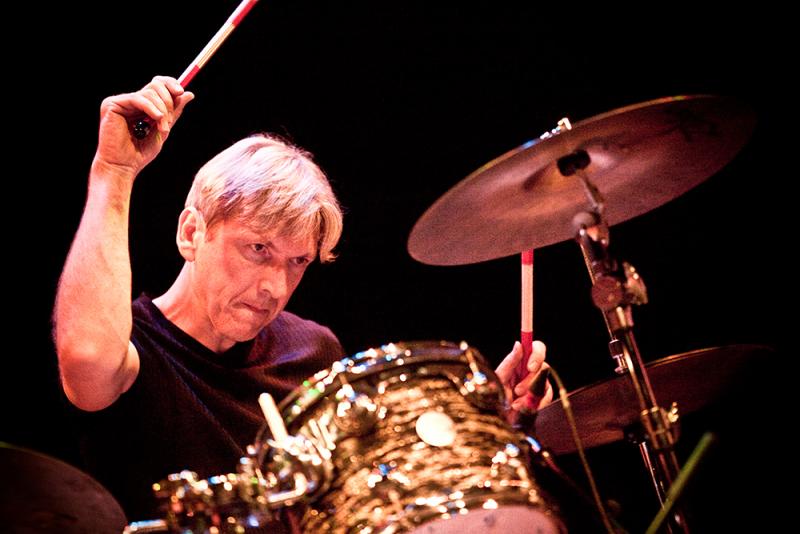
That Magnus Öström's quartet made it to Navan at all was good going given that the band's previous gig had been on a Scottish island boasting no fewer than eight whisky distilleries. The Scottish—as the quartet discovered—take their whisky and their hospitality seriously. That gig was part of the three-day Lagavulin Islay Jazz Festival, one of a growing number of jazz festivals popping up throughout the British Isles. From Islay, Öström hopped over the Irish Sea for two lower key gigs in Navan and Carrick-on-Shannon. For these towns it surely represented something of a coup to entice the Swedish drumming legend away from potentially higher profile gigs in Dublin or Cork.
Öström was promoting Searching for Jupiter (ACT Records, 2013), his second recording as leader since the sad demise of e.s.t. following the accidental death of pianist Esbjorn Svensson in 2008. Öström, Svensson and bassist Dan Berglund had reinvented the piano trio in a fifteen year career that took the jazz world by storm and it was hardly surprising given the intensity and the duration of that trio's musical relationship that some of e.s.t's DNA occasionally colored the drummer's compositions.
In the main, however, the music displayed Öström's personal seal, with guitarist Andreas Hourdakis and Thobias Gabrielsen on electric bass/bass synthesizer and pianist/keyboard player Daniel Karlsson bringing an art rock aesthetic to the equation. In sparse, delicate compositions like the show opener "The Moon (And the Air it Moves)," the emphasis on melodic contour and shifting sound dynamics over virtuosity evoked Serbian alt rock band EYOT much more than e.s.t. On the bouncing rocker "Dancing at the Dutchtreat," built upon Gabrilesen's clawing riff, a jaunty piano motif and Öström's effervescence, Hourdakis stretched out, though his biting, sinewy solo was unwaveringly melodic.
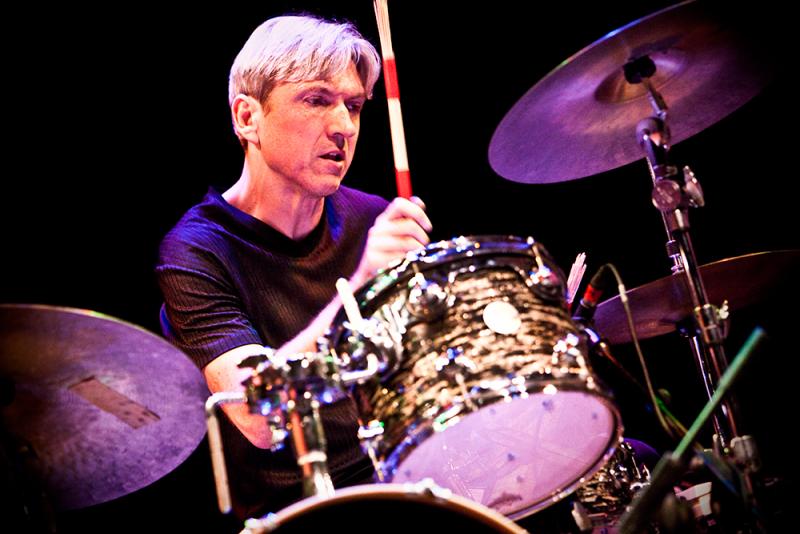
The ballad "Mary Jane Doesn't Live Here Anymore" showcased pianist Karlsson, whose gently cascading runs carried this lyrical piece from start to finish. The episodic "Searching for Jupiter" switched from melodic head followed by tight unison lines, to a jazzier piano-led freedom underpinned by driving bass and drums of some intensity—an irresistible slice of modern prog-rock. Minimalism and power combined on first set closer "Hour of the Wolf"; Öström's repeating patterns and insistent piano and bass ostinatos created an unrelenting tension from the get go, with Hourdakis's greater freedom providing striking contrast.
The second set began with "Through the Sun"; a poppish melodicism soon gave way to an improvised section with bass at the center. From the quieter mid-section, Hourdakis' fluid solo inspired a growing group momentum and eventual return to the sunny opening melody. Understated church organ introduced the aching lyricism of "Weight of Death" from Öström's critically acclaimed debut Thread of Life. The leader's dynamism on brushes signaled a highly charged quartet segment that bristled with collective energy and formed a bridge between the previous song and "Happy on the Fall," a jaunty number that Karlsson steered from honky tonk blues to a more contemporary space.
On "Song for E," Öström's heartfelt tribute to Svensson, Hourdakis reprised the role that guitarist Pat Metheny played on Thread of Life. Svensson's spirit was also present in the closing number, "At the End of Eternity," an anthemic charger that featured a thrilling solo from the leader. It also served as a reminder of how much a part of the e.s.t. sound Öström always was.
Earlier, Öström had explained the genesis of "Happy on the Fall": "It's a little bit about my son when he was two years old or something; he keeps running around and falling but he's very good at getting up again and running again. I've learned a lot from him, actually." The sense of loss at Svensson's death will always remain, but Öström, leading a strong band, has clearly picked himself up and channeled a deep source of creative energy that has plenty of legs to run yet.
Photo Credits
Enda Casey, Gasun Photography
 FOLLOW Ian Patterson
and get notified whenever a new article published.
FOLLOW Ian Patterson
and get notified whenever a new article published.
Ian is dedicated to the promotion of jazz and all creative music all over the world, and to catching just a little piece of it for himself.
About Magnus Ostrom

Tags
PREVIOUS / NEXT


Become a Sustaining Member

Since 1995, All About Jazz has championed jazz as an art form and supported the musicians who create it. Over three decades, it has grown into one of the world's leading jazz resources, serving hundreds of thousands of readers, musicians, presenters and industry professionals each month.
Help Build the Future of All About Jazz
Your support helps us continue building All About Jazz for the next generation—expanding our editorial coverage, preserving jazz history, developing new community features and creating better ways to discover the music and the people behind it.
Become a sustaining member for as little as $20 per year and you'll immediately enjoy an ad-free experience along with access to subscriber features and future articles for a full year.
Together, we're not simply sustaining All About Jazz—we're building its future. Thank you for being part of the journey.
Near

Stockholm Concerts