Home » Jazz Articles » Album Review » James Farm: James Farm
James Farm: James Farm
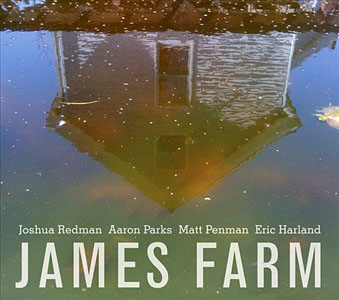
A year later, and James Farm's eponymous debut not only confirms the group's egalitarian nature, but positions this über-quartet of established and rising stars as a clear force with which to be reckoned. Redman, pianist Aaron Parks and bassist Matt Penman each contribute three songs to James Farm, while Eric Harland may only contribute one that, along with Parks' lyrical, folksy "Bijou," represents the album's shortest tracks, but a lot happens in the 4:31 of the drummer's fiery "I-10." A knotty, high velocity theme, over an irregularly metered pulse, leads to Redman's hottest solo of the set, while Parks follows with a brilliantly motivic feature that builds in intensity, only to soar even higher, as the pianist returns briefly to Harland's theme before joining the drummer for a quirky ostinato, driving it to a fever-pitched climax and ending, as Redman's tenor reaches for the stratosphere. It's the closest any acoustic quartet has come to approximating the alt-rock energy of groups like Radiohead.
The rock references continue on Redman's "If By Air," where Parks' introductory blend of Hammond Home Organ and pump organ is redolent of Soft Machine's Third (Sony, 1970)—keyboardist Mike Ratledge's "Out-Bloody-Rageous," specifically—but once the band enters it's back to an all-acoustic environs, with a prismatic solo from Penman who, like Harland, solos less frequently than Parks and Redman, but is no less distinctive for it, or equal in his relevancy to James Farm's sounds.
The quartet's inherent chemistry comes from multiple cross-pollinations of its members, most notably Parks, Harland and Penman as the core of the pianist's stellar Invisible Cinema (Blue Note, 2008), and Redman, Penman and Harland's work with SFJAZZ Collective, from 2005-2007, a context that encouraged the bassist and drummer to hone their compositional chops to the same level as their already well-established partner.
Whether it's on Penman's foreboding, arpeggio-driven but ultimately tumultuous "Coax," Parks' polyrhythmic, Middle Eastern-tinged "Chronos," or Redman's initially balladic but gradually accelerating "Star Crossed," the interaction is at a mitochondrial level, with an attention to melody and song, even when the context is more challenging. A group of four leaders—Redman the senior, but Harland's recent incendiary debut, Voyager—Live By Night (Space Time, 2010), no less accomplished—could be a recipe for disaster, as James Farm deflects everyone from their own work. But with a collective this vital, there are few who won't be prepared to allow its members to hang around a little longer together, before returning to their individual, equally ascendant careers.
 FOLLOW John Kelman
and get notified whenever a new article published.
FOLLOW John Kelman
and get notified whenever a new article published.
With the realization that there will always be more music coming at him than he can keep up with, John wonders why anyone would think that jazz is dead or dying.
Track Listing
Coax; Polliwog; Bijou; Chronos; Star Crossed; 1981; I-10; Unravel; If By Air; Low Fives.
Personnel

James Farm
band / ensemble / orchestraJoshua Redman: soprano saxophone (10), tenor saxophone (1-9); Aaron Parks: piano, tack piano (1), Prophet-5 synthesizer (1, 8), pump organ (2), humming (2), Fender Rhodes (4), Hammond Home Organ (4, 9), celeste (8); Matt Penman: bass, whistle (2); Eric Harland: drums, vocalization (7).
Album information
Title: James Farm | Year Released: 2011 | Record Label: Nonesuch Records
About James Farm
Tags
PREVIOUS / NEXT

Become a Sustaining Member

Since 1995, All About Jazz has championed jazz as an art form and supported the musicians who create it. Over three decades, it has grown into one of the world's leading jazz resources, serving hundreds of thousands of readers, musicians, presenters and industry professionals each month.
Help Build the Future of All About Jazz
Your support helps us continue building All About Jazz for the next generation—expanding our editorial coverage, preserving jazz history, developing new community features and creating better ways to discover the music and the people behind it.
Become a sustaining member for as little as $20 per year and you'll immediately enjoy an ad-free experience along with access to subscriber features and future articles for a full year.
Together, we're not simply sustaining All About Jazz—we're building its future. Thank you for being part of the journey.