Home » Jazz Articles » Album Review » Hugh Hopper: Hopper Tunity Box
Hugh Hopper: Hopper Tunity Box

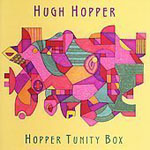
According to Hopper, during the mastering process of Hopper Tunity Box, an unnoticed skip during the late saxophonist Elton Dean's solo on the lyrically swinging "The Lonely Sea and the Sky made it onto several thousand vinyl copies before it was detected. A previous CD version was transferred from vinyl and included this annoying problem.
With Cuneiform's access to the original master tapes, Dean's solo is restored and Hopper's 1976 release has never sounded better, clearer, warmer or more three-dimensional. It's now possible to hear the disc the way Hopper intended it. Despite a review by a British jazz magazine that said, as Hopper puts it, "it had all the subtlety of a fourteen pounds of potatoes tumbling downstairs and all the melodic and harmonic interest of a trapped wasp, it's a more approachable album than his 1973 solo debut 1984 (Cuneiform, 1998).
That doesn't mean Hopper's compromised his skewed view of melody, his predilection for tape loops, slowing down and speeding up recordings or making joyful noise with his fuzz bass. But while there's plenty of sonic fiddling on Hopper Tunity Box, it's more of a group record, despite a changing lineup throughout. Still, with Gilgamesh drummer Mike Travis on board for most of the disc, there's a consistency in the rhythm section that carries through changes in instrumentation elsewhere.
The episodic "Gnat Prong is one of many highlights. It begins as a fiery and propulsive piece that revolves around a stunningly complex yet focused solo from (at that time) National Health keyboardist Dave Stewart, ultimately breaking down into an idiosyncratic theme layered over Hopper's visceral fuzz bass.
Stewart's performance on three tracks may be a calling card for the album, but Hopper's mate in Isotope, electric pianist Frank Roberts, delivers equally fine work on the buoyant "Crumble, while cornetist Mark Charig, the late saxophonist Gary Windo and Dean provide some added weight throughout.
The three horns come together only once, on Hopper's brooding version of Ornette Coleman's "Lonely Woman. The familiar theme emerges front and center, then gradually breaks down as Hopper's layered and processed bass takes it to ethereal places Coleman might never have imagined.
With remasters a booming cash grab these days, it's not often that one hears a reissue that makes such a significant difference. Hopper Tunity Box is one of those rare cases where so much is revealed that it regains its relevance as a once lost but now found treasure in Hopper's discography.
Track Listing
Hopper Tunity Box; Miniluv; Gnat Prong; The Lonely Sea and the Sky; Crumble; Lonely Woman; Mobile Mobile; Spanish Knee; Oyster Perpetual.
Personnel

Hugh Hopper
bass, electricHugh Hopper: bass, guitar, recorder, soprano saxophone, percussion; Elton Dean: alto sax, saxello (4,6,8); Mark Charig: cornet, tenor horn (4,6,8); Frank Roberts: electric piano (4,5,8); Dave Stewart: organ, pianet, oscillators (1,3,7); Mike Travis: drums (1-5,8); Richard Brunton: guitar (2,5); Gary Windo: bass clarinet, saxophones (1,2,5,6); Nigel Morris: drums (7).
Album information
Title: Hopper Tunity Box | Year Released: 2007 | Record Label: Cuneiform Records
About Hugh Hopper
Tags
PREVIOUS / NEXT

Become a Sustaining Member

Since 1995, All About Jazz has championed jazz as an art form and supported the musicians who create it. Over three decades, it has grown into one of the world's leading jazz resources, serving hundreds of thousands of readers, musicians, presenters and industry professionals each month.
Help Build the Future of All About Jazz
Your support helps us continue building All About Jazz for the next generation—expanding our editorial coverage, preserving jazz history, developing new community features and creating better ways to discover the music and the people behind it.
Become a sustaining member for as little as $20 per year and you'll immediately enjoy an ad-free experience along with access to subscriber features and future articles for a full year.
Together, we're not simply sustaining All About Jazz—we're building its future. Thank you for being part of the journey.