Home » Jazz Articles » Album Review » Adam Berenson: Everything That No One Ever Saw
Adam Berenson: Everything That No One Ever Saw

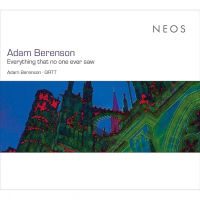
Berenson's aesthetic resists categorization. A formidable pianist and composer, he moves fluidly among jazz, contemporary classical and electronic music, dissolving the customary boundaries between them. Minimalist structures coexist with avant-garde gestures; acoustic instrumentation merges seamlessly with electronic production. The result is music that feels less like a stylistic hybrid and more like a unified, self-contained language.
The locus of the two-disc release seems suspended between imagined geographies: the depths of the ocean and the expanses of outer space. Two guiding presences suggest themselves, Sun Ra and cetacean song, particularly that of humpback and sperm whales. With brains vastly larger than our own, these mammals produce vocal systems whose complexity continues to intrigue researchers. Whether consciously or not, Berenson appears to channel this sense of alien communication.
His compositions "Mammisi" (Egyptian for "birthplace") and "String Quartet No. 4," performed by QRTT, evoke an immersive, subaquatic environment. The quartet, violinists Alexandr Kislitsyn and Aisha Dossumova:, violist Yoshihiko Nakano and cellist Branson Yeast, deploys extended techniques, bowing, scraping, and shaping pitches into sounds that resemble vocalizations rather than conventional tones. These textures populate the sonic field like an indecipherable yet expressive language. The effect is haunting, intimate and distinctly otherworldly.
From the imagined oceanic depths, Berenson shifts toward the celestial. The title track unfolds as a concerto for piano and electronic orchestra, the latter realized through an array of synthesizers and processors that might have pleased Sun Ra himself: Korg Triton Extreme, Sequential Oberheim OB-6, Sequential Prophet Rev2, Sequential Pro 3, Oberheim OB-X8 and Boss Space Echo RE-202. Across more than 50 minutes, evolving electronic landscapes provide the stimulus for Berenson's piano improvisations. His lines weave through the circuitry with a sense of discovery, as though human touch and machine resonance were converging into a single, cosmic gesture.
Everything That No One Ever Saw ultimately succeeds not by depicting specific worlds, underwater or interstellar, but by creating a perceptual state in which such distinctions lose meaning. Berenson's music occupies that liminal zone Serling once described: a realm of sound, mind and imagination, where the listener is not merely observing another dimension, but momentarily inhabiting it.
Track Listing
Everything That No One Ever Saw; Mammisi; String Quartet No. 4.
Personnel

Adam Berenson
synthesizerAlexandr Kislitsyn
violinAisha Dossumova:
violinYoshihiko Nakano
violaBranson Yeast
celloAdditional Instrumentation
Adam Berenson: Yamaha GH1 Baby Grand piano, Korg Triton Extreme, Sequential Oberheim OB-6, Sequential Prophet Rev2, Sequential Pro 3, Oberheim OB-X8/Boss Space Echo RE- 202; Alexandr Kislitsyn: violin; Aisha Dossumova: violin; Yoshihiko Nakano: viola; Branson Yeast: cello.
Album information
Title: Everything That No One Ever Saw | Year Released: 2025 | Record Label: Neos
About Adam Berenson
Tags
PREVIOUS / NEXT

Become a Sustaining Member

Since 1995, All About Jazz has championed jazz as an art form and supported the musicians who create it. Over three decades, it has grown into one of the world's leading jazz resources, serving hundreds of thousands of readers, musicians, presenters and industry professionals each month.
Help Build the Future of All About Jazz
Your support helps us continue building All About Jazz for the next generation—expanding our editorial coverage, preserving jazz history, developing new community features and creating better ways to discover the music and the people behind it.
Become a sustaining member for as little as $20 per year and you'll immediately enjoy an ad-free experience along with access to subscriber features and future articles for a full year.
Together, we're not simply sustaining All About Jazz—we're building its future. Thank you for being part of the journey.