Home » Jazz Articles » Album Review » Harper Trio: Dialogue of Thoughts
Harper Trio: Dialogue of Thoughts

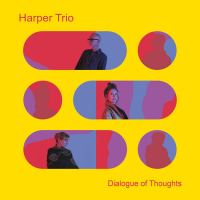
"Quiet Mind," the opening track, sets the tone. Harper's harp is not just melodic—it is percussive, textural, sometimes shimmering and reflective, other times sharp and insistent. Her lines ripple across the soundscape while Davies' saxophone offers a warm, grounded presence. Jenkins' drumming is intricate but never showy, guiding the piece with a light hand. The trio moves between improvisation and structure, revealing each piece gradually rather than announcing its intentions upfront. We hear them listening to each other, responding in real time, shaping the music as it unfolds. Then comes "Walk," the single—and the energy shifts entirely. There is a punk-inflected momentum here, a sense of forward motion that feels deliberate. Harper's harp handles both rhythm and melody, Davies interjects with urgency, and Jenkins drives the groove with understated complexity. It is a reminder that this album isn't purely contemplative—there are moments of determination, even resilience. Harper has described the album as a mindfulness diary, and "Walk" captures that tension between striving and stillness, the effort of moving forward while trying to stay present. It is one of the album's most accessible tracks, but it does not compromise the trio's aesthetic.
Other tracks explore contrast more quietly. "Ephemeral Now" and "Inner Thoughts" are meditative, almost cinematic in how they use space. The harp creates a sonic canvas, the saxophone traces emotional lines across it, and Jenkins offers a pulse that feels like a heartbeat. Texture, dynamics, and silence matter as much as the notes. In "Dialogue Fusion Politics," the trio flips the script—it is tight, kinetic, almost confrontational, demonstrating their comfort with intensity as well as restraint. Cultural threads run through the album without announcing themselves. In "ometime in Cairo," Harper weaves her Greek and Egyptian heritage into a contemporary jazz context, bringing modal inflections into play. It is subtle, not performative—just another color in the palette. "Moving On" and its intro track suggest narrative, reinforcing the album's thematic arc: personal evolution, the search for stillness, the push and pull between struggle and calm.
Technically, the playing is sharp. Harper combines percussive attacks, glissandi, and extended techniques to build dynamic landscapes. Davies' phrasing is responsive and conversational, occasionally exploratory. Jenkins' drumming is a study in texture—propulsive when it needs to be, delicate when it does not What sets the trio apart is how closely they listen to each other. Every note feels like a reaction, a question posed in real time.
Dialogue of Thoughts expands what the harp can do in a modern jazz context. It is not a flashy record, but a rewarding one—music that unfolds slowly, revealing layers of nuance and emotional depth. The Harper Trio has refined its sound and, more importantly, found the courage to explore the spaces between notes. This is thoughtful, adventurous music that feels profoundly human.
Track Listing
Harper Trio - Quiet Mind; Harper Trio - Walk; Ephemeral Now; Inner Thoughts; Dialogue Fusion Politics; Madness While Trying to Meditate; In Between Dreams; Sometime in Cairo; Moving On (Intro); Moving On.
Personnel



Album information
Title: Dialogue of Thoughts | Year Released: 2025 | Record Label: Self Produced
About Harper Trio
Tags
PREVIOUS / NEXT


Become a Sustaining Member

Since 1995, All About Jazz has championed jazz as an art form and supported the musicians who create it. Over three decades, it has grown into one of the world's leading jazz resources, serving hundreds of thousands of readers, musicians, presenters and industry professionals each month.
Help Build the Future of All About Jazz
Your support helps us continue building All About Jazz for the next generation—expanding our editorial coverage, preserving jazz history, developing new community features and creating better ways to discover the music and the people behind it.
Become a sustaining member for as little as $20 per year and you'll immediately enjoy an ad-free experience along with access to subscriber features and future articles for a full year.
Together, we're not simply sustaining All About Jazz—we're building its future. Thank you for being part of the journey.