Home » Jazz Articles » Album Review » Jonas Hellborg: Aram of the Two Rivers (Live in Syria)
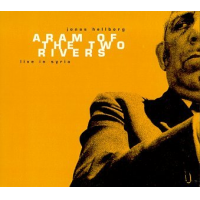
Jonas Hellborg: Aram of the Two Rivers (Live in Syria)
The other instruments, with the exception of the violin, are also noteworthy for their rarity in Jazz. Each is an instrument typical of Arabic music. The riq is a percussion instrument similar to a tambourine, and the derbuka is a percussion instrument similar to a clay pot.
With three percussionists, a bass guitarist, and only two melody instruments, which never play together, this is a rhythm centered ensemble. It is rhythm that breathes life into this music, propelling it forward without stop. At the forefront of that rhythmic drive is Hellborg, taming it by the liberal use of silence, or by letting notes dissipate for several measures.
The music itself is a fusion of Jazz and Arabic music. As such it is reminiscent of music by Rabih Abou-Khalil (Nabil Khaiat plays frame drums with Abou-Khalil, and Hellborg has toured with Abou-Khalil). Both share the same rhythmic drive. Abou-Khalil prefers larger ensembles, while Hellborg has stripped his band down to little more than the bare essentials. This, consequently, feels somewhat closer to Arabic music. The melodies do not sound like anything that might have been written on Tin Pan Alley. On the other hand, the improvisations, although guided by that insistent percussion, embody the heart and soul of Jazz.
Those who already listen to both Jazz and Arabic music will surely love this. I encourage the rest of you to give it a spin; I bet you'll find it as infectious as I do.
FOLLOW Eric Saidel
and get notified whenever a new article published.
Track Listing
Aram of Damascus; Sham; Akkadia 11; Aram of Zoba; Salah al Din; Suriya.
Personnel

Jonas Hellborg
bassJonas Hellborg- bass guitar; Mased Sri al Deen
Album information
Title: Aram Of The Two Rivers: Live In Syria | Year Released: 1999 | Record Label: Bardo Records
About Jonas Hellborg
Tags
PREVIOUS / NEXT


Become a Sustaining Member

Since 1995, All About Jazz has championed jazz as an art form and supported the musicians who create it. Over three decades, it has grown into one of the world's leading jazz resources, serving hundreds of thousands of readers, musicians, presenters and industry professionals each month.
Help Build the Future of All About Jazz
Your support helps us continue building All About Jazz for the next generation—expanding our editorial coverage, preserving jazz history, developing new community features and creating better ways to discover the music and the people behind it.
Become a sustaining member for as little as $20 per year and you'll immediately enjoy an ad-free experience along with access to subscriber features and future articles for a full year.
Together, we're not simply sustaining All About Jazz—we're building its future. Thank you for being part of the journey.