Home » Jazz Articles » Album Review » Moller/Balke/Lund: Trialogue
Moller/Balke/Lund: Trialogue

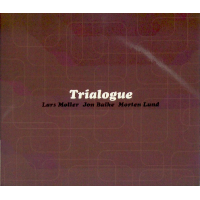
On most of his records, Balke amply uses synthesizers. That symbol of the electronic age has been both boon and bane for musicians. It offers an endless new sound palette, but can be a crutch for real invention, or worse, completely dominate an ensemble. Its smooth, almost plastic tones can sound like an alien presence in more traditional jazz contexts. (Witness the bizarre, but successful David S. Ware quartet album, Corridors & Parallels, where Matthew Shipp creates unsettling sonic environments with which the acoustic musicians interact.) Balke, here and on all his recordings, mines the synth’s electronic colors and possibilities with taste and imagination, and often becomes the catalyst that develops the improvisations.
Balke’s broad, hollow tones, wisps, pulsating beds, and organ effects challenge Moller and Lund to interact in new ways, most apparent on “Chapter Two” and “Three.” The addictive “Two” slithers along as a minimalist rhythm jam. Balke sets the mood with a scratching, dripping beat, a spare bass pulse and tinkling piano fragments. Moller adapts and transforms his sax into a popping, sucking, moaning percussion device, while Lund restrains the drum’s role as rhythmic front man, content with accenting and underlining the groove.
”Three” starts as a sax and synth duet, Moller blowing cascading smears of notes against Balke’s stream of squelches and solar wind swoops. Out of a low-volume thicket of distorted piano and sax squiggles, Lund builds a sludgey groove. Balke soon inserts dub-wise warbling bass, and Moller simmers behind them. Eventually Balke laces in aggressively dissonant blasts, dissolving the fabric of the beat, and paving the way for a dramatic climax.
In places Trialogue feels like a scattered collection of ideas, for the trio roams so freely from episode to episode; such inconsistency is a hallmark of freely improvised music. The focus of “Two” makes it the most successful track, but “One” and “Three” do supply more daring and more surprises.
Moller, Balke and Lund show themselves to be ultra-sensitive improvisers, and they react meaningfully to the electronic presence, generating for their instruments new roles. Improvisation is a two-way street; it can reinforce old habits, but also open new paths. Trialogue marvelously documents how spontaneous interaction pushes players in new directions.
Track Listing
Trialogue Chapter 1; Trialogue Chapter 2; Trialogue Chapter 3.
Personnel



Album information
Title: Trialogue | Year Released: 2004 | Record Label: Imogena Records
About Lars Møller
Tags
PREVIOUS / NEXT


Become a Sustaining Member

Since 1995, All About Jazz has championed jazz as an art form and supported the musicians who create it. Over three decades, it has grown into one of the world's leading jazz resources, serving hundreds of thousands of readers, musicians, presenters and industry professionals each month.
Help Build the Future of All About Jazz
Your support helps us continue building All About Jazz for the next generation—expanding our editorial coverage, preserving jazz history, developing new community features and creating better ways to discover the music and the people behind it.
Become a sustaining member for as little as $20 per year and you'll immediately enjoy an ad-free experience along with access to subscriber features and future articles for a full year.
Together, we're not simply sustaining All About Jazz—we're building its future. Thank you for being part of the journey.