Home » Jazz Articles » Live Review » The Gathering Tradition
The Gathering Tradition
While many focused their attentions on a political race that had served to underscore the racial divide that often permeates the Crescent City, this was a gathering of people of all cultures and backgrounds sharing a common goal; to celebrate the music and traditions of their home. A second line, long a part of New Orleans' cultural tapestry, wined its way throughout the Treme neighborhood that served as home to a gathering spot for African American slaves and their freemen of color owners. There in Congo Square, people were free to celebrate, to gather and to worship, just as their descendents did on this Sunday afternoon. As one man dressed in traditional African garb put it as the music began, "You are on sacred ground.
For those of you who have had the experience of a second line, you understand how difficult it is to explain. For those who have not, a New Orleans second line captures in its rhythms and syncopations the highest expression of unbridled joy imaginable. It is at times both a rhythmic, self-expressive walk and an elaborately choreographed dance. But all moves made by second line participants are right, because a second line is improvisation in its purest form. Jazz can trace many of its traditions to the music that accompanied the street parades of New Orleans and it is at the moment of creation, the moment of true improvisation, that the beauty of this music is felt.

Hundreds of people marched to the music provided by members of numerous brass bands and the streets were once again filled with the sounds of joy that make New Orleans a unique and magical place. No doubt, for one brief moment, our ancestors smiled and we found peace in these troubled times. Smiling faces greeted each other and echoes of "It's good to see you, and "How's everybody doing? could be heard all along the parade route as those once separated by great distances were once again reunited in their beloved city. Those great distances were shortened first by a smile and then an embrace and finally by an unspoken promise that they would gather again come hell or high water.
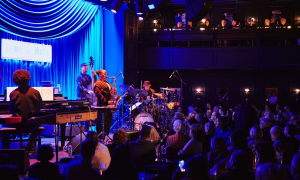
Yes, New Orleans is a city unlike no other. And music, jazz music is part of that uniqueness. As the crowd poured into Congo Square, it was evident that the music of New Orleans would again take center stage in the healing process that continues day in and day out. The Lincoln Center Jazz Orchestra (LCJO) under the direction of Wynton Marsalis and in collaboration with the percussion ensemble Odadda! provided the soundtrack for this gathering of spirits past and present. This was as much about healing as it was about the premiere of this powerful composition penned by Marsalis and Yacub Addy of Odadda!. Those who were there, surely felt a presence that could not be easily expressed in words, but was captured first by the music of the brass bands and then by the music of the LCJO and Odadda!.
Tradition plays its part in healing and Victor Goines, artistic director of Julliard's Jazz Studies, member of the LCJO and native New Orleanian may have said it best. As the second line danced and made its way down tree-lined Esplanade Avenue, Goines smiled and said, "It's just like old times. For those who love the Crescent City, its music and its traditions, let's hope he's right.
Until next time, see you 'Round About New Orleans.
 FOLLOW Tod Smith
and get notified whenever a new article published.
FOLLOW Tod Smith
and get notified whenever a new article published.
He loves all music, but it's jazz that touches his soul.
Tags
PREVIOUS / NEXT

Become a Sustaining Member

Since 1995, All About Jazz has championed jazz as an art form and supported the musicians who create it. Over three decades, it has grown into one of the world's leading jazz resources, serving hundreds of thousands of readers, musicians, presenters and industry professionals each month.
Help Build the Future of All About Jazz
Your support helps us continue building All About Jazz for the next generation—expanding our editorial coverage, preserving jazz history, developing new community features and creating better ways to discover the music and the people behind it.
Become a sustaining member for as little as $20 per year and you'll immediately enjoy an ad-free experience along with access to subscriber features and future articles for a full year.
Together, we're not simply sustaining All About Jazz—we're building its future. Thank you for being part of the journey.