Home » Jazz Articles » Book Review » Signs Along The Road
Signs Along The Road
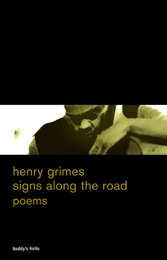 Signs Along The Road
 Henry Grimes
Soft cover; 128 pages
ISBN: 978-3-00-020142-4
Buddy's Knife
2007
Bassist Henry Grimes was one of the leading lights on the free jazz scene in the 1960s, playing with many of the music's most famous names, including pianist Cecil Taylor, multi-instrumentalist Don Cherry, reed player Pharoah Sanders and saxophonist Albert Ayler. Financial struggle forced him away from jazz and in 1968 he stopped playing. But fortunately, several years later, he met his future wife and manager, Margaret Davis, who back in 2002, started a search for a bass so Grimes could play music again. The quest was successful, resulting in Grimes' triumphant return to the jazz scene.
The story of Grimes' renaissance has become almost mythological, but what is lesser known is that while he took an extended break from music, he never abandoned artistic expression. Throughout the many years of musical abstinence, he wrote constantly, filling his diaries with poems. Thanks to the publisher and editor, Renate Da Rin, a generous selection of Grimes' poetry is presented in book form by Buddy's Knife.
Signs Along the Road spans several decades, and includes poetry written as recently as 2005, but the bulk of the work comes from the 1980s. In other words, the poetry presented here is not the spontaneous jottings of an amateur, but excerpts from an artist's lifelong existential search, an artist whose medium has included not only music, but also words. In fact, in Grimes' work there is a close correspondence between music and poetry: both are languages, which try to say what it is not possible to say in everyday language. Grimes is known as a musician who doesn't talk a lot, but in his poetry he speaks with a profound, wise voice.
A leitmotif in several poems is the use of time, which is explored on several levels throughout the collection. It emerges as the metaphor of nature, the river of time, and as the passing of people, places and history, the different shapes of memory, but most of all it reveals itself as the investigation of form. Perhaps the most striking definition of art as the sculpting of time is presented in "monk music" whose first extensive stanza deserves to be quoted verbatim:
"Music functions in a pattern. Patterns. Patterns function in a whiz; the worse for patternistry which is not there. The gems of few lines. Then—music functions whole, patterns into system patterns. Thus do patterns become history and music—forms. Yes, do pages of phrases write motion, still things—that move, that have lines in mystery, because the best music then forms benign of misery."
Here, the correspondence between music, writing and time is clear and so is the relation between the creation of the moment and history: "patterns become history." The notion of time also shows itself in the use of enjambment and dash, that little word of punctuation so brilliantly explored by Emily Dickinson. With his use of poetic form, Grimes extends and expands time—the words are in motion, just like music being played in the moment. The musical effect of the words is also underlined by rhythm, rhyme, alliteration and assonance as in the last lines: "because the best music then forms benign of misery."
Time moves through three stages in the poems; the time of the individual subject, the time of history and the time of art. While Grimes is interested in all aspects of time, he is mostly concerned with the aspect of artistic time. What is remarkable about artistic time is that it unfolds itself through a subject to transcend subjectivity: "Yes, do pages of phrases write." It is the pages that write not the artist.
The experience passed on in Grimes' words is that humans exist on three time-levels: individually, historically and transcendentally. It is the achievement of the poet Grimes that he is able to show the coexistence of these levels, bringing the reader closer to the true essence of being.
 FOLLOW Jakob Baekgaard
and get notified whenever a new article published.
FOLLOW Jakob Baekgaard
and get notified whenever a new article published.
Jakob is still amazed by the ability of jazz to constantly transform itself as an art form.
About Henry Grimes

Tags
PREVIOUS / NEXT


Become a Sustaining Member

Since 1995, All About Jazz has championed jazz as an art form and supported the musicians who create it. Over three decades, it has grown into one of the world's leading jazz resources, serving hundreds of thousands of readers, musicians, presenters and industry professionals each month.
Help Build the Future of All About Jazz
Your support helps us continue building All About Jazz for the next generation—expanding our editorial coverage, preserving jazz history, developing new community features and creating better ways to discover the music and the people behind it.
Become a sustaining member for as little as $20 per year and you'll immediately enjoy an ad-free experience along with access to subscriber features and future articles for a full year.
Together, we're not simply sustaining All About Jazz—we're building its future. Thank you for being part of the journey.