Home » Jazz Articles » Profile » Pierre D
Pierre D
Every musician must have a specialty and also be totally aware--here and now in the music.
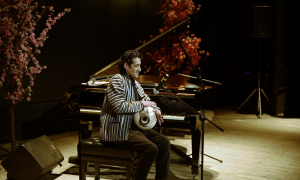
 If there ever was doubt about the universality of jazz and its creative spirit, one need look no further than the wildly inventive Danish guitarist/bandleader Pierre Dørge and his New Jungle Orchestra (NJO). Through a career that spans over forty-five years, Dørge has never ceased to surprise with music that touches on a world of traditions and yet bursts forth new and revelatory and never without a sense of great fun. He has constantly added to his primary original influences—Duke Ellington, Charles Mingus—by listening keenly to music from many cultures and using diverse elements to broaden his sonic palette.
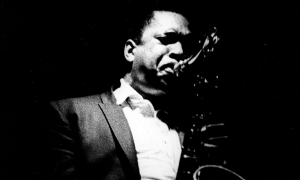
Dørge was born in Copenhagen in 1946. As a teenager he developed an interest in modern jazz, learned the guitar and was soon making a name for himself as a soloist with his own Copenhagen Jazz Quartet. When Dørge felt that jazz was becoming intellectualized and stiff, he sought new means of expression. Danish saxophonist John Tchicai, who played on John Coltrane's landmark Ascension (Impulse!, 1965), was someone who helped with that quest. The guitarist found new ways to expand the potential of the guitar by uniting composed music with spontaneous and instinctive improvisation.
In the '70s he took this new approach to rock music in the group Thermaenius. As a player and soon, too, as a composer, Dørge found ways to have chaos and order run smack up against each other. Simple themes met collective improv and thus was born the notion of the NJO.
The NJO came to life in 1980, founded as a composers' workshop by Dørge and Simon Spang-Hanssen, a saxophonist who had imagined a Noah's Ark Orchestra, with two players on each instrument. The name comes from Duke Ellington's Jungle period at New York's Cotton Club. In that setting Ellington actually shocked his white audiences by simulating animal noises meeting traffic noises of the city. In Dørge's NJO, musics from around the world face up with each other and with the brash and often "crazy colors of an orchestra that wants to improvise freely but which must also negotiate Dørge's scores. This "showdown produces a wild mix of sonic colors and allows soloists to take off on personal trips that have proved to be exceptionally appealing and communicative to audiences.
Dørge is proud of the longevity of his band and of its special players. "There are four original members still in the band, says Dørge. "Reedman Morton Carlsen, who specializes in Asian and Balkan music; trombonist Kenneth Agerholm, who picks up all the Cotton Club 'wah-wahs'; keyboardist and composer Irene Becker; and myself. Carlsen, Becker and I also have our own performing trio. We have musicians from Sweden, Norway and Denmark and our percussionist, Aya Solomon, is from Ghana. And we continue to find fantastic, young, newcomers. Every musician must have a specialty and also be totally aware—here and now in the music. It's more than just playing the written parts—each player must also have the power to show their feelings on top and out front.
This might be called world music in the fullest expression of that overused term. Dørge has found, over the years, music from Africa, Asia, the Middle and Far East, Europe and, of course, America, but it must be stressed that it's not meant to be authentic but, rather, to renew the spirit of invention that so often becomes bogged down in academics, technical blowouts and the like (in fact, in Dørge's childhood, the fake ethnic music used in early Tarzan movies awakened his interest.). He notes, "Our influences jump from Duke's Jungle music to [Charles] Mingus, [Eric] Dolphy, [Don] Cherry and Ornette [Coleman]. These are mixed with elements from everywhere—Africa, Asia, Australia, Europe and America and also with Gregorian chant, Stravinsky, Ligeti...and then, of course, our main influence is the Danish music from where and when we grew up.
A desire to find the soul of other cultures has always informed the efforts of this explorer. Sometimes that's happened in odd ways. In a restaurant in Paris, the kitchen staff held a late-night jam session, playing spoons, pots, pans and an oud. In this fashion, Dørge met Arabic music. He heard Ravi Shankar in the late '60s, and for a while thought of Indian music in contemplative and healing terms.
There's more than a hint of Dadaism about the art of Pierre Dørge. It provokes the listener out of middle- class complacency, but it's somehow always infectious, optimistic and damned funny. Critic Norman Weinstein, in his book A Night in Tunisia: Imaginings of Africa in Jazz, has called the NJO, "...unabashedly one of Europe's most sophisticated bands...Dørge and band do not simply reverently imitate the Ellington jungle sound, but ironically and humorously carry the sound to its logical musical conclusion. His imaginative play with African styles and instrumentation is unparalleled by any other musician not of African descent.
The NJO has recorded eighteen albums since its inception. It shares a sense of anarchy tempered, somehow, by a gentle restraint that makes it both adventurous and appealing. Negra Tigra is its most recent recording and it manages to incorporate stylistic flourishes from early jazz into a brash and noisy contemporary setting.
Tchicai has been the most notable of the soloists—he's on eight of the recordings—and has a special feeling about Dørge and the NJO. "Pierre and I are closely related in terms of our roots and preferences, says Tchicai. "And when we play in groups outside of the NJO—anywhere in the world—we're especially well in touch." Dørge shares the feeling. "John put a lot of power in the NJO.
The band has also worked with tenor saxophonist David Murray (on its 1991 Enja album, The Jazzpar Prize, the pianist is Horace Parlan), trombonist Ray Anderson, trumpeter Harry Beckett, vocalist Josephine Cronholm, bassist Johnny Dyani and drummer Hamid Drake. It says a great deal about both Dørge and his native Denmark that from '93-'96 the band was the Danish State Ensemble and in 1998, Dørge received a life grant as a composer from the Danish State. "It's my dream, he hopes, "that music makes people understand each other and different cultures can meet, through music, in a peaceful way.
In addition to his NJO activities Dørge has sought out other like-minded players to improvise and invent in a wide variety of contexts. He has worked in small group contexts with Tchicai, Beckett, violinist Svend Asmussen and vibraphonist Walt Dickerson. As a guitarist he is accomplished technically but always uses his chops with his larger aesthetic in mind. "For many years Pierre and his orchestra have been able to dance the tightrope of renewal and creativity, says Tchicai. "He creates the very best repertoire—music that in a tasteful way illustrates and incorporates the musics of non-Western cultures.
Selected Discography
Pierre Dørge/New Jungle Orchestra, Negra Tigra (New Green-Ilk Music, 2001)
Pierre Dørge/New Jungle Orchestra, Live at Birdland (Stunt, 1999)
Pierre Dørge/New Jungle Orchestra, Music From The Danish Jungle (Marco Polo-Dacapo, 1995)
David Murray/Pierre Dørge's New Jungle Orchestra, The Jazzpar Prize (Enja, 1991)
Pierre Dørge/New Jungle Orchestra, Even The Moon Is Dancing (Steeplechase, 1985)
John Tchicai, Real Tchicai (Steeplechase, 1977)
Photo Credits
Top Photo: Jesper Svarre
Bottom Photo: Jose Manuel Horna
About Pierre Dorge

Tags
PREVIOUS / NEXT
Become a Sustaining Member

Since 1995, All About Jazz has championed jazz as an art form and supported the musicians who create it. Over three decades, it has grown into one of the world's leading jazz resources, serving hundreds of thousands of readers, musicians, presenters and industry professionals each month.
Help Build the Future of All About Jazz
Your support helps us continue building All About Jazz for the next generation—expanding our editorial coverage, preserving jazz history, developing new community features and creating better ways to discover the music and the people behind it.
Become a sustaining member for as little as $20 per year and you'll immediately enjoy an ad-free experience along with access to subscriber features and future articles for a full year.
Together, we're not simply sustaining All About Jazz—we're building its future. Thank you for being part of the journey.