Home » Jazz Articles » Album Review » Joe Lovano: Paramount Quartet
Joe Lovano: Paramount Quartet
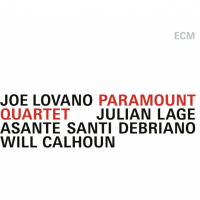
The quartet's origin helps explain the album's internal tension. Lovano has traced the group's beginnings to trio encounters with bassist Asante Santi Debriano and drummer Will Calhoun around a Puerto Rico relief fund event, with guitarist Julian Lage added afterward as the missing angle (as Lovano explained). That background matters because Paramount Quartet does not sound like a studio construction assembled for contrast. It sounds like a group formed from contact: old associations, new pressure, and a leader willing to let the balance move.
The instrumentation matters, though less as a question of absence than of proportion. Lage supplies plenty of harmonic definition, but guitar harmony behaves differently from piano harmony. His compact voicings, dyads, open intervals, and clipped chordal punctuations enter the texture quickly and decay before they can harden into a wall. They give Lovano's lines something to resist without furnishing every bar. When Lage turns linear, the function shifts toward counterline and angle; the harmonic weight then falls more sharply on Debriano's bass choices and on the memory of the guitar's previous voicings. The result is lighter, more volatile harmonic weather.
Lovano's use of tenor saxophone and tarogatos also affects the group's scale. The tenor gives the music breadth, grain, and a familiar post-bop weight. The tarogatos narrow the aperture, adding a reedier pressure and pulling the ensemble away from the expected heft of a saxophone-led quartet. Lovano uses the contrast to alter the room around him. The change is not ornamental; it changes how much space the band has to negotiate.
The repertoire frames that negotiation carefully. Five Lovano originals sit beside Charlie Haden and Abbey Lincoln's "First Song" and Wayne Shorter's "Lady Day." Those two pieces establish coordinates rather than provide relief. Haden brings song, patience, and the discipline of space. Shorter brings harmonic ambiguity, shadow and a melodic language that can sound inevitable while still withholding resolution.
"First Song" opens the album by refusing to overstate its own tenderness. Lovano gives the melody a broad presence, but the performance never swells into ceremony. The line moves slowly enough for its intervals and silences to register, and Lage's voicings stay close to the tune without enclosing it. Debriano and Calhoun keep the pulse flexible but legible. The track sets a standard for the album: space has to be earned by proportion, not by atmosphere alone.
"Amsterdam" changes the pressure. Its rubato unisons between horn and guitar are effective because the two instruments do not dissolve into one surface. Lovano gives the line mass; Lage gives it edge and articulation. The written material stays intact, yet the difference between the two attacks keeps it unstable. Debriano avoids closing the harmony too quickly, and Calhoun turns time into a surface that can be pressed, bent and briefly withheld. The piece has an urban angularity without becoming descriptive.
"The Call" reduces the music to shorter units of decision. The track depends on placement: where a phrase begins, how long it remains unresolved, and how the next sound changes the space left behind. Lovano often states less than a full argument. Lage answers from oblique positions, sometimes with a harmonic nudge, sometimes with a line that reframes the horn. Calhoun is especially telling here because his smallest details carry structural weight: cymbal decay, a dry drum stroke, a tom resonance that changes the density of the room. The track's intensity comes from compression rather than volume.
"Fanfare for Unity" is where Calhoun most clearly changes the band's metabolism. The piece is built from vamp, riff and forward pressure, but its force comes from the drummer's control of subdivision and attack. He gives the groove voltage without turning it into a rock-jazz display. Accents land hard, then loosen; the beat fractures at its edges while the band's motion stays aimed. Lovano and Lage respond with compressed figures rather than expansive solo rhetoric, while Debriano keeps the low register active enough to move and stable enough to prevent sprawl. The title's unity arrives as coordination under stress, four players agreeing on direction while preserving friction.
"Lady Day" is the album's most inwardly complicated reading. The piece carries its Billie Holiday dedication and its Shorter authorship, but the quartet treats those facts as musical inheritance rather than a frame for reverence. Lovano follows the melody's asymmetries and lets its tenderness remain unsettled. Lage's role is decisive because he resists over-completing the harmony; his voicings imply the changes while leaving their edges exposed. Debriano and Calhoun keep the ballad from becoming static. The performance understands how much shadow Shorter could place inside a beautiful line.
"The Great Outdoors" opens the album's broadest field, though the field is uneven rather than pastoral. Debriano gives the track much of its shape. His bass does not simply anchor the form; it makes the form movable, placing enough low-register information for the others to orient themselves while continually shifting the ground under them. Above that moving floor, Lovano and Lage treat the written figures as routes rather than destinations. Calhoun supplies cross-currents of speed and accent, so the piece expands by complication rather than accumulation. Its freedom functions as pressure on form, keeping the structure permeable without letting it go slack.
"Congregation" closes the album by converting volatility into gait. The mid-tempo sway gathers the record's earlier tensions into a durable pulse. Lovano keeps a blues burr in the line without standing apart from the group; Lage answers with clipped harmonic angles; Debriano lets the bass walk with melodic intention; Calhoun bends the groove from inside the beat. After the exposed terrain of "The Great Outdoors," the track refuses a ceremonial ending. It puts the band back in motion and leaves the argument there.
The album's strongest feature is the clarity with which the four voices remain distinct. Lage gives the music its harmonic glint and lateral movement without turning the guitar into substitute architecture. Debriano often makes the next harmonic opening feel discovered from below. Calhoun supplies the most volatile edges, though he rarely overstates them. Lovano remains the primary voice, but his leadership is not a matter of occupying every foreground. He frames situations in which others can alter the music's balance.
ECM's production is central to both the album's achievement and its limitation. The recording gives the instruments separation, resonance and enough air for small decisions of register, decay and attack to matter. It also seals off some abrasion. A club document of this quartet would almost certainly place more danger on the surface, especially in "Fanfare for Unity" and "The Great Outdoors." That is the cost of the record's clarity: the band's roughest heat is partially disciplined by the studio frame.
The trade-off is worth it. Paramount Quartet is not the album for listeners seeking Lovano at his most volcanic, nor for those who want the quartet's live risk left entirely unfiltered. Its value lies elsewhere: in the way it lets pressure, proportion, and mutual adjustment become audible. The recording clarifies the internal mechanics of a band still testing its own center, and that clarity gives the music its force.
The title risks sounding inflated, but the music gives it a practical meaning. "Paramount" does not mean monumental here. It means primary. What is primary is the ensemble problem itself: four strong players, no single authority over harmony or time, and a leader willing to let command be redistributed. Lovano has made many records that demonstrate mastery. This one earns its place by showing mastery under negotiation: tested, adjusted, and shared before it hardens into certainty.
 FOLLOW Sue Yang
and get notified whenever a new article published.
FOLLOW Sue Yang
and get notified whenever a new article published.
Mental health therapist, jazz critic, educator, and founder of DeepListeningJazz
Track Listing
First Song; Amsterdam; The Call; Fanfare for Unity; Lady Day; The Great Outdoors; Congregation.
Personnel

Joe Lovano
saxophone
Julian Lage
guitar, electric
Asante Santi Debriano
bass, acoustic
Will Calhoun
drumsAlbum information
Title: Paramount Quartet | Year Released: 2026 | Record Label: ECM Records
About Joe Lovano
Tags
PREVIOUS / NEXT


Joe Lovano Concerts
Become a Sustaining Member

Since 1995, All About Jazz has championed jazz as an art form and supported the musicians who create it. Over three decades, it has grown into one of the world's leading jazz resources, serving hundreds of thousands of readers, musicians, presenters and industry professionals each month.
Help Build the Future of All About Jazz
Your support helps us continue building All About Jazz for the next generation—expanding our editorial coverage, preserving jazz history, developing new community features and creating better ways to discover the music and the people behind it.
Become a sustaining member for as little as $20 per year and you'll immediately enjoy an ad-free experience along with access to subscriber features and future articles for a full year.
Together, we're not simply sustaining All About Jazz—we're building its future. Thank you for being part of the journey.