Home » Jazz Articles » Album Review » Stephanie Borgani: Mímica: Música para Quatro Instrumentos
Stephanie Borgani: Mímica: Música para Quatro Instrumentos
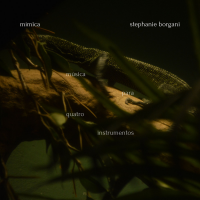
There is a comparable aesthetic duality in the work of some of Borgani's musical heroes. Sara Serpa's cool nonconformity, for example (Sara Serpa & Matt Mitchell: End of Something, Obliquity, 2025). She also names Miguel Zenon with Spektral Quartet (Yo Soy La Tradicion, Miel Music, 2018), PRISM Quartet (Dissolve, XAS, 2026), and Lea Freire (Vento em Madeira, Maritaca, 2011). It is not hard to find parallels. Bold compositional choices are articulated in chamber-jazz ensembles, sound environments that tend to be active rhythmically and melodically, yet diaphanous.
Borgani's inventive compositions are a mix of written and improvised material. The scores employ an SATB setup (soprano voice, alto voice, alto sax, tenor sax). The vocal lines are wordless and the textures are diverse.
To begin at the end, the program culminates with "Quieto, Por Favor" (Quiet, Please), a confection that combines baroque precision with jazz freedom. For a quick blow-by-blow, voice one (Borgani) sings a running eighth-note theme at the top, in unison with alto sax (Lucas Sales). After eight bars, voice two (Marina Marchi) and tenor sax (Marlon Cordeiro) join in improvised counterpoint as the opening melody repeats. The texture thickens in the 17th bar as both saxophones momentarily assume the theme while voice two continues to improvise and voice one moves on to a contrasting legato melody. Alto hands the melody off to tenor three bars later, as alto plays in canon with voice one's legato theme. A relatively long composed developmental section ensues, with tenor maintaining the primary melody as the themes entwine and new contrapuntal material is added. This culminates with an open collective improvisation based on an alternating two-bar harmony, followed by a coda, which serves as a recapitulation of sorts, ending with a written coda. The four minutes are delightfully jam-packed.
"Colorida" (Colorful), the penultimate track, contains a similar mix of composed contrapuntal backgrounds and solo sections, this time with improvisations over more jazz-like forms in that the soloists (Sales and Borgani) each improvise over 32-ish bar segments in a mixed meter of sevens and threes. The scores are meticulous and substantial (14 pages for "Colorida," nine for "Quieto").
On the other hand, "Coro" (Choir), track six, is entirely composed (as is "Trave" [Goalpost], track four), and fills just three pages. "Coro" may remind some listeners of early Swingle Singers, in their Jazz Sébastien Bach period (Philips, 1963); "Aria" from Suite No. 3 in D.
Call her music third stream if you like (she earned her master's degree from New England Conservatory), although música instrumental brasileira (Brazilian instrumental music) might be more apt, since she is based in São Paulo and continues to do post-graduate work at the Escola de Música do Estado de São Paulo Tom Jobim (EMESP), studying composition with Tiago Costa, Rodrigo Lima, and Nelson Ayres. However you choose to categorize Mímica, the album distinguishes Borgani as an emerging composer-performer with a fresh, creative voice. She is one to watch.
 FOLLOW Katchie Cartwright
and get notified whenever a new article published.
FOLLOW Katchie Cartwright
and get notified whenever a new article published.
Ethnomusicologist, singer-flutist, writer, radio host (KRTU San Antonio 91.7FM).
Track Listing
I. Montagem; II. Brincadeira; III. Interlúdio Saxofones; IV. Trave; V. Meditação (De Se Esperar) / VI. Interlúdio Vozes; VI. Coro; VII. Colorida; VII. Quieto, Por Favor.
Personnel


Additional Instrumentation
Marlon Cordeiro: tenor saxophone.
Album information
Title: Mímica: Música para Quatro Instrumentos | Year Released: 2026 | Record Label: Yb Music
About Stephanie Borgani
Tags
PREVIOUS / NEXT


Become a Sustaining Member

Since 1995, All About Jazz has championed jazz as an art form and supported the musicians who create it. Over three decades, it has grown into one of the world's leading jazz resources, serving hundreds of thousands of readers, musicians, presenters and industry professionals each month.
Help Build the Future of All About Jazz
Your support helps us continue building All About Jazz for the next generation—expanding our editorial coverage, preserving jazz history, developing new community features and creating better ways to discover the music and the people behind it.
Become a sustaining member for as little as $20 per year and you'll immediately enjoy an ad-free experience along with access to subscriber features and future articles for a full year.
Together, we're not simply sustaining All About Jazz—we're building its future. Thank you for being part of the journey.