Home » Jazz Articles » Album Review » Sara Serpa & Matt Mitchell: End of Something
Sara Serpa & Matt Mitchell: End of Something
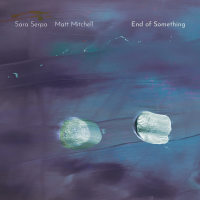
The sound is uncommonly stark and light; just Serpa's agile, fragile voice and Mitchell's crystalline piano. There is a sense of interiority. At times, the pair seems to be on an identical wavelength, but not so much conversing with each other (except maybe in synchronic telepathy) as simultaneously talking to themselves, or sharing a surreal dream. The songs are predominantly wordless and on the fringes of tonality, blending and blurring composition and improvisation in textures that skew homophonic.
In troubled times, some artists produce music to uplift and/or provide relief. Serpa has a different perspective: "I feel like sometimes there's a tendency for people to just look for distraction and joy, which is fine. But I think accepting what we have—the bad things that are around us—and making art about that is OK too. It's what helps us process that darkness and that reality."
She steps into darkness with compositions like "The Future," which sets a quote from Virginia Woolf's diary during World War I (January 18, 1915): "The future is dark, which is the best thing the future can be I think." A slow-paced quasi-out-of-time melody is given in unisons/octaves over a relentless, metronomic, walking ostinato, rendered in scat at first (over which the piano provides little upper-register starburst punctuations), then on piano. As she sings the lyric, Serpa leans way into a dissonance on the word "is," as if to emphasize the currency of Woolf's observation; Mitchell dances well with her subtle melodic rubato, highlighting the line in rhythmic unison. After a few variations on the doubled vocal line and a brief wordless duet improvisation, the music dissolves into a portentous silence. The performance is chilling and thrilling.
Both musicians contributed to the set list, with Serpa bringing a wordless piece ("News Cycle") and four settings of poetry and prose, including a quotation from the writings of Luce Irigaray ("Dead Spirits"), a haiku by Sonia Sanchez ("Carry You Like a River"), and a poem by Sofia de Mello Breyner Andresen ("Ar e Vento" [Air and Wind]). At nine pieces, all without words, Mitchell provided the lion's share of the repertoire. Some of his are cells just one measure in length, to be developed through improvisation; "compact forms and open structures" as the liner notes state. Other selections are fully composed, with "Les Bergers" (the second movement of Olivier Messiaen's La Nativité du Seigneur) making an effective surprise appearance halfway through the program.
In interviews and liner notes, Mitchell and Serpa have each pointed to a freedom they experienced making End of Something (and working together on other projects), where her acute ear and mobile voice allowed him to move around harmonically, free to explore without fear of losing her; and where her most subtle vocal inflections could find room to bloom, thanks to the transparency and gentleness of the approach he takes.
What Mitchell and Serpa create on End of Something is refreshingly idiosyncratic; a particular quiet space, antidote to the constant, homogenized, artificially-intelligized roar of social media and general freneticism of the moment.
 FOLLOW Katchie Cartwright
and get notified whenever a new article published.
FOLLOW Katchie Cartwright
and get notified whenever a new article published.
Ethnomusicologist, singer-flutist, writer, radio host (KRTU San Antonio 91.7FM).
Track Listing
News Cycle; Diction; Hyper Pathos; The Future; Trouvaille; Les Bergers; Gluey Clamor; Carry You Like a River; Fettleau; Elegiac Foldouts; Ar e Vento; Tooth Helmet; End of Something; Dead Spirits; Hypo Bathos.
Personnel


Album information
Title: End of Something | Year Released: 2025 | Record Label: Obliquity Records
About Sara Serpa & Matt Mitchell
Tags
PREVIOUS / NEXT

Become a Sustaining Member

Since 1995, All About Jazz has championed jazz as an art form and supported the musicians who create it. Over three decades, it has grown into one of the world's leading jazz resources, serving hundreds of thousands of readers, musicians, presenters and industry professionals each month.
Help Build the Future of All About Jazz
Your support helps us continue building All About Jazz for the next generation—expanding our editorial coverage, preserving jazz history, developing new community features and creating better ways to discover the music and the people behind it.
Become a sustaining member for as little as $20 per year and you'll immediately enjoy an ad-free experience along with access to subscriber features and future articles for a full year.
Together, we're not simply sustaining All About Jazz—we're building its future. Thank you for being part of the journey.