Home » Jazz Articles » Album Review » Louis Sclavis / Bernard Struber Jazztet: Le Phare
Louis Sclavis / Bernard Struber Jazztet: Le Phare
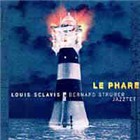
Emerging on the scene in the mid-1980s, Sclavis worked with artists like Henri Texier, Peter Brötzmann, and Cecil Taylor. But while these associations would correctly suggest a penchant for free improvisation, Sclavis has always been compelled by more finely-hued structures steeped in the musical traditions of his own country and contemporary classical composition. "Manoir begins as a dark fanfare for horns, lacking any semblance of a pulse. Three minutes in it dissolves into an improvised duet for trumpet and bass. Piano and drums gradually enter, but while the piece gradually picks up steam, it remains spacious, ultimately fading to black, with a brief trumpet line signalling its end.
Elsewhere Sclavis' writing is more jazz-centric, with the swing of "Kampala supporting a characteristically knotty and rhythmically staggered melody. Sclavis has worked with larger ensembles before, but never with one possessing the Jazztet's broad textural range from gentle and warm to sharp and—often within the confines of a single piece. And while Struber's arrangements make good use of the Jazztet's greater palette, there are plenty of instances where he reduces it down to smaller subgroups.
There's an undeniable focus on Sclavis' playing, but there are plenty of opportunities for others to shine, with François Thuiller's tuba solo in the middle of "Kampala especially notable for its combination of simple lines and outré multiphonics.
When Sclavis played with his Napoli's Walls project in Victoriaville, Canada in the spring of 2004, one of the most remarkable aspects to the performance was the quartet's ability to seamlessly shift gears from unfettered free play to strict form, with cues so invisible as to seem nonexistent. Hard enough, no doubt, to pull off with a smaller ensemble like the one on Napoli's Walls, here it's even more uncanny. "Les Marches begins with a free exchange that manages to remain somehow delicate and feather-light. Suddenly, out of nowhere, Sclavis' elliptical theme bursts out over a triplet pulse from tuba and trumpet and resolves into a soprano saxophone/clarinet duet over a busy, but nevertheless insistent, percussion pulse. As the piece evolves it becomes increasingly complex and texturally rich, all the while providing space for additional improvisation.
The stylistic devices that Sclavis employs on Le Phare will be familiar to anyone who's heard any of his more recent releases. But by expanding the potential of his writing with Struber's Jazztet, Sclavis affords himself a greater opportunity for contrapuntal interaction and denser sonics, making this a worthy addition to his expanding catalogue.
 FOLLOW John Kelman
and get notified whenever John has a new article published.
FOLLOW John Kelman
and get notified whenever John has a new article published.
With the realization that there will always be more music coming at him than he can keep up with, John wonders why anyone would think that jazz is dead or dying.
Track Listing
Le Retour D'Ottomar; Le Phare; Derniers Regards; Procession; Manoir; Kampala; Les Marches.
Personnel

Louis Sclavis
woodwindsLouis Sclavis: soprano saxophone, clarinet, bass clarinet; Bernard Struber: guitar; Jean-Luc Cappozzo: trumpet, flugelhorn; Serge Haessler: trumpet, flugelhorn; Jean-Claude Eglin: trombone; Fran
Album information
Title: Le Phare | Year Released: 2006 | Record Label: Enja Records
About Louis Sclavis
Tags
PREVIOUS / NEXT
Louis Sclavis Concerts
Become a Sustaining Member

Since 1995, All About Jazz has championed jazz as an art form and supported the musicians who create it. Over three decades, it has grown into one of the world's leading jazz resources, serving hundreds of thousands of readers, musicians, presenters and industry professionals each month.
Help Build the Future of All About Jazz
Your support helps us continue building All About Jazz for the next generation—expanding our editorial coverage, preserving jazz history, developing new community features and creating better ways to discover the music and the people behind it.
Become a sustaining member for as little as $20 per year and you'll immediately enjoy an ad-free experience along with access to subscriber features and future articles for a full year.
Together, we're not simply sustaining All About Jazz—we're building its future. Thank you for being part of the journey.