Home » Jazz Articles » Album Review » Mick Goodrick: In Pas(s)ing
Mick Goodrick: In Pas(s)ing

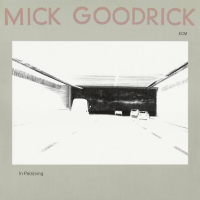
In Pas(s)ing will be re-issued July 10, 2026 as part of ECM's Luminessence series.
The album's title is a homonym, referring to the title song and "Pasing," the name of the street and district of Munich in which ECM is headquartered. He released his own Biorhythms (CMP Records, 1990) and duos with guitarist Joe Diorio and Wolfgang Muthspiel, but his discography otherwise includes only side appearances. That is, until June 19, 2026, when ECM released Feebles, Fables And Ferns (ECM Records, 2026), a forgotten 1988 duo recording made in pianist Fred Hersch's New York home.
Rather than recording, Goodrick devoted his considerable talents to teaching and writing. In our interview, Hersch called him the "Guitar Whisperer," as he mentored so many of today's great jazz guitarists such as John Scofield, Bill Frisell, Pat Metheny, and more. Known as "Mr. Goodchord," Goodrick was a leading theorist in voice leading for guitar and his 1987 book The Advancing Guitarist has been a fundamental text for a generation. It eschews exercises and method in favor of essays that create a conceptual system of the instrument.
The strong enters our soul like a conqueror... the tender presents itself before the city like a debonair king who has but to show himself for the doors to open. —Wanda Landowska Early Music' (1909).
In Early Music, the great harpsichordist and early music scholar Wanda Landowska lamented Romanticism's elevation of "noisy effects" over early music's tender "sonorous force." Her words retain their relevance in a revisitation of In Pas(s)ing. Goodrick, John Surman, Eddie Gomez, and Jack DeJohnette win us over not with noisy assaults but sonorous force. There are no screaming guitar solos or thunderous drums, but instead a subtle, harmonic interplay.
A delicate complexity surfaces in the first song, "Feebles, Fables, and Ferns," as Goodrick adds countermelodies to Surman's expressive baritone saxophone. His guitar solo is actually a duet with Gomez's bass, as they wander around G Major's minor chord harmonies.
The second track, "In The Tavern Of Ruin," is a reference to Sufi Master Dr. Javad Nurbakhsh's In The Tavern Of Ruin (1978), a primer on that faith's fundamental tenets. Modal melodies, along with Surman's attempts to surpass his instrument's register and the searching tempo shifts may represent the quest for Sufi's "fitra," or man's original purity.
"Summer Band Camp" begins with Goodrick and Surman playing an abstract, melodic figure before trading solos and visiting all twelve keys. "Pedalpusher" opens with "Mr. Goodchord's" characteristic harmonic density, supporting Surman's bass clarinet wanderings.
The album ends with the improvised "In Passing," again anchored by Goodrick's orchestral harmonies. The great Jack DeJohnette offers a clinic in rhythmic tension and release before the quartet slowly winds down.
In Pas(s)ing is at once of its time and deeply relevant to the current moment. It represents the spacious, free jazz of five decades past, but Goodrick's powerful influence on current music makes it sound fresh and familiar.an playing an abstract, melodic figure before trading solos and visiting all twelve keys. "Pedalpusher" opens with "Mr. Goodchord's" characteristic harmonic density, supporting Surman's bass clarinet wanderings.
The album ends with the improvised "In Passing," again anchored by Goodrick's orchestral harmonies. The great Jack DeJohnette offers a clinic in rhythmic tension and release before the quartet slowly winds down.
In Pas(s)ing is at once of its time and deeply relevant to the current moment. It represents the spacious, free jazz of five decades past, but Goodrick's powerful influence on current music makes it sound fresh and familiar.
Track Listing
Feebles, Fables and Ferns; In the Tavern of Ruin; Summer Band Camp; Pedalpusher; In Passing.
Personnel




Album information
Title: In Pas(s)ing | Year Released: 1979 | Record Label: ECM Records
About Mick Goodrick
Tags
PREVIOUS / NEXT

Become a Sustaining Member

Since 1995, All About Jazz has championed jazz as an art form and supported the musicians who create it. Over three decades, it has grown into one of the world's leading jazz resources, serving hundreds of thousands of readers, musicians, presenters and industry professionals each month.
Help Build the Future of All About Jazz
Your support helps us continue building All About Jazz for the next generation—expanding our editorial coverage, preserving jazz history, developing new community features and creating better ways to discover the music and the people behind it.
Become a sustaining member for as little as $20 per year and you'll immediately enjoy an ad-free experience along with access to subscriber features and future articles for a full year.
Together, we're not simply sustaining All About Jazz—we're building its future. Thank you for being part of the journey.