Home » Jazz Articles » Album Review » Tom Wheatley: Double Bass
Tom Wheatley: Double Bass
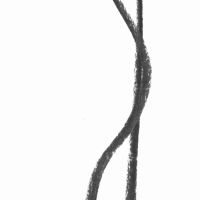
Now comes Wheatley's self-produced album Double Bass, consisting exclusively of solo bass improvisations—surely the ultimate test of any improvising bassist's mettle ever since the first solo bass album, Barre Philips' Journal Violone (Opus One, 1969). Issued on vinyl LP, Wheatley's album consists of four tracks, titled after their locations on the record, a twenty-minute track occupying side A, and three shorter ones, totalling nineteen minutes, on the B side. The disc comes housed in a monochrome sleeve which, along with the record's labels, is illustrated with Wheatley's own appealing "schematic diagrams" showing parts of the bass.
Once the music begins, its most immediately striking features are the richness of the sounds that Wheatley extracts from his instrument and the sheer quality of the recordings of them, thanks to James Johnston who recorded and mixed the album. Throughout, one does not feel like an external spectator, more that one is situated inside the action, enveloped by the instrument and its rich sounds. Employing a combination of conventional and extended techniques, Wheatley forensically explores what his bass is capable of, extracting a broad range of sounds across the spectrum from the lowest, warm, resounding tones right up to far edgier, high frequency bowed sounds.
Wheatley strikes a near-ideal balance between repetition and variety. When he hits upon a particularly pleasing combination of sounds, he happily repeats them without overdoing it. His explorations do not include change for its own sake, so transitions are carefully handled and feel natural. The album clearly demonstrates that Wheatley deserves his burgeoning reputation and is on an upward trajectory.
 FOLLOW John Eyles
and get notified whenever a new article published.
FOLLOW John Eyles
and get notified whenever a new article published.
Writing about music is like doing a dance about architecture...
Track Listing
A1; B1; B2; B3.
Personnel
Tom Wheatley
bassTom Wheatley: double bass.
Album information
Title: Double Bass | Year Released: 2018 | Record Label: Self Produced
About Tom Wheatley
Tags
PREVIOUS / NEXT


Become a Sustaining Member

Since 1995, All About Jazz has championed jazz as an art form and supported the musicians who create it. Over three decades, it has grown into one of the world's leading jazz resources, serving hundreds of thousands of readers, musicians, presenters and industry professionals each month.
Help Build the Future of All About Jazz
Your support helps us continue building All About Jazz for the next generation—expanding our editorial coverage, preserving jazz history, developing new community features and creating better ways to discover the music and the people behind it.
Become a sustaining member for as little as $20 per year and you'll immediately enjoy an ad-free experience along with access to subscriber features and future articles for a full year.
Together, we're not simply sustaining All About Jazz—we're building its future. Thank you for being part of the journey.