Home » Jazz Articles » Album Review » Alicia Hall Moran: Coldblooded
Alicia Hall Moran: Coldblooded
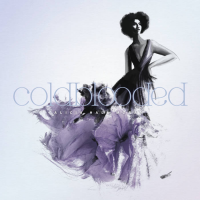
The album announces its climate immediately in "Walking on Thin Ice," a steadfast interpretation of the 1981 anthem by Yoko Ono. On Moran's tongue, it sheds its pop skin and becomes ritual, an act of embodiment and disembodiment at once. The arrangement introduces the album's core band, The Hands Free: James Moore on guitar, Nathan Koci on accordion, Caroline Shaw on violin, and Eleonore Oppenheim on bass and mandolin. Their sound gathers as evening cold, quiet yet pressurized, risk pulsing through. Love becomes a form of skating, each glide shadowed by an intimate knowledge of fracture. When the sound dissolves, it leaves a frost of testimony, clenching around the outline of a face sharp enough to divide the world in two. Whether speaking or singing, Moran is both weather and witness, the needle threading a seam coming undone. That same ring holds "Duluth (Postlude)," where the scrape of skates turns the ice itself into percussion. Each cut is a sentence written in the grammar of balance and collapse. Figure-eights emerge, gestures toward infinity that crumble the instant they are abandoned. Nothing lasts. Not even the symbols we invent to convince ourselves otherwise.
With that awareness, the journey flows inward.
"Wolf (pacing on the lake)" reveals the titular predator circling a place meant for grace, the natural rink transformed into a theater where survival writes its own choreography. Women's voices echo throughout, their lines etched as scars and signatures. "I have skated through some hard times," Moran sings, and the phrase bears the weight of experience that refuses metaphor. Somewhere beyond the treeline, a howl forms, teeth flashing behind the polished masks of civility. LaFrae Sci's glitching electronics cradle that howl, amplifying it into a nervous system trembling with alarm. Moran asks, "Don't we see the wolf?" Perhaps the beast stalks the opposite shore. Perhaps it waits behind the mirror. Perhaps it hides within systems that claim neutrality while sharpening their claws. In an era where headlines carry the density of gunmetal and grief, predators rarely need fur anyway. The counterweight arrives with the spiritual "Oh, Glory!" where Aaron Diehl's piano stands beside Moran's voice, a single candle in a corridor of night. The performance strips the wolf of power and returns it to bone. Supplication replaces confrontation, yet this is not surrender. Beneath the prayer lies an architecture designed to smuggle hope through hostile terrain. Every syllable unfurls a map toward dignity, written in the language of a faith that has endured centuries of brutality yet still lifts its face toward heaven.
Another layer falls away.
"Civil Twilight" fractures both language and space. Words arrive as shards of glass catching the last available light. Moran's piano casts arpeggiated nets with which she collects fragments of starlight and glues them with saliva into song. Therein lives a choice: remain within the wreckage, or step toward morning. Across the water stands "The Three Kings," a personal hymn in which the past speaks with prophetic urgency even while refusing the comfort of recognition. Its only task is to remind us that destruction is often nothing more than a breath waiting to be exhaled.
She is on the move.
Joni Mitchell's "River" appears as a confession whispered over still water. Moore's acoustic guitar serves as a delicate scaffold for the arrangement. The longing for escape here is palpable, the wish to fly away from woundedness. Yet within that longing lives tenderness, a small shelter where exhaustion curls itself into rest. "Inside of a Rose" answers that grief with the patience of growth. Moran opens the flower slowly, turning the pages of maturity with persistence, even when the ice feels uncertain. She asks, "Do you balance or do you let go in the world?" The question leaves the chest as a startled bird.
She enters the next circle.
"Everybody Wants to be Carmen" burns with sharper fire, exposing the fantasy of rebellious romance that our culture sells while condemning those who believe in it. Independence dazzles the imagination; society responds by whetting its knives. Moran navigates the paradox with surgical clarity. Passion invites punishment. Silence invites erasure. The cycle turns endlessly, a wheel lubricated by every click of disapproval. Beneath that tension rests "2 B Cold," a capsule of emotion sealed inside the machinery of daily life. Assurance and doubt tumble together in its washing drum until the difference becomes philosophical rather than vibrational: temperature as a matter of perception. Some climates freeze the spirit. Others teach it to smolder.
All she can do is leap again.
"Iced Cotton" arrives in variations on the act of pivoting, suggesting a hidden physics that honors the rare tenderness of love without bruises. Trust falls as snow over a battlefield while the blood is still wet. Its partner, Jethro Tull's "Skating Away on the Thin Ice of a New Day," expands that image outward. Jacquelene Acevedo's percussion moves through operatic imaginations while Moran strikes flint against stone. The new day promises no safety, only possibilities in the simple act of gliding forward.
With that playfulness echoing still, she descends further.
"Oil and Salt," James Moore's setting of Chris Garrecht-Williams' poem, gathers fragments of street life. Snatches of conversation drift as wind through alleyways. Life assembles itself from these small particles: a voice, a footstep, a passing remark. The ordinary becomes luminous when attention lingers long enough. "Trax" reaches from the fog with a cold hand, its nails glittering as fragile crystals that fear warmth. Invitation and warning share the same gesture. The sky promises freedom even as it becomes a ceiling beneath which identities are measured and persecuted. Flight never remains innocent in a world that decides who may rise and who must fall.
She transfigures.
"Moonfunk" bends Robert Schumann through a prism of groove and reparation, unfolding as the closing montage of a romance projected onto the inside of an eyelid. Highs flicker beside lows. Desire dissolves into regret. Yet hope glows somewhere in the sequence, a small orange ember refusing extinction. "Cruise Control" serves as an instrumental suspension on the flipside, with Kaoru Watanabe's Japanese flute conveying the melody while Moran steps out of frame.
Airborne, she floats across the next threshold.
"Destiny" contemplates the art of landing. Sleek beats move through liquid time as walls built from abuse begin to splinter. Escape alone is not enough. One must also arrive somewhere intact. "On the Motion of Animals," Moore's setting of Camille Rankine, explores the intimacy of bodies in motion. To touch another person becomes a way of rediscovering oneself. As the guitar drifts between sleep and waking, love is shown to operate as a web of invisible strings, pulling gestures into patterns that feel chosen yet inevitable.
At last, the center appears: "Blizzard."
The track opens a corridor through forests long erased by industrial appetite. Electronics shimmer as snow blown sideways through recall. Snowblind erases the horizon, clearing the ground for new paths.
The cumulative force of Coldblooded resists singular interpretation. The album feels born of a particular mind in a particular body, standing in a particular moment of American history, an era vibrating with grief, protest, and an unfinished reckoning. Yet its voice stretches across centuries. Ice remembers, and by now, the heart thrown into the water at the beginning has melted it.
And so, the deeper question is not whether we can survive the cold. Humanity has done that for millennia. The question is what we carve into the tundra of life while we are here. Every blade leaves a mark. Some wound. Others trace a line toward flight. Either way, the surface waits patiently for the weight we bring to it.
 FOLLOW Tyran Grillo
and get notified whenever a new article published.
FOLLOW Tyran Grillo
and get notified whenever a new article published.
Music writer, singer, translator, scholar.
Track Listing
Walking on Thin Ice; Wolf (pacing on the lake); Civil Twilight; River; Everybody Wants to be Carmen; Iced Cotton; Oil and Salt; Moonfunk; Destiny; Blizzard; On the Motion of Animals; Cruise Control; Trax; Skating Away on the Thin Ice of a New Day; 2 B Cold; Inside of a Rose; The Three Kings; Oh, Glory!; Duluth (Postlude).
Personnel

Alicia Hall Moran
vocals
LaFrae
electronics
Tony Scherr
bassCaroline Shaw
violin
Nathan Koci
accordion
Eleonore Oppenheim
bass
Aaron Diehl
piano
Brandon Ross
guitar
Jacquelene Acevedo
percussion
Kaoru Watanabe
fluteAdditional Instrumentation
Tony Scherr: guitar; James Moore: guitar; Eleonore Oppenheim: mandolin; Kaoru Watanabe: taiko.
Album information
Title: Coldblooded | Year Released: 2026 | Record Label: Self Produced
About Alicia Hall Moran
Tags
PREVIOUS / NEXT

Become a Sustaining Member

Since 1995, All About Jazz has championed jazz as an art form and supported the musicians who create it. Over three decades, it has grown into one of the world's leading jazz resources, serving hundreds of thousands of readers, musicians, presenters and industry professionals each month.
Help Build the Future of All About Jazz
Your support helps us continue building All About Jazz for the next generation—expanding our editorial coverage, preserving jazz history, developing new community features and creating better ways to discover the music and the people behind it.
Become a sustaining member for as little as $20 per year and you'll immediately enjoy an ad-free experience along with access to subscriber features and future articles for a full year.
Together, we're not simply sustaining All About Jazz—we're building its future. Thank you for being part of the journey.