Home » Jazz Articles » Album Review » Richard Baratta: Another Kind of Bird
Richard Baratta: Another Kind of Bird
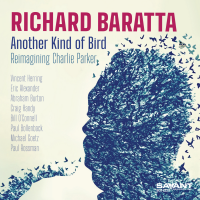
And so when drummer Richard Baratta said he planned to "reimagine" the music of Parker, that was no walk in the park, as many of Parker's compositions have been indelibly ingrained in the minds and memories of jazz lovers for decades. To help carry out his ambitious plan, Baratta enlisted the services of pianist and arranger Bill O'Connell, who was born less than two years after Parker died but has studied his music for years, as have many other aspiring young musicians. O'Connell was given the daunting task of "reimagining" such Parker classics as "Donna Lee," "Anthropology," "Yardbird Suite," "Au Privave" and five others, reshaping their tone and texture while keeping Bird's insuperable spirit alive.
An enormously arduous task indeed, rendered even more so by the need to keep Parker's familiar melodies largely intact. Faced with the challenge, O'Connell soon realized that rhythm and emphasis held the keys. Unable to alter the melodies, he set them to different beats while emphasizing or de-emphasizing various melodic and harmonic facets. The result is music that sounds much like Parker's but not quite, which is beyond any doubt exactly what Baratta had in mind. He then sought further help from a trio of jazz luminaries: saxophonists Craig Handy, Abraham Burton and Eric Alexander, seasoned pros whose immense talents would enhance any session.
Baratta's guests perform, singly or in tandem, on the album's first four numbers. After that, he leads a sextet whose other members are O'Connell, alto saxophonist Vincent Herring, guitarist Paul Bollenback, bassist Michael Goetz and percussionist Paul Rossman. Everyone is on board for the chops- testing opener, "Donna Lee," whose melody and rhythm are basically unchanged from Parker's original version. What is new are the riveting post-bop solos by Alexander and one (or more) of the altos. The normally fleet-footed "Anthropology" rests in a congenial Latin groove, as does "Little Suede Shoes," the latter uplifted by Handy's exemplary flute work, O'Connell's elegant solo and typically astute timekeeping by Baratta.
O'Connell moves to electric piano while Baratta's guests make their last appearance on Parker's "Ah-Leu-Cha," set in quasi-waltz time and leading to the album's lone non-Parker number, the Gershwin brothers' endearing ballad, "Embraceable You," on which Herring is given a chance to shine and lights up the room. The groove is down and funky on "Now's the Time" (featuring more splendid drum work by Baratta to buttress sharp solos by Herring and O'Connell), while delightful changes in mood and tempo swing "Moose the Mooche" into another of the session's several highlights, leading to the memorable "Yardbird Suite," quickened by Herring's superb (but in no way imitative) work on alto. The flashy yet lesser- known "Segment" is given a fleet and festive ride, after which the ensemble closes the adventurous enterprise with a charming mid-tempo version of the usually fast-paced "Au Privave."
On the one hand, Charlie Parker's remarkable music remains inviolable; on the other, however, Baratta and his teammates have "reimagined" it with tastefulnes and perception while revealing Another Kind of Bird, and they deserve high marks not only for undertaking such a formidable challenge but for carrying it out so smoothly and effectively.
 FOLLOW Jack Bowers
and get notified whenever a new article published.
FOLLOW Jack Bowers
and get notified whenever a new article published.
A former newspaper writer / editor who has been writing about jazz for more than forty years.
Track Listing
Donna Lee; Anthropology; Little Suede Shoes; Ah-Leu-Cha; Embraceable You; Now’s the Time; Moose the Mooche; Yardbird Suite; Segment; Au Privave.
Personnel

Richard Baratta
drums
Craig Handy
saxophone
Abraham Burton
saxophone, alto
Eric Alexander
saxophone, tenor
Bill O'Connell
piano
Paul Bollenback
guitarMichael Goetz
bass, acoustic
Paul Rossman
percussionAlbum information
Title: Another Kind of Bird | Year Released: 2026 | Record Label: Savant Records
About Richard Baratta
Tags
PREVIOUS / NEXT


Become a Sustaining Member

Since 1995, All About Jazz has championed jazz as an art form and supported the musicians who create it. Over three decades, it has grown into one of the world's leading jazz resources, serving hundreds of thousands of readers, musicians, presenters and industry professionals each month.
Help Build the Future of All About Jazz
Your support helps us continue building All About Jazz for the next generation—expanding our editorial coverage, preserving jazz history, developing new community features and creating better ways to discover the music and the people behind it.
Become a sustaining member for as little as $20 per year and you'll immediately enjoy an ad-free experience along with access to subscriber features and future articles for a full year.
Together, we're not simply sustaining All About Jazz—we're building its future. Thank you for being part of the journey.