Home » Jazz Musicians » Alexander Wittges Discography
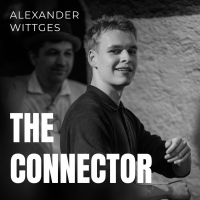
The Connector
Alexander Wittges
Label: Self Produced
Released: 2026
Duration: 42:03
Views: 31
Tracks
Devious Introduction; Can’t catch me; Dancing Clowns; The Smiling Salamander; Awakening; 深みから - From The Dephts; Lion’s Leap; Jumping Jacks; The Final Act
Personnel
Album Description
Jazz as Conversation
The Connector is built on the idea of jazz as a conversation among equals. For pianist and composer Alexander Wittges, music grows through exchange: with bandmates, mentors, audiences, and through the many encounters that have shaped his journey, from jam sessions in Munich, Augsburg, Regensburg, Burghausen, and Amsterdam to performances on his mobile street piano.
Recorded with bassist Rafael de Sousa and drummer Stefan Noelle at Johannes Then’s studio in Freising, The Connector presents nine original compositions by Alexander Wittges, shaped by a year of experiences, friendships, travels, and moments on the bandstand.
The language of that conversation is swing, the heartbeat of jazz and the core of his musical voice. The album moves freely between swing, Latin grooves and modern feels, yet never loosens its bond with the tradition. Within that frame, the three musicians take real risks, pushing and pulling in quick, often surprising exchanges. A shared sense of what each tune is about keeps them together and gives every soloist room to explore, secure in the knowledge that the others will be there. Built on trust and mutual support, the trio blends old and new into something personal. The result lives up to its name: warm, balanced and full of joy, music that connects the players with each other and the listener.
Nine Conversations – Track Notes
1 · Devious Introduction (4:46)
The opener plays its cards close to the vest. It starts out restrained, almost too polite for a debut, but an early twist quietly shifts expectations. Piano, bass, and drums step forward one at a time, not in a dutiful round of introductions but as a statement of intent: each player shows how they handle time, how much space they claim, and when they give it back. In doing so, the tune lays down the ground rules for the conversation that runs through the next eight tunes.
2 · Can’t Catch Me (3:24)
After the cautious feeling-out, the energy breaks loose. Rooted firmly in the swing tradition, this up-tempo burner is a sprint fueled by pure exuberance. The trio moves as one: every idea gets an instant answer, with no time to overthink, only time to react. The music surges ahead without ever stumbling, and here you first hear what swing means on this record: a pulse that sweeps you along. Play with this much instinct, and nobody is going to catch you.
3 · Dancing Clowns (3:35)
The third track circles back to the start of every musical encounter, the moment when strangers meet and worlds collide. It is a moment familiar from countless nights at the A’Jazz Jam and from afternoons at the mobile piano on the streets of Freising. Taken at a brisk clip, the tune feels like a first dance with someone new, when you don’t yet know how your partner moves – circling each other like clowns in the ring, half clumsy, half curious. Each player offers short statements, small musical confessions. The longer the dance goes on, the clearer the shared language becomes: unfamiliarity turns to curiosity, curiosity to connection, and by the end, everyone is dancing together.
4 · The Smiling Salamander (4:22)
With a common language established, the trio slides into a Latin groove that wins you over with precision rather than volume. The rhythmic axis between bassist Rafael de Sousa and drummer Stefan Noelle locks in so tightly that the piano can float effortlessly on top. The tune glides along without pushing and stays relaxed even at a quick tempo. Its good mood is no gimmick; it comes from three musicians standing on exactly the same rhythmic ground.
5 · Awakening (4:14)
At the heart of the album, the music opens up. After a run of dense, fast-moving tunes, this ballad lets the tempo fall away and leaves room for melody, tone color, and reflection. Echoes of everything that has shaped the record so far drift through: influences from different cultures, styles, and personalities. Slowly, a realization takes hold that music doesn’t just communicate – it connects. This awakening is no dramatic revelation but a quiet understanding, and it sits at the very core of what The Connector is about.
6 · 深みから – From the Depths (6:02)
Out of the stillness of Awakening rises a tune with a long arc. The bilingual title, with 深みから meaning “from the depths,” is a bow to Japanese jazz and to the gentle, deeply attentive interplay of many Japanese piano trios. It is also a first, careful step toward a scene the composer hopes to play in one day. The tension builds patiently and holds for long stretches instead of releasing too soon. The material is sparse but handled with total focus, carried by a swing pulse that rises from the depths. A build like this works only when all three players share the same destination and no one rushes ahead, very much in the collaborative spirit the title evokes. At its peak, the trio plays right at the edge of control. You can hear the risk, and it pays off.
7 · Lion’s Leap (5:50)
After the depths comes the leap. Lion’s Leap grew out of the experience of walking into a new scene in an unfamiliar city: a jam session, a room full of players you have never met. The tune captures that moment, from the tentative first steps to the opening phrase that tells everyone who you are, to the point where you decide to take the risk. Musically, that means up-tempo swing, exposed entrances, a very small safety net, and the trust that your bandmates will pick up the idea. Anyone who has ever walked onto a bandstand without a shared language will recognize the feeling.
8 · Jumping Jacks (3:20)
Having looked outward, the album turns back to its roots. Jumping Jacks is a tip of the hat to the jazz tradition: a stride-piano intro lays out the historical foundation with clarity and respect, and the swing that follows has a lightness that runs deep. This is where the album’s guiding motto, “Old soul, new sound,” comes through loud and clear. Every exchange is a dialogue with the past, free of nostalgia. The tune breathes history and the present at once, a fresh statement about where the musical conversation comes from.
9 · The Final Act (6:30)
The album’s second ballad brings the story full circle. Calm and focused, it plays like a look back at the work the three musicians have done together, each having absorbed something from the others. You can hear how much the interplay has grown since the cautious sizing-up of Devious Introduction: clearer, more trusting, more purposeful. This isn’t a farewell but the moment you realize you have grown through one another. The conversation doesn’t end with the final note; it carries on to the next session and the next album.
About the Musicians
Alexander Wittges, piano
Pianist and composer Alexander Wittges was born in Munich in 2007 and lives in Freising. True to his motto, “Old soul, new sound,” he pairs lyrical clarity with a modern feel for swing. He hosts the A’Jazz Jam in Freising, has received several scholarships from IG Jazz Burghausen, and in 2025 won second prize in the solo jazz piano category at Jugend jazzt Bayern, Bavaria’s state youth jazz competition. On The Connector, his debut, he brings together two seasoned players from very different worlds.
Rafael de Sousa, bass
Brazilian bassist Rafael de Sousa grew up in church music and found the electric bass at the age of ten. Trained at the Escola de Música de Brasília, he has worked professionally since 2013 across jazz, MPB, pop and gospel, with artists such as Branford Marsalis, Seu Jorge, Margareth Menezes and Salomão Soares. His 2019 debut, Embryo, is a six-part tribute to the ballad; his latest release is Quartet. He brings the trio deep Brazilian roots, jazz fluency and a groove all his own.
Stefan Noelle, drums
For decades, Stefan Noelle has been one of the most versatile drummers and percussionists in Munich. His résumé includes work with numerous musicians like saxophonists Mulo Francel and Tom Reinbrecht, genre-bending projects such as the Unterbiberger Hofmusik or genuine Oriental music with the Ogaro Ensemble. Since 2013 he has hosted Be My Guest, a neighborhood jazz series that has built a loyal following in Munich. As a composer and arranger he has contributed to many film and theater productions, including the 2011 award-winning Almanya. His score for Aus der Tiefe des Raumes earned him a nomination for the German Film Award in 2005, and in 2023 the City of Munich gave him its Musikförderpreis. Noelle plays with deep swing, a light touch and palpable joy, and he gives the trio both a solid foundation and constant forward drive.
Credits
All compositions and arrangements by Alexander Wittges
Recording & Mastering: Johannes Then
Photography: Holger Wittges
Cover Picture: Wolfgang Hirschpoltner
alexander.wittges.de/en
© Alexander Wittges 2026. All Rights Reserved.
Album uploaded by Alexander Wittges
About Alexander Wittges
Tags
More Albums
Recordings: As Leader | As Sideperson