
Home » Jazz Articles » Album Review » Rodrigo Amado / Joe McPhee / Kent Kessler / Chris Corsano: Wailers
Rodrigo Amado / Joe McPhee / Kent Kessler / Chris Corsano: Wailers
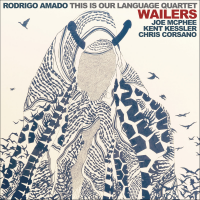
Wailers captures Portuguese saxophonist Rodrigo Amado's This Is Our Language quartet at a fascinating juncture, revealing fresh dimensions within one of his most compelling working bands. An unchanged lineup features reedman Joe McPhee (restricting himself solely to tenor), bassist Kent Kessler and drummer Chris Corsano alongside the leader's tenor saxophone. Recorded in a Lisbon studio in 2019, the album now arrives with the feel of an archival issue. But it constitutes the first since Let The Three Be Men (Trost, 2021), recorded two years earlier. Its delayed appearance trails a succession of notable Amado releases, including La Grande Crue (NoBusiness, 2024) and Further Beyond (Trost, 2025).
Only two of the six cuts break the ten-minute barrier, but the group maintains its characteristic freewheeling intensity and spontaneous evolution of both focus and mood, regardless of duration. All four principals share an uncommon gift for seamless and unerring on-the-fly orchestration that distinguishes only the most seasoned improvisers.
"Subterranean Night Color" offers a case in point. It begins with McPhee and Corsano, an established pairing in their own right, in roiling duet, until Amado takes over with Kessler's sawing joining the drummer to fuel a correspondingly explosive energy level. A transition to a detailed Corsano solo brimming with rolls and flourishes ensues. As he recedes, both tenors and Kessler's arco bass simultaneously assume the momentum and carry the piece to its close, which evokes an American spiritual. "Hot Folk" too pivots repeatedly in an even shorter span, the result of an uncanny responsiveness which unfolds without even a hint of rote turn-taking.
More typical of the outfit's approach, the blistering opening title track plunges in with everyone already at full gas: Amado and McPhee sparring, intertwining and squalling over a churning rhythm. But even here, Amado displays his grasp for form, transmuting a reiterated motif into the basis for further exploration, plotting a purposeful route from within the heart of the storm. He deploys a similarly decisive dynamic on the trio "Theory Of Mind II (for Joe)." After a solo intro of chirping bird whistles, his tenor murmurs in conjunction with Kessler's bowing, before launching into a fast scrawl with Corsano in close pursuit. But as if mindful of McPhee's capacity for nuanced and multidimensional expression, they ease into a final statement suitably measured and stately.
Wailers once again confirms Amado's stature as one of Europe's most commanding improvising saxophonists. In equally strong company, he not only thrives but does so in a performance in which every impulse has been weighed, answered and transformed before the next one appears.
Only two of the six cuts break the ten-minute barrier, but the group maintains its characteristic freewheeling intensity and spontaneous evolution of both focus and mood, regardless of duration. All four principals share an uncommon gift for seamless and unerring on-the-fly orchestration that distinguishes only the most seasoned improvisers.
"Subterranean Night Color" offers a case in point. It begins with McPhee and Corsano, an established pairing in their own right, in roiling duet, until Amado takes over with Kessler's sawing joining the drummer to fuel a correspondingly explosive energy level. A transition to a detailed Corsano solo brimming with rolls and flourishes ensues. As he recedes, both tenors and Kessler's arco bass simultaneously assume the momentum and carry the piece to its close, which evokes an American spiritual. "Hot Folk" too pivots repeatedly in an even shorter span, the result of an uncanny responsiveness which unfolds without even a hint of rote turn-taking.
More typical of the outfit's approach, the blistering opening title track plunges in with everyone already at full gas: Amado and McPhee sparring, intertwining and squalling over a churning rhythm. But even here, Amado displays his grasp for form, transmuting a reiterated motif into the basis for further exploration, plotting a purposeful route from within the heart of the storm. He deploys a similarly decisive dynamic on the trio "Theory Of Mind II (for Joe)." After a solo intro of chirping bird whistles, his tenor murmurs in conjunction with Kessler's bowing, before launching into a fast scrawl with Corsano in close pursuit. But as if mindful of McPhee's capacity for nuanced and multidimensional expression, they ease into a final statement suitably measured and stately.
Wailers once again confirms Amado's stature as one of Europe's most commanding improvising saxophonists. In equally strong company, he not only thrives but does so in a performance in which every impulse has been weighed, answered and transformed before the next one appears.
 FOLLOW John Sharpe
and get notified whenever a new article published.
FOLLOW John Sharpe
and get notified whenever a new article published.
John first fell under the spell of free jazz in the 1970s when he wistfully regarded the loft jazz scene from across the Atlantic