Home » Jazz Articles » Album Review » Serge Rogalski: This Is Not a Blues
Serge Rogalski: This Is Not a Blues

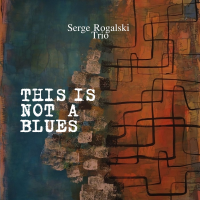
The Serge Rogalski Trio, with Rogalski on guitar, Gael Petrina on double bass, and Sam Ospovat on drums, works in a charged space between modern jazz and free rock. The music is compact, with five main tracks and a download-only bonus track, but it carries the density of a larger statement. Rather than presenting themes and then opening them into solos, the trio builds pieces from friction, recurrence, and rupture. A phrase appears, hardens into a pattern, then begins to fray. A groove nearly stabilizes, then breaks open. A texture becomes the argument.
That method gives the recording its particular force. This is not free improvisation as pure dispersal, nor is it jazz rock built from riffs and volume alone. Rogalski's music depends on the moment when a material begins to resist its own shape. Repetition does not settle the music. It wears it down. Pulse does not simply organize the ensemble. It creates pressure. The players keep returning to figures that seem familiar for only a few seconds before they are bent, interrupted, or swallowed by the surrounding sound.
The opening title track sets the terms immediately. "This Is Not a Blues" is not a rejection of blues feeling so much as a dismantling of blues grammar. Rogalski's guitar keeps close to riff, attack, and abrasion, while Petrina and Ospovat give the piece a rough physical propulsion without settling into a predictable grid. The trio sounds as if it is using the blues not as a form but as a memory of pressure. The result is less a tune than a compact field of force, where structure arrives through collision rather than design.
"El Mapa de las Olas" broadens that pressure into motion. Its Spanish title, "the map of the waves," is apt, since the trio treats pulse as topography rather than meter. The music rises, thins, regroups and surges again, with bass and drums functioning like intersecting currents beneath Rogalski's angular gestures. There is a sense of direction, but not a straight line. The track moves as if it were charting a body of water from inside the water itself, registering pressure, drag, and turbulence rather than drawing a clean outline from above.
"Wind Without Ink" moves inward. Here, the trio exchanges force for suspension, placing small sounds, scraped edges, and resonant gaps at the center of the music. Rogalski resists melodic declaration, Petrina darkens the space from below, and Ospovat colors the silence rather than simply marking time. The piece has a concentrated small ensemble intensity, yet it never feels static. Its tension lies in the way every fragment seems to leave a trace before vanishing. The title suggests a movement that passes without writing itself down, but the performance quietly contradicts that idea. Every scrape, pause, and resonance leaves some kind of mark.
The brief "El Mapa de las Nubes" functions as a companion to "El Mapa de las Olas," but where the earlier piece moves like water, this one hangs in the air. It gathers and disperses quickly, a miniature weather system of attack, resonance, and decay. The track's importance is structural. It prepares the final expansion by making instability feel not like an interruption, but like architecture. In less than three minutes, the trio shows that a short piece can function as a hinge, shifting the album from inward abstraction toward outward ignition.
That ignition arrives with "La Ramiro," the only main track to add Gaël Horellou's alto saxophone. His entrance sharpens the album's language, pushing the trio's already volatile materials toward collective combustion. The saxophone does not simply decorate the ensemble. It pressures it. Guitar and alto rub against each other, while bass and drums keep the music grounded enough for its noise to carry direction. Horellou brings a more explicit free jazz cry into the music, but the track never becomes a conventional guest feature. Instead, the quartet sound expands the record's existing vocabulary of friction, pulse, and abrasion.
"La Ramiro" also clarifies the album's relationship to tradition. The music is experimental, but it is not rootless. Blues, jazz, rock, and textural abstraction appear as traces rather than categories. They enter the music in flashes: a riff that almost settles, a line that nearly sings, a drum accent that briefly suggests a groove, a bass figure that grounds the ensemble before the ground shifts again. These moments are not nostalgic anchors. They are provisional landmarks in a terrain that keeps moving.
This Is Not a Blues is strongest when heard as music made at a threshold. Image and sound, structure and entropy, repetition and accident, body and abstraction all touch without merging. Rogalski's trio does not seek polish, and the EP is better for that refusal. Its roughness is not unfinished business. It is the condition that allows the music to stay alive. The recording understands that form can be temporary, that coherence can be built through rupture, and that a piece of music can be most articulate when it refuses to explain itself too quickly.
The denial in the title, then, becomes a kind of permission. This may not be a blues, but it carries the blues as pressure, residue and bodily memory. It draws from free rock without surrendering to blunt force, and from modern jazz without settling into formal display. Rogalski, Petrina, and Ospovat have made a compact record that feels larger than its duration because it keeps opening thresholds rather than closing arguments. The music does not resolve its contradictions. It makes them audible, physical, and alive.
Track Listing
This Is Not A Blues; El Mapa De Las Olas; Wind Without Ink; El Mapa De Las Nubes; La Ramiro.
Personnel


Additional Instrumentation
Gaël Horellou , alto saxophone
Album information
Title: This Is Not a Blues | Year Released: 2026 | Record Label: Silsey Publishing
About Serge Rogalski
Tags
PREVIOUS / NEXT


Become a Sustaining Member

Since 1995, All About Jazz has championed jazz as an art form and supported the musicians who create it. Over three decades, it has grown into one of the world's leading jazz resources, serving hundreds of thousands of readers, musicians, presenters and industry professionals each month.
Help Build the Future of All About Jazz
Your support helps us continue building All About Jazz for the next generation—expanding our editorial coverage, preserving jazz history, developing new community features and creating better ways to discover the music and the people behind it.
Become a sustaining member for as little as $20 per year and you'll immediately enjoy an ad-free experience along with access to subscriber features and future articles for a full year.
Together, we're not simply sustaining All About Jazz—we're building its future. Thank you for being part of the journey.