Home » Jazz Articles » Album Review » Momo Kodama: Point and Line
Momo Kodama: Point and Line
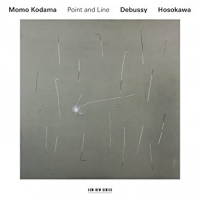
What is evident are the abstract musical worlds reflected in the works of both composers, with Debussy's Études and Hosokawa's Études I-VI. As a whole, the recording is thoughtful throughout, if not always contemplative. These compositions take the listener through a wide range of sounds without losing focus. What strikes first is the clarity of Kodama's playing and as a result, none of the compositions outstay their welcome. Obviously, by mixing the selection of compositions, she has entered into a place where the worlds of both composers collide and mesh. It's a place full of surprises and a quiet drama, full of whispered figures, evaporating echoes, and beautiful cascades of notes. Each of these compositions has their own motivations, different forms, and frames, where each composition and performance arrive at different destinations.
The pieces evolve slowly where they seem to be verging on the edges of subtleties of texture, echo, and harmonics. Great attention is given to details and nuances which in turn makes this recording a detailed and private exploration of the sonics of the piano. Every detail about this music indicates that Kodama is an exceptionally thoughtful interpreter, with musicianship that more than matches her technical gifts.
 FOLLOW Nenad Georgievski
and get notified whenever a new article published.
FOLLOW Nenad Georgievski
and get notified whenever a new article published.
For as long I can remember music has been a focal point in my life.
Track Listing
Pour les Arpèges composés; Point and Line; Pour les Quartes; Calligraphy, Haiku, 1 Line; Pour les Sixtes; 2 Lines; Pour les Sonorités opposées; Pour les Tierces; Pour les huit doigts; Lied, Melody; Pour les ‘cinq doigts’ d’après Monsieur Czerny; Pour les Accords; Pour les Agréments; Ayatori, Magic by 2 hands, 3 Lines; Pour les Degrés chromatiques; Anger (Toshio Hosokawa); Pour les Notes répétées; Pour les Octaves;
Personnel
Momo Kodama: piano
Album information
Title: Point and Line | Year Released: 2017 | Record Label: ECM Records
About Momo Kodama
Tags
PREVIOUS / NEXT


Become a Sustaining Member

Since 1995, All About Jazz has championed jazz as an art form and supported the musicians who create it. Over three decades, it has grown into one of the world's leading jazz resources, serving hundreds of thousands of readers, musicians, presenters and industry professionals each month.
Help Build the Future of All About Jazz
Your support helps us continue building All About Jazz for the next generation—expanding our editorial coverage, preserving jazz history, developing new community features and creating better ways to discover the music and the people behind it.
Become a sustaining member for as little as $20 per year and you'll immediately enjoy an ad-free experience along with access to subscriber features and future articles for a full year.
Together, we're not simply sustaining All About Jazz—we're building its future. Thank you for being part of the journey.