Home » Jazz Articles » Album Review » Eleni Karaindrou: The Weeping Meadow
Eleni Karaindrou: The Weeping Meadow

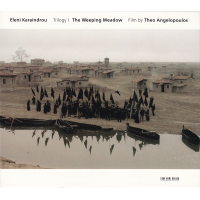
While some film music can be called incidental, it would be impossible to define Karaindrou's music as such. And as some composers rely on stock melodramatic devices to enhance or even manipulate the emotive power of a film, Karaindrou uses nothing so obvious. Instead, she searches for themes—sometimes but a single theme—that can be expanded, contracted, broken into components and scored with a variety of instruments, to work together with a film, creating something greater than either sight or sound. It is true that Karaindrou's scores are best experienced when integrated with Angelopoulos' images, but they also stand alone as complete pieces of music with their own sensibilities and evocative arcs.
The Weeping Meadow, Karaindrou's latest score, is a hauntingly beautiful piece of music that hovers in the air, only occasionally touching down into something more specific. Based on the image of a landscape in the midst, the music has a serenity, occasionally interjected with melancholy, linking to the film's characters who struggle to find the meaning of freedom for themselves. While the ethnic instruments and music of her native country are an integral part of Karaindrou's musical language, so too are elements including the backgrounds of her chosen ensemble, musicians from far and wide who seem to connect to the theme of exile integral to the film.
The string orchestra creates a gentle sense of floating, over which instruments including violoncello, accordion, French horn, violin, and Constantinople lyra develop Karaindrou's gentle theme. Delicately, with no sense of dramatic urgency, Karaindrou once again relies on a theme that is interpreted, reinterpreted, stretched and reduced to smaller components. That Karaindrou chooses to work with a single melodic idea, providing an aural link that ties together the entire narrative, is in contrast to more conventional film scoring, where each character or idea has its own motif. It's a simpler philosophy, but one resulting in an integrated musical landscape that mirrors the various times, places and circumstances through which the film's characters must travel.
Filled with a paradoxically elegant plaintiveness, The Weeping Meadow is a compelling work which places pure and untarnished emotion over the more boldly melodramatic, making it all the more convincing.
Track Listing
The Weeping Meadow; Theme of the Uprooting I; Waiting I; Memories; The Tree; Young Man's Theme I; The Weeping Meadow I; Theme of the Uprooting II; Waiting II; Theme of the Uprooting; Prayer; The Tree; On the Road; Young Man's Theme; Theme of the Uprooting III; The Weeping Meadow II
Personnel
Eleni Karaindrou (piano, composer), Maria Bildea (harp), Renato Ripo (violoncello), Konstantinos
Raptis (accordion), Socratis Sinopoulos (Constantinople lyra), Vangelis Skouras (French horn),
Sergiu Nastasa (violin), Angelos Repapis (double-bass)
Hellenic Vocal Ensemble, Antonis
Kontogeorgiou directing
La Camerata, Athens (string orchestra)
Album information
Title: The Weeping Meadow | Year Released: 2005 | Record Label: ECM Records
About Eleni Karaindrou
Tags
PREVIOUS / NEXT


Become a Sustaining Member

Since 1995, All About Jazz has championed jazz as an art form and supported the musicians who create it. Over three decades, it has grown into one of the world's leading jazz resources, serving hundreds of thousands of readers, musicians, presenters and industry professionals each month.
Help Build the Future of All About Jazz
Your support helps us continue building All About Jazz for the next generation—expanding our editorial coverage, preserving jazz history, developing new community features and creating better ways to discover the music and the people behind it.
Become a sustaining member for as little as $20 per year and you'll immediately enjoy an ad-free experience along with access to subscriber features and future articles for a full year.
Together, we're not simply sustaining All About Jazz—we're building its future. Thank you for being part of the journey.