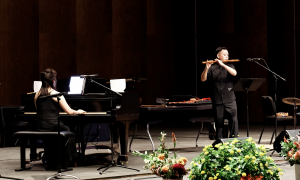
Frances Blaisdell, Girl Flutist Who Opened Doors, Dies at 97

In addition to playing with the Philharmonic, Ms. Blaisdell performed with prominent chamber ensembles, on Broadway, at Radio City Music Hall, in vaudeville, and with Phil Spitalny and His All-Girl Orchestra on the Hour of Charm on CBS and NBC radio. She also taught generations of leading flutists.
I had lots of opportunities because I was sort of a freak, and people couldnt imagine a girl flutist, she said in an interview printed in The Flutist Quarterly in 2005.
Chamber Music magazine suggested in 1992 that she was considerably more than that, saying, Every woman flute player in every major American orchestra, every little girl who pays the flute in a school band, has Frances Blaisdell to thank. She was first.
Ms. Blaisdell had to overcome the mixed feelings of her father to become a professional; proud of her talent, he feared that as a woman, she would not survive as a player. He was in the lumber business, but his own love was the flute, and he started teaching her to play when she was 5. He wished she were a boy and called her Jim, she said in The Flutist Quarterly interview, which first appeared in the New York Flute Club newsletter. Ms. Blaisdell wrote to Ernest Wagner, a flutist with the New York Philharmonic, to ask if he would teach Jim.
When she appeared for her lesson, she said, Mr. Wagner refused to teach her, saying there was no future for a woman trying to play the flute in orchestras. But he finally agreed to six lessons, and then more.
Ms. Blaisdells father wanted her to pursue a career, but saw no future for her in music. He gave her the choice of being a teacher, nurse or secretary. She persuaded him that since she was graduating at 16, two years early, she should spend the two years pursuing her dream.
Two years, but not another day, he said.
So in 1928 she wrote Georges Barrre, the great French flutist, who taught at what is now Juilliard. She was given an appointment, perhaps because her name had been taken down as Francis. She was admitted with a scholarship.
Ms. Blaisdell later studied with two other giants of the flute, Marcel Moyse and William Kincaid. In 1941, after Barrre had a stroke, she took his place in the Barrre Trio.
In 1930, she became first flute of the National Orchestral Association and soon joined Barrre to play Bachs Brandenburg Concerto No. 4 under the baton of Walter Damrosch at Madison Square Garden. She was first flute in the New Opera Company and in the New Friends of Music.
On Nov. 26, 1932, she was the soloist with the Philharmonic at a childrens concert, playing Mozarts Flute Concerto No. 2 in D major. Josh Marcum, a spokesman for the Philharmonic, confirmed the appearance.
But in 1937, she was refused an audition for an opening as assistant first flute of the Philharmonic because she was a woman. In 1962, she said, she became one of the first women to play a woodwind with the Philharmonic, when a piece demanded extra flutes. Mr. Marcum said this was possible, but not provable.