Dizzy's Club Coca-Cola Releases October 2005 Schedule

New York, NY (August 23, 2005) - Jazz at Lincoln Center proudly announces the October 2005 lineup of performances at Dizzy's Club Coca-Cola, launching a Fall season full of must-see players. Trombonist Delfeayo Marsalis kicks the month off with his quintet featuring Donald “The Duck" Harrison and brother Jason Marsalis. Up next, the soulful, sweet and serious sounds of pianist Cyrus Chestnut, joined by the ace rhythm section of George Mraz and Lewis Nash. They are followed by one of the most significant players in jazz today, and for the past several decades, pianist George Cables, leading a quartet featuring Gary Bartz on alto saxophone, Eric Revis on bass and Jeff “Tain" Watts on drums. Closing out October is the mighty Randy Weston. After five decades of musical prowess and inventiveness, Weston remains one of the most innovative and visionary pianists and composers on the scene today.
Dizzy's Club Coca-Cola offers spectacular views and serves a jazz inspired menu seven days a week through the collaboration between Great Performances and Spoonbread culinary creators. Reservations can be made at 212-258-9595 or via the Jazz at Lincoln Center web site http://www.jalc.org.
Dizzy's Club Coca-Cola Schedule October 2005
UPSTARTS! Mondays at Dizzy's Club Coca-Cola
Every Monday night, Dizzy's Club Coca-Cola, 7:30 & 9:30pm
Every Monday, Dizzy's Club Coca-Cola will host a program entitled UPSTARTS! providing performance opportunities for students from area high schools and colleges, including Juilliard Jazz. $15 cover charge plus $10 minimum at tables/ $5 minimum at bar
October 4 - 9: 7:30 & 9:30pm Tuesday - Sunday, 11:30pm show Friday and Saturday
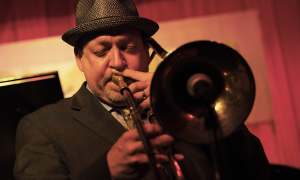
Delfeayo Marsalis Quintet featuring Delfeayo Marsalis (trombone), Donald Harrison (alto saxophone), Mulgrew Miller (piano), Jason Marsalis (drums)
Placing him with the masters of the trombone, many music reviewers have also labeled Delfeayo Marsalis as one of the freshest modern voices to arrive on the scene. At Dizzy's Club Coca-Cola Delfeayo will present the Minion's Dominion show featuring veteran pianist Mulgrew Miller, saxophonist Donald Harrison and Jason Marsalis on drums. This appearance is in support of Marsalis' upcoming CD, Minion's, recorded in 2003 with the legendary late drummer Elvin Jones and older sibling Branford, bassist Robert Hurst, in addition to Miller and Harrison. Particularly significant is that the recording represents one of Jones' final recording sessions, the master musician most well known for his affiliation in the John Coltrane Quartet. Minion's, Marsalis' first recording in 5 years, marks a new direction in both composition and solo development for the trombonist. An accomplished musician touted as “the most original voice on the instrument of his generation," by critic Philip Elwood, Marsalis has a playing style evocative of the great modern trombonist J.J. Johnson, performing with a passion and enthusiasm found in the best of American music.
October 11 - 16: 7:30 & 9:30pm Tuesday - Sunday, 11:30pm show Friday and Saturday
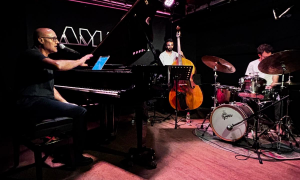
Manhattan Trinity: Cyrus Chestnut (piano), Lewis Nash (drums), George Mraz (bass)
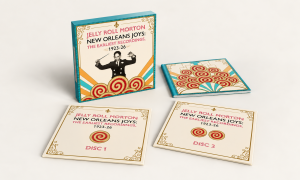
This week the soulful, sweet and serious pianist Cyrus Chestnut, along with George Mraz on bass and Lewis Nash on drums, presents Manhattan Trinity. Chestnut began his professional life working with such celebrated modern artists as Wynton Marsalis and his Jelly Roll Morton influences can still be heard. But, Cyrus has learned from great jazz musicians of many eras and this shines through in his music. Born in Baltimore, Maryland on January 17, 1963, Chestnut first received musical training at age 5 from his father. His first public performance was two years later at the Mt. Calvary Star Baptist Church in Baltimore. He received further musical training at the Peabody Institute where he obtained a certificate in Piano and Music theory. Between 1981 and 1985, Chestnut attended the Berklee College of Music where he graduated with a degree in Jazz Composition and Arranging. While there, he received the Eubie Blake Fellowship in 1982, the Oscar Peterson Scholarship in 1983, and the Quincy Jones Scholarship in 1984. Cyrus began his professional career working with Jon Hendricks (1986 - 88), Terence Blanchard and Donald Harrison (1988 - 90), and Wynton Marsalis (1991). In September of 1991 he began a two-year tenure with jazz legend Betty Carter. Then, Chestnut actively launched his career as a leader with the album titled Revelation which was released by Atlantic Jazz in 1994.
October 11 - 16 AFTER HOURS 11:30pm Tuesday - Thursday, 12:30am Friday - Saturday
Giacomo Gates (vocals) with Larry Ham (piano)
October 18 - 23 7:30 & 9:30pm Tuesday - Sunday, 11:30pm show Friday and Saturday
George Cables Project: George Cables (piano), Gary Bartz (alto saxophone), Eric Revis (bass), Jeff “Tain" Watts (drums)
George Cables, a native New Yorker, was classically trained as a youth and when he started at the High School for Performing Arts, he admittedly “didn't know anything about jazz," but was soon smitten with the potential for freedom of expression he heard. Cables attended Mannes College of Music for two years and by 1964 he was playing in a band called The Jazz Samaritans, which included such rising stars as Billy Cobham, Lenny White, and Clint Houston. Gigs around New York at the Top of the Gate, Slugs, and other clubs attracted attention to Cables' versatility and before long he had recorded with tenor saxophonist Paul Jeffrey, played on Max Roach's Lift Every Voice and Sing, and earned a brief 1969 tenure at the piano bench with Art Blakey and the Jazz Messengers. A 1969 tour with tenor titan Sonny Rollins took Cables to the west coast.
By 1971 he became a significant figure in the jazz scenes of Los Angeles and San Francisco. Collaborations and recordings with tenor saxophonists Joe Henderson and Sonny Rollins, trumpeters Freddie Hubbard and Woody Shaw, and vibist Bobby Hutcberson made Cables' wide-ranging keyboard skills, often on electric piano, amply evident. Demand for his sensitive accompaniment increased and by the end of the 1970s, Cables was garnering a reputation as everyone's favorite sideman. Perhaps the most pivotal turn came when hard-bop legend Dexter Gordon invited Cables into his quartet in 1977. The two years he spent with the tenor giant ignited Cables's passion for the acoustic piano and the bebop vocabulary. “I don't feel that one should be stuck in the mud playing the same old stuff all the time, trying to prove that this music is valid," Cables says. “We don't need to prove anything. But I think you really have to be responsive to your heritage and then go on and find your own voice."
The longest standing relationship Cables developed in the late seventies was with alto saxophonist Art Pepper. Cables, who Pepper called “Mr. Beautiful," became Art's favorite pianist, appearing on many quartet dates for Contemporary and Galaxy, and joining Art for the extraordinary duet album, Goin' Home, that would be Pepper's final recording session.
Cables has performed and recorded with some of the greatest jazz musicians of our time, including Joe Henderson, Roy Haynes, Max Roach, Art Blakey, Sonny Rollins, Freddie Hubbard, Woody Shaw, Sarah Vaughn, Tony Williams, Bobby Hutcherson and Dizzy Gillespie.
October 25 - 30 7:30 & 9:30pm Tuesday - Sunday, 11:30pm show Friday and Saturday
Randy Weston and his African Spirits
After contributing five decades of musical direction and genius, Randy Weston remains one of the world's foremost pianists and composers today, a true innovator and visionary. The culmination of Weston's rich musical offerings has resulted in numerous awards: Encompassing the vast rhythmic heritage of Africa, his global creations musically continue to inform and inspire. “Weston has the biggest sound of any jazz pianist since Ellington and Monk, as well as the richest most inventive beat," states jazz critic Stanley Crouch, “but his art is more than projection and time; it's the result of a studious and inspired intelligence...an intelligence that is creating a fresh synthesis of African elements with jazz technique".
Randy Weston's latest recording, Randy Weston Live in St. Lucia, features the Randy Weston African Rhythms Quintet. The recording Ancient Future is a two-disc solo piano recording that is a meditation on music's origins. “I thought about Osiris," Weston recalled, “when he was assigned to teach man about civilization and he used music to do it."
Born in Brooklyn, New York in 1926, Randy Weston didn't have to travel far to hear the early jazz giants that were to influence him. Though Weston cites Count Basie, Nat King Cole, Art Tatum, and of course, Duke Ellington as his other piano heroes, it was Monk who had the greatest impact. “He was the most original I ever heard," Weston remembers. “He played like they must have played in Egypt 5000 years ago." Randy Weston's first recording as a leader came in 1954 on Riverside Records, Randy Weston Plays Cole Porter. It was in the 50's when Randy Weston played around New York with Cecil Payne and Kenny Dorham that he wrote many of his best loved tunes, “Saucer Eyes," “Pam's Waltz," “Little Niles," and, “Hi-Fly." His greatest hit, “Hi-Fly," Weston (who is 6'8") says, is a “tale of being my height and looking down at the ground."
Randy Weston has never failed to make the connections between African and American music. His dedication is due in large part to his father, Frank Edward Weston, who told his son that he was, “an African born in America." “He told me I had to learn about myself and about him and about my grandparents," Weston said in an interview, “and the only way to do it was I'd have to go back to the motherland one day." In the late 60's, Weston left the country. But instead of moving to Europe like so many of his contemporaries, Weston went to Africa. Though he settled in Morocco, he traveled throughout the continent tasting the musical fruits of other nations. One of his most memorable experiences was the 1977 Nigerian festival, which drew artists from 60 cultures. “At the end," Weston says, “we all realized that our music was different but the same, because if you take out the African elements of bossa nova, samba, jazz, blues, you have nothing. To me, it's Mother Africa's way of surviving in the new world."
(Schedule subject to change.)
About Jazz at Lincoln Center's Dizzy's Club Coca-Cola Dizzy's Club Coca-Cola, one of the three main performance venues located in Jazz at Lincoln Center's new home at Frederick P. Rose Hall, is an intimate 140-seat jazz club, set against a glittering backdrop with spectacular views of Central Park that provides a hip environment for performance, education and other special events. The club also includes fine dinner, dessert and late night menus by New York culinary creators Great Performances and Spoonbread Inc. Jazz at Lincoln Center is a not-for-profit arts organization dedicated to jazz and advances a unique vision for the continued development of the art of jazz by producing a year-round schedule of performance, education, and broadcast events for audiences of all ages.
Jazz at Lincoln Center is a not-for-profit arts organization dedicated to jazz. With the world-renowned Lincoln Center Jazz Orchestra, the Afro-Latin Jazz Orchestra, and a comprehensive array of guest artists, Jazz at Lincoln Center advances a unique vision for the continued development of the art of jazz by producing a year-round schedule of performance, education, and broadcast events for audiences of all ages. These productions include concerts, national and international tours, residencies, weekly national radio and television programs, recordings, publications, an annual high school jazz band competition and festival, a band director academy, a jazz appreciation curriculum for children, advanced training through the Juilliard Institute for Jazz Studies, music publishing, children's concerts, lectures, adult education courses, film programs, and student and educator workshops. Under the leadership of Artistic Dir! ector Wynton Marsalis, President & CEO Derek E. Gordon, Executive Director Katherine E. Brown, Chairman of the Board Lisa Schiff and Jazz at Lincoln Center Board and staff, Jazz at Lincoln Center will produce hundreds of events during its 2004-05 season. This is the inaugural season in Jazz at Lincoln Center's new home - Frederick P. Rose Hall - the first-ever performance, education, and broadcast facility devoted to jazz.
For more information, please visit www.jalc.org
For more information contact All About Jazz.