Home » Jazz Articles » Profile » Lawrence Killian
Lawrence Killian
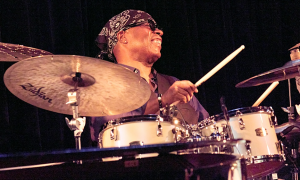
Lawrence Killian's drums talk, harkening back to the days in Africa when the drum was played as a form of communication, giving lightning power to communal dances.
Born September 5th, 1942 in Jersey City, Killian's uncle Al played trumpet with the legendary Ellington orchestra during one of its finest periods and his father Rollie was a postman who sang and played guitar with Sy Oliver. Although encouraging his musicality, Rollie made sure that his son developed a trade to fall back on, so Killian would later study to be an electrician. Starting on a silver trumpet at the Glenfield School in New Jersey, he played in the band and also the drum and bugle corps. Attracted to the snare drum, he joined the Blue and Gold Marching Band. Killian then started playing the trap drums with saxophonist Lloyd Wheeler and Jimmy Anderson. He played in all the local bars, though he eventually joined the Coast Guard as an electrician.
Killian's first major gig was with vibraphonist Johnny Lytle, during which he would become friends with Roy Haynes and Freddie Hubbard, both of with whom he would later play. Killian was percussionist of the original Roy Haynes Hip Ensemble with saxophonist George Adams, trumpeter Hannibal Marvin Peterson, pianist Joe Bonner and bassist Cecil McBee—all except Adams destined to play with Pharoah Sanders, one of Killian's greatest jazz associations.
It was at the Blue Cornet that McBee invited Sanders to first hear Killian. He would go on to record with Sanders on the seminal albums Thembi (on one track never properly credited in discographies) and Black Unity. It was during this time, while playing free music, that Killian furthered his relationship with the drum as an ancient talking spirit.
An outgrowth of Sanders' band in the '70s was Lonnie Liston Smith's Cosmic Echoes whose spare electronic piano style brought in a new era of light, cosmic funk. This experience included trips to Japan and more recordings in nearly half a dozen years.
At this time, he also played with two of the most famous men in jazz: Stan Getz and Miles Davis. When Killian was still playing with Sanders, Miles eased into a club undercover (similar to Pharoah), but finally made it known that he wanted Killian to play in the wild fusion band that also had percussionist Mtume, Michael Henderson (bass), Keith Jarrett (piano), Tiki (drums) and Gary Bartz (alto sax). Killian played at the sessions for the exploratory funk album On the Corner (though those particular takes have never been released) and did gigs with Miles at the Village Gate, Lennie's on the Turnpike and at the Jazz Workshop.
After playing with Rahsaan Roland Kirk and pianists Hilton Ruiz and Ahmad Jamal, Killian crossed genres and joined the rock-disco band The Village People which led to a five year stint, some good money and hits like the song, "YMCA .
His friendship with Johnny Lytle led to a positive connection when Pucho (of Latin Soul Brothers fame) was putting together a tour. He asked Killian to play congas in this working Latin band. Killian gladly accepted and played extensively with Pucho in the '90s, leading to the CD Groovin' High.
It was at this time, that Killian and I formed our first band and what is now a 17-year friendship. I had a steady gig and percussionist Leopold Fleming was called away to play with Nina Simone. When he said he would send a sub, I had no idea that this wonderful man with powerful forearms and razor sharp time would end up playing for the entire summer.
After over 20 years as a fireman, Killian is still teaching and playing at William Patterson College with Chico Mendoza. He meets a lot of young kids that want to be quick stars these days, but his advice to them, knowing that jazz is a complex art form is to: "Listen! Listen! and practice! ...Amen.
Selected Discography
Larry Coryell, Barefoot Boy (Flying Dutchman-One Way, 1971)
Pharoah Sanders, Live at the East (Impulse, 1971)
Roy Haynes, Senyah (Mainstream, 1972)
Lonnie Liston Smith & The Cosmic Echoes, Cosmic Funk (Flying Dutchman, 1974)
Cecil McBee, Mutima (Strata East, 1974)
Big John Patton/John Zorn, Blue Planet Man (Evidence, 1993)
 FOLLOW AAJ Staff
and get notified whenever a new article published.
FOLLOW AAJ Staff
and get notified whenever a new article published.
Various staff members.
Tags
PREVIOUS / NEXT


Become a Sustaining Member

Since 1995, All About Jazz has championed jazz as an art form and supported the musicians who create it. Over three decades, it has grown into one of the world's leading jazz resources, serving hundreds of thousands of readers, musicians, presenters and industry professionals each month.
Help Build the Future of All About Jazz
Your support helps us continue building All About Jazz for the next generation—expanding our editorial coverage, preserving jazz history, developing new community features and creating better ways to discover the music and the people behind it.
Become a sustaining member for as little as $20 per year and you'll immediately enjoy an ad-free experience along with access to subscriber features and future articles for a full year.
Together, we're not simply sustaining All About Jazz—we're building its future. Thank you for being part of the journey.