Home » Jazz Articles » Album Review » Louis Stewart: Joyce Notes
Louis Stewart: Joyce Notes
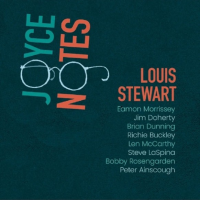
Banned in the UK, subject to an obscenity trial in the USA, scrutinized, vilified and glorified, it has inspired and baffled in equal measure. Its experimental stream-of-consciousness style—liberally laced with puns and mordant humor—has proven a literary Everest for many, an indigestible slog for others. Even Joyce's wife allegedly observed: "Why don't you write books people can read?"
With its rattling, coiling rhythms, vivid soundscapes, lyricism and deeply observed humanity, Ulysses is also a work ripe for musical interpretation. Luciano Berio and Anthony Burgess both took the plunge. Likewise, Irish jazz musician Ronan Guilfoyle's large-scale work "Counterpoints"—premiered in 2013 —was inspired by the musicality in Joyce's prose. And then there is guitarist Louis Stewart's Joyce Notes.
Dubliner Stewart (1944-2016) was best known as an interpreter of standards—a jazz guitarist with few peers. Jim Hall and Martin Taylor were both admirers. And, thanks to Livia Records' reissues of Stewart's long-out-of-print discography, a host of modern six-stringers such as Mary Halvorson, Kurt Rosenwinkel, Ant Law and Eleonora Strino have also fallen under Stewart's spell. Equally known for his wit, it is easy to see how Stewart would have gravitated towards Joyce, though his Joyce Notes extended work—funded by an Irish Arts Council Award to mark the writer's centenary in 1982—marked a departure from his customary musical habitat.
Recorded live at the Cork Jazz Festival in 1982, Stewart leads an eight-piece jazz ensemble through an hour-long suite inspired by various episodes from Ulysses. Stewart's old sparring partners Jim Doherty (piano) and Peter Ainscough (percussion) are joined by Americans Steve LaSpina (bass) and veteran Bobby Rosengarden (drums) in a swinging rhythm section. Up front, Richie Buckley (tenor saxophone), Len McCarthy (alto saxophone) and Brian Dunning (flute) revel in the spoils of improvisation. This was Stewart's only completely self-composed project in his career, and he seems content, in the main, to stoke the rhythmic fires. When he does solo, notably on "Stephen" and "Molly"—where Rosengarden's fills conjure cartwheels rattling over cobblestones—he lifts the ensemble around him.
Central to the success of the suite is narrator Eamon Morrisey, whose clipped Dublin tones relay scenes from Joyce's book. It is no easy task to translate the myriad rhythms of the characters' speech, emotions and subconscious voices; drunken sailors, capricious students, world-weary prostitutes, dreamers and hopeless romantics come and go against the sonic backdrop of bustling, cosmopolitan early-20th-century Dublin. Morrisey pulls it off quite brilliantly, catching the current of humor that runs through Ulysses like one long seam of gold.
Special mention too for flautist Dunning, whose melodious virtuosity is another constant delight. Anyone intrigued by Dunning could do worse than lend an ear to the reissue of the Louis Stewart-Brian Dunning collaboration Alone Together (Livia Records, 2025), where the flautist arguably outshines his more illustrious senior.
Joyce Notes remains a one-off in Stewart's discography, but it is more than a mere curio. Its charms may well entice waverers to dive, fully committed, into Ulysses' depths, while making a compelling case for Stewart as a composer and conceptualist who hid those particular talents under a bushel.
 FOLLOW Ian Patterson
and get notified whenever Ian has a new article published.
FOLLOW Ian Patterson
and get notified whenever Ian has a new article published.
Ian is dedicated to the promotion of jazz and all creative music all over the world, and to catching just a little piece of it for himself.
Track Listing
Bronze By Gold; Gerty McDowell; Night Town; Stephen; W.B. Murphy; Molly.
Personnel

Louis Stewart
guitar
Jim Doherty
piano
Richie Buckley
saxophoneLen McCarthy
saxophone
Steve LaSpina
bass
Bobby Rosengarden
drumsPeter Ainscough
percussion
Brian Dunning
fluteAdditional Instrumentation
Eamon Morrissey: narration.
Album information
Title: Joyce Notes | Year Released: 2026 | Record Label: Livia Records
About Louis Stewart
Tags
PREVIOUS / NEXT


Become a Sustaining Member

Since 1995, All About Jazz has championed jazz as an art form and supported the musicians who create it. Over three decades, it has grown into one of the world's leading jazz resources, serving hundreds of thousands of readers, musicians, presenters and industry professionals each month.
Help Build the Future of All About Jazz
Your support helps us continue building All About Jazz for the next generation—expanding our editorial coverage, preserving jazz history, developing new community features and creating better ways to discover the music and the people behind it.
Become a sustaining member for as little as $20 per year and you'll immediately enjoy an ad-free experience along with access to subscriber features and future articles for a full year.
Together, we're not simply sustaining All About Jazz—we're building its future. Thank you for being part of the journey.