Home » Jazz Articles » Multiple Reviews » Joe McPhee: N.Y.N.Y.1971 & Pieces of Light (1974)
Joe McPhee: N.Y.N.Y.1971 & Pieces of Light (1974)
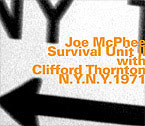 |  |
Joe McPhee Survival Unit II with Clifford Thornton, N.Y. N.Y. 1971 Hatology 2006 | Joe McPhee Pieces of Light (1974) Atavistic 2006 |
Something that often gets overlooked amongst the generations of post '60s free jazz blowers and fans is that John Coltrane was a conceptualist and that the free improvisation that erupted out of his 1965 album Ascension was just one concept. He went on to do such albums as Kulu Se Mama, Interstellar Space and Expression, very different records based on very different ideas about structuring improvisation.
Joe McPhee might be the truest living heir to Trane's mantle. On top of the face-value (the tenor saxophone, the spiritual and political undercurrents, the ability to evoke both gentleness and fury), there's a shared dedication to exploring, to seeking out new contexts. Two recent releases - each recorded more than 30 years ago - show that McPhee's thirst for new challenges has been with him as long as he's been recording.
His Survival Unit II - recorded at New York City's WBAI radio, at the time a hotbed of political dissent - came after his original Survival Unit fell apart and after a solo tape-music project called Electronic Survival Unit. The first half hour of the concert shows what a good acoustic jazz band was expected to be in New York in the early '70s (the blueprint being Trane's later band with wife Alice and Rashied Ali a few years prior), a mixing of freeform fervence with unabashed, abstract beauty. Not McPhee's strongest band, nor his strongest record from the period, but a memorable period piece.
The final three tracks (each about 15 minutes) are what make the disc worthy of attention. "Message from Denmark is built from a series of unaccompanied solos, giving each of the players a very different vantage by the time the group improv begins. The 16-minute "The Looking Glass I , opening with a prerecorded introductory holdover from the Electronic Survival days, is a dense, exciting and fairly prophetic piece of music. The disc concludes with "Harriet , a sort of anxious ballad (like the rest of the tracks, it's McPhee's composition) dedicated to Harriet Tubman.
Some three years later, McPhee picked up again on the growing electronic music movement, recording a set of duos on saxophones, trumpet, e flat alto horn, flute, modified Nagoya harp, chimes and voice with John Snyder playing an ARP analogue synthesizer. McPhee at times anticipates and complements the limited wave forms of his playing partner, but the two don't try to mimic or play on top of each other. Rather, they assume, shift, meld and counter roles. McPhee at times plays marvelously jazzy in alien vistas and if Snyder's synthesizer sounds a bit dated at times it never comes off as quaint. With the renewed popularity of analogue electronics of late, 'dated' is not much of an issue. In fact, if anything dates this as an 'electroacoustic' meeting, it's the pair's willingness to be musical. But being musical is one thing that has never been a problem for McPhee.
Tracks and Personnel
Survival Unit II with Clifford Thornton, N.Y. N.Y. 1971
Tracks: Announcement 1; Black Magic Man; Announcement 2; Nation Time; Song For Lauren; Announcement 3; Message From Denmark; The Looking Glass I; Harriet.
Personnel: Joe McPhee: tenor saxophone, trumpet; Byron Morris: alto and soprano saxophones; Clifford Thornton: baritone horn; Mike Kull: piano; Harold E. Smith: drums.
Pieces of Light (1974)
Tracks: Prologue/Twelve; Shadow Sculptures; Les Heros Sont Fatigues; Red Giant; Windows in Dreams/Colors in Crystal.
Personnel: Joe McPhee: flute, trumpet, flugelhorn, tenor s, vocals, wind chimes, pocket trumpet; John Snyder: Arp.
 FOLLOW Kurt Gottschalk
and get notified whenever a new article published.
FOLLOW Kurt Gottschalk
and get notified whenever a new article published.
Kurt Gottschalk doesn't have a favorite Derek Bailey album, but he does have a favorite Chuck Berry song.
About Joe McPhee

Tags
PREVIOUS / NEXT

Joe McPhee Concerts
Become a Sustaining Member

Since 1995, All About Jazz has championed jazz as an art form and supported the musicians who create it. Over three decades, it has grown into one of the world's leading jazz resources, serving hundreds of thousands of readers, musicians, presenters and industry professionals each month.
Help Build the Future of All About Jazz
Your support helps us continue building All About Jazz for the next generation—expanding our editorial coverage, preserving jazz history, developing new community features and creating better ways to discover the music and the people behind it.
Become a sustaining member for as little as $20 per year and you'll immediately enjoy an ad-free experience along with access to subscriber features and future articles for a full year.
Together, we're not simply sustaining All About Jazz—we're building its future. Thank you for being part of the journey.