Home » Jazz Articles » New York Beat » Jazz at Lincoln Center: The Search for Original African Music
Jazz at Lincoln Center: The Search for Original African Music
When the slaves arrived in the New World they instantly became African-Americans and their original African forms evaporated as they merged with the European music of the slave masters. Now, after 500 years of musical synthesis the search for these forms has been taken up by ethnomusicologists, historiographic scholars, and various jazz musicians and composers. The producers of Jazz at Lincoln Center have joined in the search.
Earlier this season, I wrote of an early music form—Frevo—from Northeastern Brazil that received its first U.S. exposure at a JALC concert. Last evening, February 20, another series of African forms were resurrected in the premiere of an extended composition dubbed, "Cinque: Suite of the Caribbean." Grammy-nominated composer/pianist Elio Villafranca hails from San Luis in the Pinar del Rio province of southeastern Cuba—an area (the Tambor Yuka community) where the nearly extinct music of the African Congo has somehow managed to survive. He was classically trained at the Instituto Superior de Arte in Havana and when he arrived in the United States in 1995 he immediately joined the cavalcade of Cuban virtuosos—Paquito D'Rivera, Arturo Sandoval and others—who quickly became jazz headliners. He plunged into the jazz scene playing alongside such stalwarts as Pat Martino, Chick Corea, Wynton Marsalis, Eric Alexander, and Lewis Nash. Predictably, his first album Incantations/Encantaciones (Ceiba Tree Music, 2003) was critically acclaimed. He presently sits on the faculty of The Juilliard School of Music.
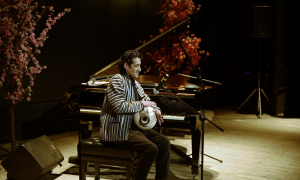
With reams of score paper for his new suite shrouding the piano where he played and led an all-star band in the Appel theater, Villafranca unleashed a mother lode of African forms in his five-part composition. Included in the work which ran on without a break for almost two hours were call-response mantras from the Congo, Bomba rhythms from the African legacy in Puerto Rico, slave folk music from Haiti, "Palo Muerto" refrains from the Dominican Republic, and revolutionary "Maroon War" sounds from Jamaica. The musical menu also featured native dancing and audience chanting.
Villafranca called the band "Jass Syncopators" recalling the initial spelling of "jazz" found in old New Orleans flyers. Featured in the group were saxophinists Vincent Herring and Gregory Tardy, clarinetist Michele Wright, trombonist Steve Turre, bassist Gregg August, drummer Willie Jones III, Congolese percussionists Arturo Stable and Jonathan Troncoso, trumpeter Michael Rodriguez, and cellist/banjoist/ vocalist Leyla McCalla.
The musicians, particularly the horn men, faced a daunting task performing the jazz insertions Villafranca constructed to counter the myriad African polyrhythms played throughout. One of the highlights of the solo improvising sequences was that of Steve Turre who performed on a variety of Conch shells with a dexterity that would have wowed the ancients.
 FOLLOW Nick Catalano
and get notified whenever a new article published.
FOLLOW Nick Catalano
and get notified whenever a new article published.
Dr. Nick is a TV writer/producer and professor of Literature and Music at Pace University.
About Elio Villafranca

Tags
PREVIOUS / NEXT

Elio Villafranca Concerts
Become a Sustaining Member

Since 1995, All About Jazz has championed jazz as an art form and supported the musicians who create it. Over three decades, it has grown into one of the world's leading jazz resources, serving hundreds of thousands of readers, musicians, presenters and industry professionals each month.
Help Build the Future of All About Jazz
Your support helps us continue building All About Jazz for the next generation—expanding our editorial coverage, preserving jazz history, developing new community features and creating better ways to discover the music and the people behind it.
Become a sustaining member for as little as $20 per year and you'll immediately enjoy an ad-free experience along with access to subscriber features and future articles for a full year.
Together, we're not simply sustaining All About Jazz—we're building its future. Thank you for being part of the journey.