Home » Jazz Articles » Album Review » Jack Wyllie: Eternal Spring
Jack Wyllie: Eternal Spring

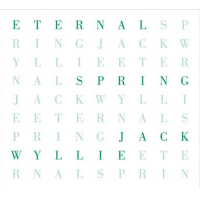
Late solo debuts often turn into showcases of past and ongoing projects, each lending flavor to the consecutive tracks. There have been many, and among them, there is only one release not marketed under a band's name but Wyllie's own—a series of saxophone-electronics improvisations recorded together with Adrian Corker and released on Chaoide Records in 2017. Wyllie's main affiliation remains the Portico Quartet, yet on Eternal Spring that formation's distinct hang drum sound had to leave space for the experiences drawn from a host of groups: the largely improvised Szun Waves (with Luke Abbott and Laurence Pike), the New Age-y Forgiveness (with Richard Pike and Joe Quirke), and neoprimal Paradise Cinema (with Senegalese percussionists Khadim Mbaye and Tons Sambe).
With locations encompassing Saint Thomas church in Clapton Common, Studio Richter Mahr (founded by Max Richter and Yulia Mahr), and Antonio Feola's Fish Factory Studio, the Spring 2024 to Autumn 2025 recording schedule almost palpably translates to the mature sound achieved on the album. Light, airy, transcendent—the tracks on the LP fashion themselves after loop structures, circadian rhythms, and ambient textures cast over an embroidery made by a group of inventive musicians—most of whom are Wyllie's Gondwana Records label-mates. Portico Quartet's Milo Fitzpatrick and Duncan Bellamy return, respectively, on double bass and drums; the cellist Francesca Ter-Berg—who first appeared on the Art in the Age of Automation (Gondwana Records, 2017)—can be heard throughout. The final track has been co-written with Hania Rani—a fellow traveler, whose piano concerto, Non Fiction, he will be supporting in October.
In the beginning, there is "Lightness," and its cascading piano notes interspersed with increasingly audacious saxophone gusts, delivered with the clarity of Mark Isham's late 1980s' work. "Eternal Spring" arrives next. The inheritance of Terry Riley's pulse music breathes in a calming mood—an interweave of Duncan Bellamy's percussive work, a synthesizer three-note melody, and the wordless vocals from Lotte Betts-Dean. Together with the synth, violins and cello create a sparkling texture—a springboard for percussive washes, soprano vocals, and the ever-meandering saxophone. "Magazine" sets off with a string rondo, going back to Michael Nyman Band's 1980s works and soundtracks. Then come the ruptured violins, an otherworldly vibraphone, and the double bass. A dusted-off Wurlitzer guides our way into the "Pavilion." It is the first of two expansive tracks that go beyond a six-minute mark. Looking at both, "Pavilion" entrances the listener lost in a hypostyle hall of sounds—a profoundly organic bass, congealing brushwork and piano roundabouts. Towards the 5'30'' mark the tension builds up, until we reach the central nave, left alone among the saxophone bird chirps and vibraphone haze. "Actor" makes us stay a bit longer with the flutter. At this point, there are mainly strings, acting as a shade cast by a soaring violin. And then, almost nothing happens throughout its sound-span, until a realization comes that the stillness took us almost fifty years back to David Bowie's "Moss Garden," (off "Heroes" (RCA Victor, 1977).
On side two, there is more tempo than upbeat on "Green Lights." It simply rushes through the speakers at moderate speed, in utter contrast to "Love Colour," which finds the composer at his most sonorous. The muffled synth backing and the strings paint a dormant landscape in wide brush strokes. "Juniper" pairs with the title track due to its ecclesiastical vocal delivery, even though Wyllie's singing enters the frame slightly past the three-minute mark, furnished up to that point by a wandering dolceola. The epilogue of "Yesterday Today" sounds as if it were born out of retrieved search histories on artists both poised and soothing, from Sigur Rós, through This Mortal Coil, to the early and more engaged Philip Glass of Einstein on the Beach (Nonesuch Records, 2012). "I think of it like the point in a film when someone's life flashes back before them," comments Wyllie. Total recall before touring the material. The musician already hinted at the possibility of incorporating compositions left off the record into the live set. Quite a few might have landed in the can, given the album's 40-minute trek.
There is an uncanny resonance between Gondwana's sound—an amalgam of post-minimalist, electroacoustic, jazz-infused, and Afro-Asian folk traditions—and the album's ecstatic yet wistful title. Seasons blur into one. This stays true for Wyllie's music. Even as a tapestry, it is insular, carried by the ebb and flow of play, rather than a mathematical framework of notes. Stranded between Antonio Vivaldi and Mark Hollis, Eternal Spring is a shimmering wallpaper that is likely to soften September's fall, filtering its composer's multiverse into an entrancing 'borrowed scenery,' which is just as complex as it is accessible.
Track Listing
Lightness; Eternal Spring; Magazine; Pavilion; Actor; Green Lights; Love Colour; Juniper; Yesterday Today.
Personnel
Jack Wyllie
saxophoneDuncan Bellamy
drumsMilo Fitzpatrick
bassFrancesca Ter-Berg
cello
Flora Curzon
violinJoy Becker
violinAnna Lowenstein
violinAdditional Instrumentation
Lotte Betts-Dean - voice (2); Hania Rani - voice, Dobrawa Czocher — cello (9)
Album information
Title: Eternal Spring | Year Released: 2026 | Record Label: Gondwana Records
About Jack Wyllie
Tags
PREVIOUS / NEXT


Become a Sustaining Member

Since 1995, All About Jazz has championed jazz as an art form and supported the musicians who create it. Over three decades, it has grown into one of the world's leading jazz resources, serving hundreds of thousands of readers, musicians, presenters and industry professionals each month.
Help Build the Future of All About Jazz
Your support helps us continue building All About Jazz for the next generation—expanding our editorial coverage, preserving jazz history, developing new community features and creating better ways to discover the music and the people behind it.
Become a sustaining member for as little as $20 per year and you'll immediately enjoy an ad-free experience along with access to subscriber features and future articles for a full year.
Together, we're not simply sustaining All About Jazz—we're building its future. Thank you for being part of the journey.