Home » Jazz Articles » Film Review » Bela Fleck: Throw Down Your Heart
Bela Fleck: Throw Down Your Heart

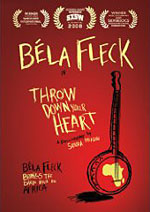 Béla Fleck
Throw Down Your Heart
Docurama Films
2009
With Throw Down Your Heart Rounder, 2009), banjo revolutionary Béla Fleck took his instrument full circle, back to Africa where the instrument originated. The third in his ongoing Tales from the Acoustic Planet series, it was the end result of a 2005, five-week trip to four African countries where Fleck met with local musicians, playing and exchanging ideas and values—musical and otherwise. While the CD provides nearly 80 minutes of absolutely compelling music—largely the result of jams rather than preplanned music—it only tells part of the story. Throw Down Your Heart, the DVD, chronicles Fleck's journey in a 100-minute documentary directed by his brother, Sascha Paladino, and it's a moving tale of an artist coming to know, first hand, the true roots of the music that has dominated his entire adult life.
Told without narrative, rather only in words of the participants, the film starts with Fleck's first stop in Uganda, and from nearly the first moments the richness of the African musical culture dominates. There are local instruments that seem nearly impossible to play, including a bowed instrument which, with no frets, not even a neck, a teenager plays with remarkable accuracy. Even more impressive is a massive marimba that's played by nine people and is, as Fleck describes it, "like a big rock band coming out of PA speakers; people don't realize how loud this thing is."
That music is fully collaborative, often involving entire villages, is no surprise. "To the Americans and Europe, the world of the white men and women, there is this negative thinking about Africa," says Wausimbi Nsimbambi Haruna, an African musician who provides much of the film's narrative context. "There is nothing good in Africa. 'They are beggars; there is HIV, AIDS, they are at war all the time.' But that is just a very small bit of what Africa is. What he [Fleck] wanted was to bring the banjo back to Africa. It would be possible for the banjo to come back and play with its old folks, these African instruments. Music is in every aspect of life in our local communities. In everything that one does, music is there."
Fleck and his small entourage, including younger brother/director/co-producer Sascha Paladino and sound engineer Dave Sinko, achieved the near-impossible and, with a minimal amount of gear, managed to acquire high quality field recordings— there were, after all, no recording studios in these small villages and often no electricity or running water. The music on the CD provides the backdrop for the film, as Fleck encounters singers and instrumentalists of all ages and engages in a true cultural mesh. He takes an instrument whose roots are in Africa but which has benefited from modernization (although not always as, at one point, Sinko has to find a creative workaround to a technical problem with Fleck's banjo that, with no hardware of music stores around, could literally have scuttled the entire project) into an altogether different kind of civilization. Certain cultural beliefs may well seem foreign to Westerners, but equally some of the foundations of Western culture are just as difficult to fathom by the villagers Fleck meets along his journey.
 Marimba in Nakisenyi, Uganda
There are plenty of moving moments throughout the film, but they're honest ones that aren't dramatized (or, worse, melodramatized) through artifice or construction. As Fleck leaves each village, he's clearly moved by the spirit of friendship that's made him welcome in every stop along the way. There are tearful moments, none perhaps more than at the film's end. In his final stop in Mali after accompanying singer Oumou Sangare in a moving duet, "Djorolen" (also one of the CD's most beautiful tracks), he gives a banjo to a young African boy whose natural aptitude is immediately evident. It might be easy to presume that Fleck walked away from this entire experience with more than the villagers he met along the way, but it's abundantly clear that Fleck left his own stamp as well.
Fleck has never given the impression of being all that comfortable with celebrity itself; even onstage, he gives the appearance of being more an introvert than a showman. Sangare may have only known Fleck for a brief time—with communication made all the more difficult given that French is Mali's official language—but she captured him perfectly with the words that end the film: "Béla is someone who might have a hard time expressing himself with his mouth, but who can express himself perfectly with his fingers."
The DVD—which has already rightfully won awards at the Vancouver International Film Festival, South by Southwest Film Festival and the AFI/Discovery Channel Silverdocs—also features a full hour of bonus scenes and performances, including a pastiched solo version of the CD's moving title track, an encounter with percussionist Trilok Gurtu at Hotel Wassulu in Mali, and an impromptu (as is much of Throw Down Your Heart's music) mix of traditional American music ("Old Joe Clark") and African jam ("Jatta Jam").

Music is, indeed, the international language, but it always has its roots somewhere, and with the combination of Throw Down Your Heart, the CD and DVD, Fleck has not only explored the roots of an instrument that's become his life's work, but given something back to it as well, in a film that explores a meeting of disparate cultures with sensitivity, grace and great beauty.
Tracks and Personnel Throw Down Your Heart Chapters: Jinja, Uganda; Giant Marimba of Makisenyi; Haruna Walusimbi; Ateso Jazz Band; The Women of Nakisenyi; Anania Ngoliga; The Zawose Family; The Jatta Family; Djelimady Tounkara; Bassekou Kouyate; Harouna Samake; Oumou Sangare. Bonus Scenes and Performances: Stoop Jam; Matitu and Cha Cha; "Bagamoyo Song"; "Dunia Haina Wema"; "Throw Down Your Heart"; Lost Luggage; Press Conference; "Old Joe Clark / Jatta Jam"; Jesus Jah Jarju and Béla Fleck; "Bassekou Jam"; Trikok at the Hotel Wassulu; "Buribal"; "N'Guatu"; "Harouna Jam."
Personnel: Béla Fleck: banjo, producer; Nakisenyi Women's Group: vocals; D'Gary: guitar; Xavier-Martial Francois: percussion; Casey Driessen: fiddle; Oumou Sangare: vocal; Souleymane Sidibe: karagnan; Zoumana Tereta: sokou; Benogo Diakite: kamala n'goni; Sekou Bah: bass; Sekou Diabate: djembe; Nabintou Diakate: backing vocal; Toumani Diabate: kora; Anana Ngoglia: vocal and thumb piano; Lua Cultural Association: lyre; Brian Siskind: swells; Haruna Samake: kamala n'goni; Madou Sanogo: djembe; Habib Sangare: bolon; Bassekou Kouyate: n'goni; Khalifan Matitu: marimba; Yoro Cisse: on njurkle; Richard Bona: electric bass; Jojo Kuo: drum; Afel Bocum: vocal, guitar; Baaba Maal: vocal; Vusi Mahlasela: guitar, vocal; Abou Coulibazy: calabash; Muwewesu Zylophone Group: wood xylophones; Hama Sankare: calabash; Barou Diallo: bass; The Zawose Family: lyres and vocals; The Jatta Family: akontings; Warema Masiaga Cha Cha: lyre and cymbal; Ateso Jazz Band: thumb pianos and vocals; Fadhili Bbata: percussion; Djelimady Tounkara: guitar; Sascha Paladino: director, producer.
DVD Feature: Running Time: 97 minutes (main feature); 64 minutes (bonus features).
Photo Credit
Stills taken from Béla Fleck, Throw Down Your Hearts, courtesy of Docurama Films.
About Bela Fleck
Tags
PREVIOUS / NEXT
Bela Fleck Concerts

Become a Sustaining Member

Since 1995, All About Jazz has championed jazz as an art form and supported the musicians who create it. Over three decades, it has grown into one of the world's leading jazz resources, serving hundreds of thousands of readers, musicians, presenters and industry professionals each month.
Help Build the Future of All About Jazz
Your support helps us continue building All About Jazz for the next generation—expanding our editorial coverage, preserving jazz history, developing new community features and creating better ways to discover the music and the people behind it.
Become a sustaining member for as little as $20 per year and you'll immediately enjoy an ad-free experience along with access to subscriber features and future articles for a full year.
Together, we're not simply sustaining All About Jazz—we're building its future. Thank you for being part of the journey.