Home » Jazz Articles » Paul Motian
Jazz Articles about Paul Motian
About Paul Motian
Eddie Costa: Guys and Dolls Love Jazz
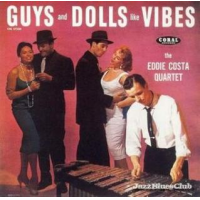
by Craig Jolley
In retrospect it's hard to see how or why this record was made in the days before CD's as calling cards. Eddie Costa had little name recognition, and what fame he enjoyed was on piano, his primary instrument. The material--cute boy-meets-girl tunes written in subservience to 1950's-clever lyrics--does not lend itself to jazz interpretation. [A couple of the songs have since become standards after being overhauled by Miles Davis and Oscar Peterson.] Costa as a sometime studio musician probably had ...
Continue ReadingLee Konitz/Steve Swallow/Paul Motian: Three Guys

by David Adler
Altoist Lee Konitz, who gets top billing on this record, has a sparse, cryptic improvisational style that lends itself well to the left-of-center, quasi-free aesthetic favored by bassist Steve Swallow and drummer Paul Motian. Recently Konitz led a very different, yet equally provocative, trio project with Brad Mehldau and Charlie Haden, which resulted in two live albums for Blue Note. This time there’s a drummer, no piano, and a bassist who couldn’t be more unlike Charlie Haden. In addition, unlike ...
Continue ReadingPaul Bley - Gary Peacock - Paul Motian: Not Two, Not One
by Glenn Astarita
Not Two, Not One is the first recording featuring Paul Bley, Paul Motian and Gary Peacock as a working unit since Bley’s 1970 ECM recording titled, “Paul Bley with Gary Peacock”. Twenty-nine years later they reunite as the overall results prove to be substantially rewarding. Aided by ECM’s trademark pristine sound quality and masterful engineering by James Farber, these gentlemen once again display the meritorious attributes befitting of their respective importance in modern jazz history.
On “Not Zero: In Three ...
Continue ReadingPaul Bley/Gary Peacock/Paul Motian: Not Two, Not One
by David Adler
Despite its esoteric thrust, this music is suffused with the classic sound of the jazz piano trio. And if anyone knows the format inside and out, it’s these three men. Pianist Paul Bley started out as a bebopper in the 50s, playing trio with Mingus and Art Blakey. A decade later, drummer Paul Motian played a key role in Bill Evans’s reinvention of the trio concept. Later still, bassist Gary Peacock furthered the idiom’s evolution in a long-standing association with ...
Continue ReadingPaul Motian & The Electric Bebop Band: Play Monk and Powell
by Ed Kopp
When you think about Thelonious Monk's or Bud Powell’s music, you think of the piano, the instrument of choice for those two eccentric legends. Drummer Paul Motian adopts a different approach to Monk and Powell with his piano-less Electric Bebop Band.The name might lead you to believe that this is a fusion outfit, but its music is actually straight-ahead jazz of a very modern variety. Motian’s group includes two electric guitarists (Kurt Rosenwinkel and Steve Cardenas), an electric ...
Continue ReadingPaul Motian and The Electric BeBop Band: Play Monk and Powell
by Glenn Astarita
It’s no secret that drummer-composer-bandleader Paul Motian adores “Monk”. Throughout his recording career, Motian generally manages to squeeze in a Monk number or two. Here, on the latest installment of Motian’s “Electric BeBop Band”, the band perform Monk and Bud Powell compositions as the CD is aptly titled, ..... Play Monk and Powell. Following up his previous release for Winter & Winter, Flight Of The BlueJay, Motian along with the potent frontline of saxophonists Chris Potter and Chris Cheeks and ...
Continue ReadingPaul Bley/Gary Peacock/Paul Motian: Not Two, Not One
by C. Andrew Hovan
In a league by himself, pianist Paul Bley's art is one that has involved taking the road less traveled. He uses the jazz vocabulary in a way that is distinctive and varies from the norm, much in the manner that Hemingway or Gertrude Stein created sentences and paragraphs that skirted typical conventions. For this new ECM release, Bley teams up with bassist Gary Peacock and drummer Paul Motian for the first time on record in several decades. The compatibility factor ...
Continue ReadingAlbum Showcase







Trending
 Interview
Lou Marini: A Solo Career Starting At The Age Of 80
 History of Jazz
John Coltrane in Detroit: A Brief History
 Live Review
The Tension Is Where the Music Lives: Miles Davis at 100,...
 Radio & Podcasts
Sullivan Fortner, Jim Rotondi & Dena DeRose, Ardeshir,...
 Reanimating Conversations Past
Charlie Haden: Anatomy of a Jazz Classic
 Radio & Podcasts
Miki Yamanaka, Stefon Harris, Paul Yonemura, Amber Weeks...
 Profile
The Discreet Charm of Tete Montoliu
Premium
VOTE!