Home » Jazz Musicians » Livio Minafra Discography
Sulfureo
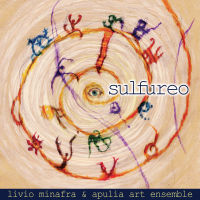
Livio Minafra
Label: Incipit Records / Egea Music
Released: 2027
Duration: 45:47:00
Views: 13
Tracks
Rakija; Luna di Gaza; Magdalena; Lo Ierofante; Sulfureo; Eruption; Quando la mia cenere; Skopje; Sipario; Dindalò
Personnel
Livio Minafra
piano
Apulia Art Ensemble
band / ensemble / orchestraVincenzo Di Gioia
saxophone, altoNicolò Marziale
percussionAntonio Fallacara
tromboneLuca Giannotti
guitarJosh Urbani
saxophone, baritoneAldo Chiarulli
vibraphoneAdditional Personnel / Information
Livio Minafra: piano; Nicolò Marziale: percussion; Antonio Fallacara: trombone; Vincenzo Di Gioia: alto saxophone; Aldo Chiarulli: vibraphone; Domenico Stragapede: drums and percussion; Luca Giannotti: guitar; Josh Urbani: sax baritone
Album Description
The Apulia Art Ensemble (AAE) was founded in Puglia in 2024 from an idea shared by Nicolò Marziale and M° Livio Minafra, with the aim of creating a permanent workshop dedicated to producing original music, nurturing young musicians and searching for a new contemporary musical language rooted in Mediterranean culture.
The ensemble brings together young musicians from the Conservatories of Bari, Monopoli and Matera, selected for their technical quality, interpretive sensitivity and creative ability. The group brings into dialogue contemporary jazz, improvisation, academic composition, Apulian and Mediterranean traditions, Balkan and rock influences, giving rise to an original musical research with a strong identity of its own.
Artistic direction is entrusted to M° Livio Minafra, pianist, composer and professor of Jazz Piano at the "Niccolò Piccinni" Conservatory in Bari. Winner of three Top Jazz awards from the Italian critics, Minafra has recorded for international labels such as Enja Records and Leo Records and collaborated with musicians including Bobby McFerrin, Paolo Fresu, Evan Parker, Frank London, Ernst Reijseger, Louis Moholo and Gianluigi Trovesi.
Production and strategic coordination are handled by Nicolò Marziale, musician, percussionist and founder of Municipale Balcanica, with over twenty-five years of experience in music production and the design of cultural initiatives.
AAE is not merely a concert group but a creative collective in which composition, improvisation and research develop through the exchange between musicians of different backgrounds and sensibilities. The ensemble's work aims to build a shared voice capable of connecting Puglia and the Mediterranean with the international contemporary music scene.
The first result of this journey is Sulfureo, an album made up entirely of original music. The record moves through Mediterranean identity, memory, conflict, intercultural dialogue and transformation, combining contemporary jazz, rock, improvisation and references to Mediterranean and Balkan music in Minafra's original compositions.
With Sulfureo, the Apulia Art Ensemble opens an artistic and production journey set to develop through new compositions, recordings, concerts and collaborations, with the ambition of bringing a new generation of Apulian musicians onto the national and international stage.
Line-up
- M° Livio Minafra — Piano · Composition · Artistic direction
- Vincenzo Di Gioia — Alto sax
- Giosuè Giovanni Urbani — Baritone sax
- Antonio Fallacara — Trombone
- Aldo Chiarulli — Vibraphone
- Luca Giannotti — Bass and electric guitar
- Domenico Stragapede — Drums
The artists
M° Livio Minafra — Piano · Composition · Artistic direction
An internationally renowned composer and pianist, Livio Minafra is one of the most original figures in contemporary Italian jazz. Three-time winner of the Top Jazz Award (2005, 2008, 2011), he has developed a musical research spanning contemporary jazz, improvisation, art music, world music and the Mediterranean tradition.
He holds four degrees from the Conservatories of Bari and Matera in Piano, Jazz, Band Instrumentation and Composition, building a particularly cross-disciplinary training that shapes his approach to composition and performance.
As a leader he has released albums on Leo Records, Enja Records and Incipit Records, including La dolcezza del grido, La fiamma e il cristallo, Sole Luna and Surprise!!!. His recording and concert activity has led him to collaborate with some of the leading figures of international jazz and world music, including Bobby McFerrin, Paolo Fresu, Evan Parker, Ernst Reijseger, Louis Moholo, Frank London, Gianluigi Trovesi, Daniele Sepe and Kocani Orkestar.
He teaches Jazz Piano at the "N. Piccinni" Conservatory in Bari, where he is also engaged in research and training. He is the author of 120 Finestre sull'Improvvisazione and Jazz Europeo, non di solo passaporto and has held artistic direction roles at major festivals devoted to musical research.
His artistic experience combines Mediterranean roots, improvisation and experimentation, the elements that form the core of the Apulia Art Ensemble's musical research.
Vincenzo Di Gioia — Alto sax
Saxophonist, composer and bandleader, Vincenzo Di Gioia is one of the emerging young voices of Apulian jazz. He earned his first-level Academic Diploma in Jazz Saxophone and his second-level Diploma in Jazz Composition at the "N. Piccinni" Conservatory in Bari, both with 110/110 cum laude and honourable mention.
Active as a soloist and sideman, he has performed at national and international festivals and events including Talos Festival, Gezziamoci and the Europe Jazz Network Conference, as well as collaborating with big bands and orchestras such as the Jazz Studio Orchestra and The Untouchable Band.
He is the founder and leader of the VMV Trio and has released several recordings as leader, co-leader and sideman. His awards include the Giovani Visionari Award 2026 from the Federazione Il Jazz Italiano, first prize at Tomorrow's Jazz 2024 and the Teano Jazz Contest 2024, along with numerous placings and finals in major national jazz competitions. He has also been awarded a Full Tuition Scholarship to Berklee College of Music.
Giosuè Giovanni Urbani — Baritone sax
A saxophonist specialising in the baritone sax, Giosuè Giovanni Urbani develops his research between contemporary jazz, improvisation and the performing arts. He trained at the "N. Piccinni" Conservatory in Bari under M° Roberto Ottaviano, later deepening his study of improvisation and composition with musicians and teachers from the Italian jazz scene, including Cettina Donato.
His research is particularly oriented towards interdisciplinary improvisation and the interaction between music, dance and performance. He took part in the workshop Improvvisi at the Cantiere Internazionale d'Arte in Montepulciano and in the residency Rapsodie at the Kilowatt Festival, both led by Giorgio Rossi and Livio Minafra.
Antonio Fallacara — Trombone
Active on the Italian orchestral and jazz scene, Antonio Fallacara has been Principal Trumpet of the ICO Symphony Orchestra of the Metropolitan City of Bari since 2020, taking part regularly in symphonic and operatic productions. His artistic activity spans classical, orchestral and jazz repertoire.
He trained at the "N. Piccinni" Conservatory in Bari, where he earned his second-level Academic Diploma in Trumpet and his academic diplomas in Jazz Trumpet and second-level Jazz Trumpet, studying with Giovanni Nicosia, Antonio Signorile, Fulvio Sigurtà and Antonello Sorrentino. He has worked with the Orchestra ICO 131 della Basilicata, Orchestra Filarmonica Pugliese, Orchestra del Mediterraneo and Orchestra della Magna Grecia, as well as the Orchestra Nazionale Jazz dei Conservatori Italiani, the Italian Big Band and the Young Art Jazz Ensemble conducted by Mario Corvini.
He has performed at festivals and events including the Traetta Opera Festival, Talos Festival, Beat Onto Jazz Festival and Tremiti Music Festival, and has taken part in concerts and tours in several European cities. He won the Absolute First Prize at the 3rd "Città di Spinazzola" National Competition and has attended masterclasses with musicians such as Immanuel Richter, Marco Braito, Giovanni Nicosia and Jim Rotondi.
Aldo Chiarulli — Vibraphone
A percussionist and performer of contemporary music, Aldo Chiarulli has built his path between classical repertoire, contemporary research, orchestral music and new performance forms. He graduated in Percussion Instruments from the "N. Piccinni" Conservatory in Bari with 110 cum laude and Special Mention, later earning his second-level diploma in Contemporary Performance at the "Santa Cecilia" Conservatory in Rome, with top marks.
He has been selected for major European programmes dedicated to contemporary music, including the Hamburg Biennale Contemporary Academy and the Bled Contemporary Week, and has collaborated as a guest performer with the Chigiana Percussion Ensemble.
Finalist and winner of the Flavio Vespasiano International Contemporary Performance Competition, he has performed as a soloist at the Reate Festival. Since 2020 he has also worked with the ICO Symphony Orchestra of the City of Bari, taking part in over 60 productions. His experience includes premieres of works by contemporary composers, interdisciplinary projects and research into the timbral possibilities of percussion.
Luca Giannotti — Bass and electric guitar
Guitarist, bassist, composer and arranger, Luca Giannotti develops his musical research between jazz, rock, contemporary improvisation and music for film. He earned his second-level Academic Diploma in Jazz Guitar at the "N. Piccinni" Conservatory in Bari, with top marks and honours, and is continuing his studies in Jazz Composition.
He has collaborated with artists and groups from the contemporary and avant-jazz scene, including singer-songwriter Roberta Gentile, Crooked Waves, Hambone and SILENT COLLECTIVE, a project devoted to live scoring of silent films that has led him to work alongside musicians such as Enrico Gabrielli. In the Apulia Art Ensemble he alternates between bass and electric guitar, bringing the rock component and the most contemporary timbral dimension to the group's sound.
Domenico Stragapede — Drums
Drummer and percussionist, Domenico Stragapede combines jazz training, timbral research and versatility across jazz, contemporary music and world music. At the "N. Piccinni" Conservatory in Bari he earned academic diplomas in Jazz Drums and Percussion Instruments.
He received a $25,000 scholarship to Berklee College of Music in Boston and has furthered his training through seminars and masterclasses at Nuoro Jazz, Umbria Jazz Clinics and Siena Jazz.
In 2026 he won the JazzFlirt Call for Artist, gaining access to the residency I Viaggi di Ulisse with Daniele Sepe and to the Siena Jazz summer seminars. His activity combines live performance, record production and research into the expressive possibilities of drums and percussion.
Sulfureo — Listening guide
Sulfureo is not a collection of tracks simply placed side by side. It is a journey through images, places, memory, tensions and transformations. The ten compositions move through different languages — contemporary jazz, rock, improvisation, Mediterranean music, Balkan tradition, cinematic suggestions and references to art music — while seeking a common direction. The Apulia Art Ensemble approaches this journey as a small contemporary orchestra. The sound arises from the meeting of jazz instruments, brass-band winds, piano, vibraphone, guitar, bass, drums and percussion. The writing leaves room for improvisation and interplay, so that the composition is not just something to be performed but something that takes shape through the musicians listening to one another.
A journey through images and places
The opening is entrusted to "Rakija", a theatrical and ironic track in which the reference to Balkan culture becomes a metaphor for conviviality, excess and loss of control. The unstable character of the composition immediately introduces one of the album's fundamental elements: the balance between writing and improvisation.
With "Luna di Gaza" the record shifts its perspective profoundly. The collective dimension gives way to a more intimate music, born from reflection on war and civilian suffering. References to the klezmer tradition and Middle Eastern sounds accompany a path that moves gradually from lament to dance.
"Magdalena" shifts the focus onto the human figure. Mary Magdalene is reread beyond the labels through a composition inspired by cross-pollination and the language of Daniele Sepe. The track introduces one of the most important features of Sulfureo: the possibility of bringing memory, tradition and the contemporary into dialogue without treating them as separate worlds.
With "Lo Ierofante" the journey takes on a more archaic and ritual dimension. The figure of the priest of the Eleusinian Mysteries becomes the starting point for a composition suspended between Renaissance language and the research of Béla Bartók. It is a passage in which the music seems to question what is not yet known.
The centre: energy and transformation
At the centre of the record is "Sulfureo", which gives the whole project its title. It is the moment of greatest energy and represents, in a way, the ensemble's statement of identity. Psychedelic rock, orchestral jazz, mambo, contemporary improvisation and electric distortion coexist within a structure in which a hidden rhythmic pattern organises an apparent explosion of sound. Chaos, here, is not an absence of form: it is a form that must be discovered while listening.
From this energy comes "Eruption". If Sulfureo represents matter exploding, Eruption tells the story of the process that leads to the explosion. Rhythmic cells, repetitions and progressive layering build a tension that grows to breaking point.
The path changes direction again with "Quando la mia cenere…". After energy comes subtraction. Body, memory and transformation become the centre of a rarefied composition, in which references to Mediterranean sacred music and free improvisation build a contemplative space.
The Mediterranean as a space, not a border
"Skopje" brings the record back to movement and travel. Puglia looks towards the other shore of the Adriatic and recognises in the Balkans a cultural closeness that is often forgotten. Odd metres, folk melodies, winds and improvisation are reworked through contemporary jazz. The track does not try to imitate a traditional music but to build a bridge. The Mediterranean thus emerges as a space of exchange and cross-pollination rather than a dividing line.
With "Sipario" the journey returns to Puglia. Fellini's circus, Nino Rota's cinematic poetics, travelling brass bands, patron saint festivals, festive lights and the piazzas of the South enter the composition as fragments of a collective memory. It is music that looks at its own roots without turning them into folklore. The brass-band tradition meets orchestral jazz, while the rhythm section and guitar introduce a contemporary dimension. The title suggests the opening of a scene, but also the transformation of a cultural heritage that keeps on changing.
The return to memory
The record closes with "Dindalò", an intimate composition built around children's language and memory. After the energy, the journey and the collective dimension, what remains is an invented word. A sound that precedes meaning and that, for this very reason, can become memory, image, emotion. The music is pared down to the essential: few elements, space, soft dynamics, acoustic sound and suspended passages. There is no real narrative conclusion, but a feeling of openness.
And perhaps this is precisely the meaning of listening to Sulfureo: crossing ten different worlds without necessarily seeking a final answer. The record starts from celebration and loss of control, passes through war, spirituality, myth, explosion, death, the Mediterranean and memory, and finally arrives at a word that means nothing and, for this very reason, can mean everything Sulfureo is a journey into matter and memory, into tradition and the contemporary, into chaos and form. A journey that starts from Puglia, crosses the Mediterranean and tries to transform everything it encounters into a new musical language.
The tracks
01 — Rakija
"Rakija" is the most theatrical and ironic track of the project. It starts from a concrete and universal situation: the moment when alcohol dissolves social rigidity and turns people into unwitting characters. Rakija, widespread across the Balkans, becomes a symbol of conviviality, excess, celebration and momentary loss of control. The inspiration was L’ubriaco, for solo trombone, by Azio Corghi. This imagery enters the writing through an unstable balance, in which rhythmic precision and sudden deviations constantly coexist.
The ensemble works on the performative side of the composition: some passages take the form of theatrical dialogues between the instruments, with rhythmic stumbles, sudden accelerations and deliberately lopsided phrasing. Improvisation becomes an integral part of this balancing act and helps keep the track unpredictable. Behind the irony emerges a reflection on the human need for escape and sociability. "Rakija" thus tells of the thin line between celebration and bewilderment, lucidity and abandon, turning a precise cultural reference into a contemporary musical scene.
02 — Luna di Gaza
"Luna di Gaza" is the most emotionally delicate track of the Sulfureo project. It arises from the need to turn into music the sense of helplessness and bewilderment generated by the images of war and contemporary civilian suffering. The composition takes no ideological or political stance, but seeks to restore humanity to pain. The moon becomes the symbol of a fragile yet persistent light, while the music builds a space of sensitivity, listening and memory. The reference to war thus remains on a human level, without turning into a political statement.
Musically, the track begins as a suspended lament, paradoxically influenced by the klezmer tradition and Middle Eastern scales, and slowly turns into a dance. This evolution becomes part of the composition's meaning: out of suffering emerges the human capacity to keep living, dancing and resisting. The ensemble works on timbral and dynamic control, favouring an intimate, cinematic sound and leaving room for improvised sections born from mutual listening. "Luna di Gaza" thus represents the most human dimension of Sulfureo: the attempt to tell the present without giving up complexity, poetry and the possibility of a future brotherhood between peoples.
03 — Magdalena
"Magdalena" stems from an explicit reference to Mary Magdalene, the woman often identified in tradition as a prostitute who became a fundamental figure in the Gospel narrative. Beyond the interpretations and labels attached to her over time, the track looks at Magdalene first and foremost as a woman: a living, frank person, capable of being judged and, at the same time, of taking on a fundamental role alongside Christ. The centre of the composition is therefore her human dimension. Magdalene is not told only through the judgement of others, but through her own presence, authenticity and relationship with a spiritual figure. Her relationship with Christ is ideally likened to that between Clare and Francis, founded on closeness, trust and a shared path.
Musically, "Magdalena" moves in the territory of cross-pollination and takes as its reference the work of Daniele Sepe, in particular Vite Perdite and Spiritus Mundi. This reference steers the track towards a language capable of relating tradition, contemporary research and a narrative dimension. Music thus becomes a space in which a historical and spiritual figure can be reread through a contemporary sensibility. "Magdalena" brings into Sulfureo the theme of cross-pollination as a tool for research and, with it, that of the woman who resists definitions imposed from outside.
04 — Lo Ierofante
"Lo Ierofante" takes its name from the ancient hierophant, the high priest of the Eleusinian Mysteries in ancient Greece. An enigmatic and authoritative figure, he was associated with the mystery rites and with knowledge of what was not immediately visible, up to the symbolic ability to foresee and interpret the future. The track arises from this dimension of mystery, ritual and knowledge. The Hierophant is a figure suspended between the human world and the sacred, between what is known and what has yet to be revealed. It is precisely this ambiguity that forms the conceptual centre of the composition.
Musically, "Lo Ierofante" relates two seemingly distant references: the rhythmic and harmonic research of Béla Bartók and the language of Renaissance music. The dialogue between these worlds makes it possible to build a dimension in which archaic and contemporary elements coexist without losing their identity. The result is a composition founded on the tension between order and mystery, rigour and openness, ritual and research. "Lo Ierofante" thus represents one of the moments in Sulfureo in which the cultural reference becomes musical material directly, turning an ancient image into a contemporary form.
05 — Sulfureo
"Sulfureo" is the energetic core of the entire project. It is the most physical, rock and radical track in the repertoire, but also one of the most complex from a compositional point of view. The title itself evokes a primordial, volcanic, unstable matter. The writing brings into dialogue seemingly incompatible worlds: psychedelic rock, orchestral jazz, mambo, tango, contemporary improvisation and electric distortion. These languages are not simply layered on top of one another, but used to build a form in which energy, control and improvisation coexist.
The heart of the track is an almost paradoxical rhythmic structure: beneath a seemingly chaotic explosion of sound lies a pattern derived from the mambo. The idea of an order hidden within chaos thus becomes one of the central elements of the project's poetics. In rehearsal, the ensemble works above all on the collective impact of the sound, seeking to create a living, almost volcanic mass of sound. "Sulfureo" represents the very identity of the Apulia Art Ensemble: a small contemporary orchestra that fuses jazz, rock, classical and brass-band instruments into an original language, deeply rooted in the Mediterranean yet open to the international contemporary scene.
06 — Eruption
"Eruption" arises from the ambiguous fascination of nature, capable of being at once magnificent and destructive. The starting point is the image of a dormant volcano, motionless only in appearance and crossed by an invisible, continuous pressure. Over the course of the writing, the volcano becomes an emotional metaphor. Pent-up energies, fears, desires, tensions and impulses are ready to surface the moment the balance breaks and what was underground becomes visible. Nature thus becomes a way of telling something profoundly human.
Musically, through the influences of Charles Mingus, Keith Tippett and the Pino Minafra Sud Ensemble, the track works on progressive accumulation. Repetitive rhythmic cells slowly expand until they generate an explosion of sound, while contemporary jazz intertwines with rock and improvisational elements. The musical form thus follows the same logic as the metaphor: pressure, growth and release. In rehearsal, the ensemble builds a collective tension through mutual listening and emotional release. "Eruption" represents the most visceral side of Sulfureo: a composition about transformation, energy and living matter, in which the musical gesture becomes progressively physical.
07 — Quando la mia cenere
"Quando la mia cenere…" ("When my ashes…") arises from a reflection on the relationship between body, memory and transformation. The question underlying the track is simple and radical: what remains of us? The deliberately incomplete title leaves room for the listener. Death may be an end, a passage, a dissolution or a transformation, without the composition offering a definitive answer. The incompleteness of the title thus becomes an integral part of its meaning.
Musically, the composition unfolds as a slow contemporary procession, built on rarefied timbres, open harmonies and a gradual emotional progression. Some passages recall Mediterranean sacred music, others approach free improvisation, creating a relationship between structure and openness. The writing avoids dramatic rhetoric and favours a contemplative, almost ritual dimension. "Quando la mia cenere…" represents one of the most spiritual moments of Sulfureo: a reflection on permanence and transformation, in which sound becomes a space for listening rather than assertion.
08 — Skopje
"Skopje" arises from a geographical and cultural reflection. For many Italians, cities such as London, Berlin or Paris feel mentally closer than the Balkans, yet for Puglia the other shore of the Adriatic has historically represented a natural continuity made of trade, migration, music and cross-pollination. The writing starts from this forgotten closeness. North Macedonia, Greece, Albania and the Balkan region are part of the cultural history of Southern Italy. Odd metres, folk melodies, harmonic tensions and wind instruments have crossed the sea, helping to build a shared Mediterranean identity.
Compositionally, "Skopje" fuses writing and improvisation. Some rhythmic cells derive from the Balkan tradition and are reworked through a contemporary jazz language, with no intention of imitating an ethnic music but of creating a bridge between different musical worlds. The winds at times take on the character of a fanfare in transformation, while the piano introduces more modern and open harmonic elements. The ensemble works on collective interplay and an organic pulse capable of evoking travel, movement and crossing. "Skopje" thus recognises the Mediterranean as a shared cultural space rather than a border, in keeping with the vision of Sulfureo as a dialogue between different cultures, generations and musical languages.
09 — Sipario
"Sipario" is the track that most explicitly tells of the bond between Sulfureo and Southern Italy, Puglia and a collective imagination suspended between folk memory and the present. The writing stems from images before notes: Fellini, the circus, travelling brass bands, patron saint marches, summer festive lights and the piazzas of the South. These elements become musical material out of a desire to speak of roots without turning them into sterile folklore or a tourist postcard.
The reference to Nino Rota's poetics carries the track towards a cinematic dimension, where irony, nostalgia and movement coexist. The winds evoke the village brass band and orchestral jazz, while the rhythm section and guitar introduce contemporary and unpredictable elements. Some passages are left open to improvisation, turning the composition into a small theatrical scene in sound. The title ("Curtain") evokes the opening of a show, but also the transformation of the folk cultures of the South. "Sipario" thus springs from the desire to turn memory into a contemporary language, without passive nostalgia, restoring artistic dignity to a human and sonic heritage that is still alive.
10 — Dindalò
"Dindalò" is one of the most intimate and suspended tracks of the project. It arises from observing children's language: when children cannot pronounce words correctly, they reinvent them. In that gesture something profoundly creative and musical emerges. The title itself is an imaginary, distorted word, emotional rather than rational. The track recovers that fragile, undefined dimension that belongs to memories, where simple images can take on different meanings as time passes.
The images evoked are essential: a swing, a parent, a room, a distant voice. At the same time, a doubt remains open: is what we remember real, or has it already been transformed by memory? The composition moves precisely within this ambiguity. Musically, the work focuses on subtraction: few elements, plenty of space, soft dynamics and great attention to the ensemble's acoustic sound. Some passages are deliberately left incomplete or suspended, as happens with memories we can no longer fully reconstruct. Within Sulfureo, "Dindalò" represents the most contemplative and fragile moment of the narrative journey.
Album uploaded by Apulia Art Ensemble