Home » Jazz Articles » Roads Less Travelled » Albert Ayler: Forwards And Backwards
Albert Ayler: Forwards And Backwards
Ayler's take on the avant-garde was not of the same form as John Coltrane's.
—At its most intense, the music is a clamour of voices.
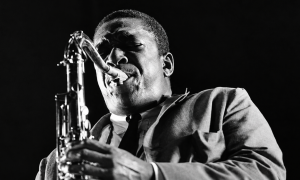
 Ayler's take on the avant-garde was not of the same form as John Coltrane's. By comparison he sidestepped the preoccupation with chords that was the initial spur for the creativity of Coltrane's leadership, and instead compiled a body of music on record that looked back to the roots of African-American musical expression at the same time as it sounded as contemporary as tomorrow. Equally importantly, he and the members of his groups implicitly questioned the primacy of instrumental virtuosity as a fundamental value of jazz.
Live In Greenwich Village. The Complete Village Vanguard Recordings documents the kind of skewed equilibrium that Ayler and his cohorts had reached, and is arguably the definitive statement of this stage of his musical development. At its most intense, the music is a clamour of voices. Ayler's trumpet playing brother Don brings an entirely different voice to the music than did Don Cherry just a year or so earlier, and Beaver Harris and Sonny Murray, the two drummers featured, bring their own musical personalities to proceedings, with Harris being the more bombastic of the two. Both men in their differing ways establish the feeling of perpetual motion which is characteristic of Ayler's music.
But despite the fact that the music frequently comes on like an idiosyncratic take on modernity, the simple, folksy quality of the melodies, frequently repeated as a kind of clarion call in the midst of lengthy performances, undermines that feeling and evokes a time before the age of recording. This paradox might just be the thing that continues to polarize opinion, such as it sadly is, on Ayler's music in the present day.
All this is encapsulated on the aptly named "Spirits Rejoice", where Ayler's emphatic vibrato evokes the rejoicing spirits of old. The violin of Michel Sampson and the basses of Bill Folwell and Henry Grimes merge as mid-range voices that are unassuming in the way they vie for attention, and Harris responds to the challenges thrown down in a way that is at odds with the history of jazz drumming as is Murray's more linear flow.
The depth of evocation here is such that the stroefront church and the campus in upheaval come to mind within the same piece. But having said this, the idea that Ayler's music amounts to some kind of soundtrack for the civil unrest and cultural upheavals of the 1960s is to damn it with faint praise. Such is the thoroughness of the revision here that any purely socio-historical assessment of it appears deterministic.
Robert Palmer, writing in 1978, refers to a conversation he had with Marion Brown that touched upon Ayler's music (1) What's significant is that no major jazz saxophonist is cited as influential on Ayler, but instead the work of gospel saxophonist Vernard Johnson brings the talk around to him. This is Ayler's old modernism in context. At the same time as he was aiming towards a totality of sound, he was evoking the sounds of early African-American Christianity. This historical depth may be the thing that most irks his detractors.
1. Essay included in the booklet accompanying the CD set discussed here.
Live In Greenwich Village. The Complete Impulse Recordings - 052 272-2 (IMP 22732)
 FOLLOW Nic Jones
and get notified whenever a new article published.
FOLLOW Nic Jones
and get notified whenever a new article published.
Nic gets a positive sense of wonder from the most worthwhile music.
About Albert Ayler

Tags
PREVIOUS / NEXT

Become a Sustaining Member

Since 1995, All About Jazz has championed jazz as an art form and supported the musicians who create it. Over three decades, it has grown into one of the world's leading jazz resources, serving hundreds of thousands of readers, musicians, presenters and industry professionals each month.
Help Build the Future of All About Jazz
Your support helps us continue building All About Jazz for the next generation—expanding our editorial coverage, preserving jazz history, developing new community features and creating better ways to discover the music and the people behind it.
Become a sustaining member for as little as $20 per year and you'll immediately enjoy an ad-free experience along with access to subscriber features and future articles for a full year.
Together, we're not simply sustaining All About Jazz—we're building its future. Thank you for being part of the journey.