Home » Jazz Articles » Album Review » Michael William Gilbert: Wheel Within the Wheel
Michael William Gilbert: Wheel Within the Wheel

The album's title provides more than a visual metaphor. Wheel Within the Wheel is built from nested cycles: loops inside loops, pulses inside larger temporal arcs, electronic gestures that appear fixed until their surfaces begin to mutate. The music unfolds through modular synthesizer, percussion, voice samples, Elta Solar 42N synth and sample-based loops, but its deeper subject is not technology. It is perception. Gilbert uses electronic systems to ask how attention changes when sound repeats, how time feels when meter becomes atmosphere, and how a loop can behave less like a machine than a contemplative practice.
Gilbert's long-standing position between electroacoustic composition, global musical thought and the electric afterlife of jazz matters here. His music does not borrow jazz as a set of stylistic signs. Instead, it engages one of jazz's more enduring principles: the transformation of time through responsiveness. In this context, improvisation is not necessarily a solo line placed over changes. It can be a filter opening by degrees, a loop thickening by imperceptible increments, a pulse shifting its psychological weight, or a texture altering the listener's sense of space. Wheel Within the Wheel locates improvisational intelligence inside the behavior of systems.
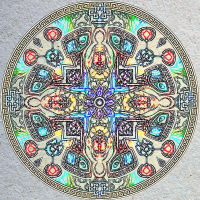
The opening title track establishes the album's philosophical ground. Its association with Tibetan Buddhist sand painting is apt: the piece feels constructed from gesture, pattern and impermanence. Nothing in it moves toward monumentality. Instead, sounds gather, rotate, shimmer and withdraw. The point is not to arrive at a grand statement, but to make audible the fragile discipline of formation itself. Gilbert's cover artwork, with its mandala-like circularity and hand-drawn color, extends the same idea visually. The image suggests not a cold diagram but a living geometry, a structure made by hand even as it points toward cosmic order.
"Fractal Loup" intensifies the album's concern with alert repetition. The title suggests a double movement: the mathematical recursion of the fractal and the animal intelligence of the wolf. The track does not simply loop; it circles. Its patterns seem to survey their own terrain, returning to familiar coordinates while registering subtle changes in density, timbre and spatial placement. The result is a kind of predatory meditation: not aggressive, but acutely awake. The listener is drawn toward micro-events rather than melodic declarations.
The paired tracks, "The Prayer is the Road" and "The Road is the Prayer," form the conceptual axis of the album. Their reversed titles are not wordplay for its own sake. They describe two directions of the same practice. "The Prayer is the Road" moves from inner discipline toward outward motion. Its pulse carries the feeling of walking: measured, persistent and quietly transformative. "The Road is the Prayer," shorter and more compressed, begins from the opposite premise. Here, the act of movement already contains the ritual. The road does not lead to prayer; the road performs it. Together, the two pieces turn repetition into secular devotion, a practice of attention without doctrinal weight.
"The Float" changes the album's gravitational field. Its techno and Berlin School electronic music affinities are clear, but Gilbert avoids both club functionality and retro- sequencer nostalgia. The track has propulsion, yet its pulse does not press the body downward. It suspends it. Rhythm becomes buoyancy rather than impact. After the road-centered pair, "The Float" feels like a release from walking into levitation, as if the previous tracks' ritual motion has lifted the listener slightly above the ground. Its achievement lies in retaining structural clarity while allowing the music to dream.
The closing "Kush Clock" returns the album to time, but not to clock time in any ordinary sense. The piece suggests a mechanism whose precision has been softened by haze. Low pulses mark duration, small electronic ticks imply gears and circuitry, and blurred resonance bends regularity into something more sensuous and unstable. As a finale, it resists finality. The album does not close with resolution; it leaves behind an apparatus still turning somewhere beyond the ear.
The strongest quality of Wheel Within the Wheel is its refusal to let concept overpower sound. The album's ideas, wheel, road, prayer, floating and clock, could easily have become explanatory scaffolding. Instead, they become musical behaviors. The title track rotates. "Fractal Loup" stalks. "The Prayer is the Road" walks. "The Road is the Prayer" condenses. "The Float" levitates. "Kush Clock" measures and distorts. Each piece does what its title proposes without reducing itself to illustration.
Approaching the album through jazz, the connection lies beneath idiom. There are no conventional solos, no swing syntax, no harmonic narrative in the usual sense. Yet the music is deeply concerned with time, interaction, variation and presence. Gilbert's electronic language does not abandon improvisational values; it relocates them. Instead of foregrounding the individual instrumental voice, it foregrounds the responsiveness of a sonic environment.
That choice gives the EP its intellectual coherence and its emotional restraint. The music rarely dramatizes itself. It does not chase climax or sentiment. Its rewards are cumulative and observational: the slight change in a loop after repeated exposure, the way a pulse becomes a body, the way texture becomes thought. This restraint may make the album seem understated on first hearing, but the work opens as its repetitions accumulate.
Wheel Within the Wheel is a compact meditation on recurrence, impermanence and electronic embodiment. It treats the loop not as a production convenience but as a philosophical form. The wheel turns, but it does not merely return. Each revolution alters the field of perception. Inside one cycle is another; inside one rhythm, another sense of time. Gilbert's accomplishment is to make that structure audible, tactile and strangely human.
Track Listing
Wheel Within the Wheel; Fractal Loup; The Prayer is the Road; The Road is the Prayer; The Float; Kush Clock.
Personnel

Michael William Gilbert
composer / conductorAdditional Instrumentation
Michael William Gilbert: synthesizers
Album information
Title: Wheel Within the Wheel | Year Released: 2026 | Record Label: Gibex Recordings
About Michael William Gilbert
Tags
PREVIOUS / NEXT


Become a Sustaining Member

Since 1995, All About Jazz has championed jazz as an art form and supported the musicians who create it. Over three decades, it has grown into one of the world's leading jazz resources, serving hundreds of thousands of readers, musicians, presenters and industry professionals each month.
Help Build the Future of All About Jazz
Your support helps us continue building All About Jazz for the next generation—expanding our editorial coverage, preserving jazz history, developing new community features and creating better ways to discover the music and the people behind it.
Become a sustaining member for as little as $20 per year and you'll immediately enjoy an ad-free experience along with access to subscriber features and future articles for a full year.
Together, we're not simply sustaining All About Jazz—we're building its future. Thank you for being part of the journey.