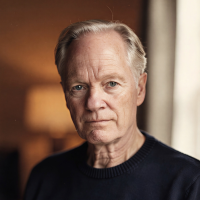
CURTIS ROUSH
COMPOSER · MULTI-INSTRUMENTALIST · BERKLEE 1980 · AUCKLAND, NZ
DEBUT ALBUM · OUTSIDE THE IN-BOX · 10 JUNE 2026 For thirty-three years, Curtis Roush sat in the dark.
Not literally — though the rooms weren't far off. The editing suites of Hollywood, fluorescent-free zones humming with playback decks and console lights, where music editors ensure that composers' visions reach the screen exactly as intended — every cue spotted, synced, and shaped into scenes. A Few Good Men. Starship Troopers. X-Men. The Hunger Games. More than a hundred feature films, thousands of hours of someone else's music run through his hands and his ears. Roush was one of the best in the business. And all the while, quietly, he was writing his own.
Outside the In-Box is what happens when a lifelong player finally becomes a composer.
A LIFE LIVED INSIDE MUSIC
Curtis Roush started hearing music differently before most of his peers had started hearing it at all. He was a child when the British Invasion changed everything — old enough to feel the seismic shift, young enough to let it reshape him completely. By high school he was playing in bands chasing the progressive rock sound that was exploding in the early 1970s: technically ambitious, compositionally restless, unafraid of the long form. The music that moved him most wasn't built on verse-chorus economy. It was built on ideas that needed room to breathe.
The jazz fusion moment hit him like a second revelation. Weather Report. Mahavishnu Orchestra. The Brecker Brothers. Chick Corea's Return to Forever. Here was music that had absorbed everything — jazz's improvisational intelligence, rock's electric energy, classical music's structural ambition — and fused it into something that didn't fit any existing category. Roush didn't just listen to this music. He studied it, played it, eventually began composing in its spirit.

He'd always loved the way music and image fit together. This was before MTV, before music videos — yet the artists who moved him most were already thinking visually: Yes, Jethro Tull, Emerson, Lake & Palmer, Frank Zappa, David Bowie, a Led Zeppelin steeped in Tolkien. So when he enrolled at Berklee College of Music in the late 1970s and discovered its film-scoring classes around his third semester, he was hooked. He hadn't come to study film music — but the program was impacted, so he declared the major simply to get into the room. It added years to his degree, including four semesters of counterpoint, and he graduated summa cum laude in 1980.
Read more
The next thirty-three years would be, professionally, an extraordinary success — and personally, a long conversation between the musician he was and the musician he was becoming.
THIRTY-THREE YEARS IN THE ROOM
Film music editing is one of the least visible and most essential jobs in Hollywood. When a score works in a film — when the music swells at exactly the right moment, when the composer's cues land precisely where the director needs them, when the vision in the scoring session translates faithfully to the final print — it is often because a music editor shepherded it there behind the scenes. Roush was that person for more than three decades.
His credits read like a catalog of the last century's most enduring films. He cut music for Barry Levinson (Sphere), Paul Verhoeven (Starship Troopers), Rob Reiner (A Few Good Men), Michael Bay (Bad Boys), Bryan Singer (X-Men). He worked on Julie Taymor's Across the Universe — a film built entirely on reimagined Beatles music, which gave a music editor's craft its own starring role. He was in the room when Frida won its Oscar for Best Original Score. He edited music for The Hunger Games, one of the defining blockbusters of the 2010s.
Through all of it, he thought of himself first as a player. He spent those years alongside some of the finest composers in the business — Mark Isham, Dave Grusin, Basil Poledouris, Elliot Goldenthal — and loved every minute of it without ever wishing the music were his own. His own pulse beat elsewhere: in jazz fusion, in the bands he played in on weekends and evenings, in the long-form ideas he'd chased since the 1970s. He kept composing, too — not prolifically, the work left little time, but steadily. Film scoring exercises. Jazz pieces for the bands. Small things that went into a drawer. Nothing released, nothing intended to be. The music was simply his.
In 2014, Curtis Roush stepped away from film. He stayed in Los Angeles — living, playing, and writing — until 2023, when he moved to New Zealand. He was done serving other people's musical visions; the question was what to do with his own.


Stepping away from film didn't mean silence. Back in Los Angeles, Roush threw himself into playing — jazz fusion bands again, the same restless territory he'd loved since the 1970s, practicing for hours a day as he had in his youth. He wrote for those bands, and somewhere in those years something shifted: the player who had always composed on the side began, for the first time, to think of himself as a composer.
Then, in 2020, the world went quiet for everyone. The bands stopped. The rehearsal rooms closed. What remained was Roush alone with his instruments and his ideas — and the gradually clarifying realization that everything he had written had been shaped toward someone else's context: a band that could play it live, a format that constrained it, a practical end. He had never once written music purely for itself — music that could be as long as it needed to be, as complex as it wanted to be, with as many tracks and textures and compositional layers as the ideas demanded.
The player had become a composer, and he had something of his own to say. He decided that the time had come. The result is Outside the In-Box.
THE ALBUM
Outside the In-Box is a jazz fusion album in the tradition that forged Curtis Roush: the grand, ambitious, genre- dissolving fusion of the 1970s and early 1980s that produced some of the most compositionally sophisticated popular music ever recorded. If you grew up on Weather Report's Heavy Weather, on Chick Corea's Romantic Warrior, on the Brecker Brothers or Gentle Giant or John McLaughlin's Mahavishnu Orchestra — or if you've never heard any of those but you're ready to hear what that tradition sounds like when filtered through thirty years of professional musicianship and a lifetime of listening — this is an album built for you.
Seven tracks. Sixty minutes. Each piece carefully, painstakingly composed by Roush, with no compromise toward commercial brevity or stylistic convention. The music is cinematic — how could it not be, after thirty-three years in film — but it is not soundtrack music. It is jazz that has absorbed the structural ambitions of progressive rock. It is fusion that has the compositional care of classical music. It is, in the deepest sense, a record that sounds like a specific person's entire inner life, finally given full expression.

The production matches the ambition. Enter Gary Bourgeois — a Hollywood sound veteran with more than three hundred feature film credits of his own, and a collaborator who understands exactly what cinematic-quality music should feel like — who mixed the album in both standard stereo and full 5.1 surround sound. The surround mix is not a gimmick. It is an invitation to experience the music spatially, the way the best film scores are designed to envelop you — not merely heard, but inhabited.
Track titles like “Synth You Asked...” and “A Different Scenario” hint at a compositional sensibility that is serious without being solemn, musically literate without being academic. This is music made by someone who has spent a lifetime thinking about how sound affects feeling, and who has finally turned that understanding entirely toward his own creative vision.
WHAT THIS ALBUM IS NOT
It is not a comeback, because there was nothing to come back from. It is not a vanity project — the craft is too evident, the ambition too genuine. It is not an old musician trying to sound young, and it is not a nostalgic exercise in a dead idiom.
It is a debut. A genuine, fully formed debut, by an artist who is new to releasing music but not to making it, not to understanding it, not to living inside it for fifty-plus years.
Curtis Roush is not after radio play. He is not chasing an algorithm. He is not interested in ubiquity. He made this album for the people who will hear it and immediately know it was made for them — the listeners who have been waiting for something that sounds like this, who didn't know they were waiting, who will play it three times in a row and then send a message to someone they know: you have to hear this.
He made it, as he says, to find the people who would love it. The music will do the finding.
Curtis Roush's debut album Outside the In-Box is available on Bandcamp. Mixed in 5.1 surround and stereo by Gary Bourgeois. · curtis-roush.bandcamp.com · © 2026 Curtis Roush
Show less