Home » Jazz Musicians » Simon Côté-Lapointe Discography
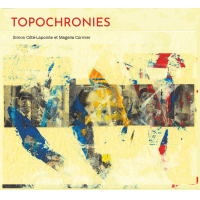
Topochronies
Simon Côté-Lapointe
Label: hecto
Released: 2024
Duration: 63:51
Views: 100
Tracks
Introduction : les tranches du passé; Prolégomènes ou d'abord plus loin; Et. je puis vous dire ...; La traversée du désert; Répons de la nuit de la poésie; Panis angelicus/ Oublions le passé (partie 1); Témoins muets des récits effacés; Trois peintres du Refus Global; Émergence du subconscient collectif; Anthropologie interculturaliste; Épilogue/ Oublions le passé (partie 2)
Personnel

Simon Côté-Lapointe
pianoMagella Cormier
drumsJerry De Villiers Jr
guitarTariq Amery
saxophoneNicola Carillo
guitar, electricAlbum Description
Topochronies is a mixed jazz-progressive-experimental music project that combines improvisation and composition, electroacoustic and electronic sequences, and acoustic and electric instruments. Composed and produced by keyboardist Simon Côté-Lapointe in collaboration with drummer Magella Cormier, the concept album is a fresco anchored in the recent history of Quebec.
The fruit of work spanning 7 years, Topochronies takes as its starting point a place (topo), Quebec, explored through its temporalities (chrono) as manifested by sound archives that serve as entry points or anchors for building the compositions. What emerges is a journey through the Quebec collective unconscious, viewed through the prism of composer Simon Côté-Lapointe's own unconscious.
Excerpts of sound archives are used throughout the album, sometimes as a narrative thread, sometimes as musical material. Among the voices heard are General De Gaulle, René Lévesque, poets Michèle Lalonde and Claude Gauvreau, Brother Marie-Victorin, as well as painters Fernand Leduc, Paul-Émile Borduas, and Jean-Paul Riopelle. The thoughts, emotions, textures, and unspoken elements evoked by the archives come into play at different levels, made possible by the various components of the documents drawn upon: content, form, and context. Each section proceeds from a different compositional process, drawing on jazz, fusion, and progressive rock, as well as world music, contemporary music, electroacoustic, and electronic music. The compositions are structured around riffs with complex, often asymmetrical rhythms (13, 15, 7), over which polymodal — and in some sections, polytonal — harmonies and melodies are layered.
Adding to this are the virtuosic keyboards and drums of Côté-Lapointe and Cormier, which occupy a prominent place within rich arrangements and orchestrations. Guest soloists join them on a few tracks: guitarists Jerry De Villiers Jr and Nicola Carillo, as well as saxophonist Tariq Amery. The result is a unique and dense summa work in which the diverse influences and techniques explored over 20 years by Côté-Lapointe intertwine — a gallery of contrasting tableaux further elevated by Cormier's dynamic and polyrhythmic contribution.
• Toutes les pièces ont été composées et arrangées par Simon Côté-Lapointe avec la collaboration de Magella Cormier (SOCAN 2024)
• Enregistrées et mixées en 2023-2024 au studio 1982 (Longueuil) et au studio Magma (Notre-Dame-de-Bonsecours)
• Graphisme : Simon Côté-Lapointe
• La création de cette œuvre a été rendue possible grâce à l’appui financier du Conseil des arts et des lettres du Québec.
Archives et sources sonores utilisées
• Narration de Jean-Louis Millette. Source : Montréal citée : 60 ans d’histoire à travers les archives sonores, 1992. (piste 1)
• Discours du général De Gaulle, Montréal, 24 juillet 1967. Source : Office National du Film du Canada. (piste 3)
• Discours de René Lévesque, Montréal, 20 mai 1980. Source : Radio-Canada Archives. (piste 4)
• « Marie-Victorin parle d’un arbre », [1930-1942]. Source : Montréal citée : 60 ans d’histoire à travers les archives sonores, 1992. (piste 4)
• « La Nuit de la poésie, 27 mars 1970 », extraits de Michèle Lalonde (Speak White) et Claude Gauvreau. Source : Office National du Film du Canada. (piste 5)
• « Panis angelicus », composé par César Franck; interprété par Joseph Saucier, baryton. Source : Berliner Gram-O-Phone Co, Montréal, [1900?] Source : BAnQ. (piste 6)
• « Oublions le passé », composé par Dickson; interprété par Torcom Bézazian, baryton avec orchestre. [New-York] : Columbia Record, [1915?] Source : BAnQ. (pistes 6 et 11)
• « Québec en 2060 », synthèse vocale d’un poème composé par ChatGPT et Simon Côté-Lapointe. (piste 7)
• « HOKURO », Sachiyo Honda, Sabri Meddeb, Michael Northam (accordion, objects, strings, winds, voices and electronics), [2009]. Source : radio aporee maps, Internet archive. (piste 7)
• Extraits d’entrevues de Fernand Leduc (1996), Paul-Émile Borduas (1954) et Jean-Paul Riopelle (1981). Source : collection « Ils ont dit », BAnQ. (piste 8)
• « 1348 - Corporate Werks » (2009), « We Know Time » (2009). Source : The Noise-Arch Archive, Internet archive. (piste 9)
• George Kingsley Roth: Fijian Music, Songs and Dances: Doc.381, 'Nose flutes and shell trumpets', 1957. Source : University of Cambridge, World Oral Literature Project Collections. (piste 10)
• « Enonyi kolojjo khumutiyeere », [1964-1997]. Source : Peter Cooke Uganda Collection, British Library. (pistes 3 et 10)
• Free music archives [extraits]
Album uploaded by Simon Cote-Lapointe