Home » Jazz Musicians » Shai Jaschek Discography
Portrait
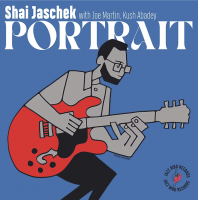
Shai Jaschek
Label: Jazz Bird Records
Released: 2026
Duration: 00:45:59
Views: 224
Tracks
Birmingham After Dark; When the Sun Came Out; June 27th; How Much Longer; Two Chords Song; May Flowers; Stomping with Pitzi; Hymn for Peace; Poem
Personnel



Album Description
Israel-born, New York-based guitarist and composer Shai Jaschek announces Portrait, his second album and first for Jazz Bird Records, out this November. Recorded at EastSide Sound with bassist Joe Martin and drummer Kush Abadey, and engineered by Alon Benjamini, the album presents nine Jaschek originals that move through groove, lyricism, modern-jazz interplay, shadow, calm and hard-won hope.
Across Portrait, Jaschek writes for directness and lift, placing clear melodic themes inside shifting textures, unusual meters and trio interplay. The album ranges from the funky, shadowed “Birmingham After Dark” to the title track, the stripped-down “Two Chords Song,” the buoyant “Stomping with Pitzi,” “June 27th,” “May Flowers,” and the paired “How Much Longer” and “Hymn for Peace.”
Born and raised in Hod HaSharon, Jaschek studied at the Jazz Institute at the Rimon School of Music and the Jerusalem Academy of Music and Dance, and worked with mentors including trumpeter Avishai Cohen, saxophonist Eli Degibri and composer Yoni Rechter. He later moved to New York, earned a master’s degree in music from Queens College, and became a regular presence around Smalls and Mezzrow.
Jaschek released his debut album, First Fall, in 2023. His follow-up grew out of writing and gigging, not a grand concept. He continued composing, played the tunes live, and eventually chose the pieces that felt ready. “There’s not a big background story,” Jaschek says. “I’m always writing and playing gigs, and composing music is a big part of my thing as a musician. After a couple years of playing some tunes that I wrote, I just felt like, okay, it’s time to go to the studio.”
Jaschek wanted his own tunes to carry the album. Jazz, he says, can sometimes feel like music for people who already know how to understand it. His writing aims for something more direct: lyrical melodies people can sing, remember and relate to. “That’s what I think is special in my music,” he says. “That’s why the entire record is original music and not standards. What I bring to the table is my own music.”
For the trio, Jaschek turned to two musicians he had long admired. Before he moved to New York, he knew Martin and Abadey from records by Gilad Hekselman, Kurt Rosenwinkel, Aaron Goldberg and others, and already thought of them as players he hoped to work with someday. In New York, he got to know Abadey at Smalls and Mezzrow, and Martin through the scene and shared gigs. “For a long time, I wanted to play with Kush and Joe,” Jaschek says. “I also thought that they’d be a great fit to this music.”
Martin and Abadey were hardly strangers. They had already played together for more than a decade, and both arrived with long modern-jazz résumés. Martin’s credits include Mark Turner, Chris Potter, Kurt Rosenwinkel and Gilad Hekselman; Abadey’s include Wallace Roney, Melissa Aldana and Hekselman. Abadey calls Martin his “partner in time” and one of his favorite bassists.
Martin recognized the bebop and straightahead guitar language in Jaschek’s playing, but also a composer who was not writing stock tunes. His music, Martin says, is “warm and inviting to the listener and the player alike,” with a firm hold on jazz-guitar tradition. Abadey heard a similar range: Grant Green and Wes Montgomery in the guitar language, Gilad Hekselman and Peter Bernstein closer to the present, and writing that could move from swing to modern jazz to odd meters.
In the studio, that preparation mattered. Jaschek says the trio recorded nine tunes in five or six hours, with no piece needing more than a second or third take. Benjamini could hear that readiness from the control room: the band came in knowing the music, and the melodies were easy to remember. His job, he says, was to capture “what it sounds like in the room” and “stay out of their way.” Jazz Bird Records’ Geoffrey Hoefer heard the result as close, clear and immediate, almost like being in the studio or an intimate club with the trio.
Hoefer did not know Jaschek when the guitarist’s music arrived in his inbox. He says he makes a point of listening to everything artists send him, though Jazz Bird rarely takes on unsolicited projects. Jaschek’s album was an exception. In the days and weeks after hearing it, Hoefer kept returning to the record — including during an after-dinner walk from Jazz at Lincoln Center to Birdland, when he put it on not because he was still evaluating it, but because he wanted to hear it again.
“I’m just so impressed with his original compositions, with the vibe he creates in a lot of his tunes,” Hoefer says. “The rhythms and melodies, to me, are subtle, but just absolutely thrilling.” Later, he put it even more simply: “Cool, smooth, and impossible to forget.”
Part of the album’s appeal was the absence of standards. At first, Hoefer kept waiting for a familiar tune; only later did he realize the record did not need one. “I found myself with Shai’s album not needing or wanting familiar jazz standards,” he says. “There was something kind of beautiful in the purity of nine original compositions that work together so great as an album.” He also heard Martin and Abadey playing those originals with “the same kind of passion and familiarity” they might bring to “a beloved standard.”
“Birmingham After Dark” opens the album with a funky, shadowed groove Jaschek traced to Peaky Blinders. The title track turns toward calm and release, its wording suggesting not sunrise exactly, but the moment light breaks through cloud. Hoefer was drawn to the way the trio shapes those contrasts, from the bass sound and nuanced drumming to Jaschek’s gradual use of overdrive: a warm hollow-body tone, a little more edge, a sense of lift, then a return before the music feels overstated. It was, Hoefer says, like taking “a journey you didn’t know he was taking you on.”
“Two Chords Song” grew from Jaschek’s attempt to write the simplest tune he could: B minor, C minor and four notes. Hoefer heard that simplicity without hearing something slight: “There’s simplicity to it, but it doesn’t sound simple.” “Stomping with Pitzi,” written for Jaschek’s dog at his wife’s request, loosely nods to “Stompin’ at the Savoy”; Hoefer sums it up in one word: “Joyful.”
Jaschek heard “May Flowers” as a shift between dark and light, and took the title from the phrase “April showers bring May flowers.” Hoefer came to hear Joe Martin’s bowed-bass introduction almost as its own small vignette before the longer tune opens up.
“How Much Longer” and “Hymn for Peace” bring the album closest to the world outside the studio: two angles on violence, despair and hope, with one asking how much longer people can live through this and the other looking toward a better future. The pieces are open to interpretation, but for Jaschek, they connect directly to Gaza and Israel. “Hymn for Peace” is the more hopeful side, he says, but not passive hope: it asks what people can do to resist violence and oppressive systems, and to help build something better.
For Jaschek, Portrait is “a snapshot of who I am as both an artist and a person at this moment in time.” Joe and Kush, he says, brought out the best in him as a performer, and the trio’s chemistry made the music feel “exciting, spontaneous and alive.”
Hoefer hears that same clarity in the finished album. “I really believe in him, and I want him to be heard,” he says.
Most importantly, the album passed Jaschek’s own test: “As musicians, we are often our own worst critics. Because of that, I’m excited beyond words to present my new album — one that even I, as a harsh critic of myself, am truly proud of. I sincerely hope you’ll enjoy listening to the music, and if it moved you in any way, I did my part as a musician.”
Album uploaded by Morgan Enos
About Shai Jaschek
Tags
PREVIOUS / NEXT
More Albums
Recordings: As Leader | As Sideperson