Home » Jazz Musicians » Nicki Adams Discography
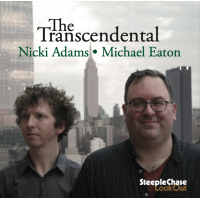
Paraphrase
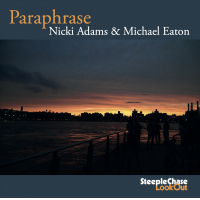
Nicki Adams
Label: Steeplechase Lookout
Released: 2022
Duration: 00:46:03
Views: 58
Tracks
The Sorcerer Flea Flop Criss Cross Iris Blues For Bern No One Like Sonny Loves Lullaby Phenomenology
Personnel

Nicki Adams
piano
Michael Eaton
saxophone, tenorAdditional Personnel / Information
Nicki Adams and Michael Eaton co-lead this album
Album Description
Owing to the SteepleChase LookOut series’s focus on younger and lesser heard musicians, and in light of the label’s retinue of historic artists, I wanted to introduce this set from Nicki Adams and me by describing our origins in the music.
I first met Nicki Adams while working at Williamsburg Music Studio in Brooklyn. We got along well, and we shared some musical sensibilities in common. I had been a student at Indiana University-Bloomington, and he had been a student at Oberlin. Nicki was born in 1988, and I was born in 1981, so consequently we are both children of the 1980s and 1990s. The musical, economic, and political changes in motion at that time in turn affected the future movements and prospects of jazz. We grew up as this was happening.
Most principally, the era was the neoclassi- cal period of jazz, more popularly termed
the Young Lions era, which marked a
return to traditional practices and increased self-consciousness about the history of jazz. “Young Lions” was a marketing term, and as a description it tells us little about the content
of the music besides the age of the perform- ers. “Neoclassical” describes a return to i. e. classic forms and procedures, often with the addition of more contemporary elements or the restructuring of existing forms.
Perhaps the most artistically significant movement to occur synchronically with the Young Lions, one which I believe has yet to be fully assessed and understand in terms of its musical significance to contemporary jazz, was the music of The M-BASE Collective, especially the music of Steve Coleman. Cole- man’s rhythmic ideas and his pancultural, panrhythmic sensibility, although presaged by elder musicians such as the Art Ensemble of Chicago and Anthony Braxton, would regis- ter a deep impact on the music in the decades that followed. From the mid to late 1990s, various musicians began assimilating odd meters into mainstream jazz, such as notably the Brad Mehldau Trio, or in another arena, the Dave Holland Quintet. Although this had been done previously by musicians like Dave Brubeck, Don Ellis, or the Mahavishnu Orchestra, a new level of synthesis, com- mand, and flexibility was reached by players
2
and a refreshing of mainstream jazz reper- toire. After Coleman, Vijay Iyer and Rudresh Mahanthappa are examples of musicians who interpolated rhythmic cycles through an Indo American perspective.
In this postmodern and global capitalist milieu, eclecticism became the new standard and often de rigueur reality for musicians
in the jazz world and and beyond. Jazz has always been a syncretic music, merging with what is around it. Elvin Jones reportedly said that every new generation was responsible for learning the music made or transmitted by previous generations; I basically agree but also think this implies that the music’s pedagogy and transmission of information must cor- respondingly increase and grow faster for musicians to do so much fluently. Neverthe- less, as the music became increasingly global and situated everywhere, the possibilities for fusion and all manner of cultural offshoots continued to proliferate.
In Bruce Mishkit’s Master Lessons for the Creative Musician, saxophonist David Lieb- man sums up the musical prospects from
the perspective of a practitioner in the mid-
1990s:
“We are in a period of collection and explanation. If you look at the music of the last decades in jazz, what’s the biggest trend besides the neoclassicism of some musi- cians, which is reinventing the past and is always present contemporaneously with new developments in any art form? For lack of a better word, it is “fusion”, not as the jazz-rock style of the 70s, but implying the blending of idioms together. It’s like a recipe-if you have one spice instead of two, you have a different tasting soup... [This broader fusion] will be the combinations which accurately reflects the world we live in.
Jazz is not some cult music played in a tiny bar on 52nd Street anymore nor does it represent a subculture as it formerly did. It’s part of the mainstream as are most art forms nowadays because of education and exposure. Therefore jazz musicians will borrow, blend, steal or whatever from everything around them. It’s all in the mix like a giant bouil- labaisse stew. A jazz musician now is no different than say a pop artist in that they
fit into the context of contemporary culture
3
where everything is mixed together. Of course you could pass a judgment that the pure art form has been diluted by this blending, but new combinations can yield original ways of looking at something.”
So this was the period in which Nicki and
I came of musical age and had our forma- tive experiences, the one which pervades
the musical unconscious and forms part of the horizon of thought for our generation. “Paraphrase” is a title that reflects the jazz tradition; it refers to taking known or classic material - the well of modern jazz repertory, in this case - and reworking it harmonically, rhythmically, and texturally. Rearrangement, rethinking, and recontextualization are core components of the jazz tradition.
There is a long-standing ambiguity in jazz orthodoxy: the admonition to jazz musicians in training that they should learn tunes from recordings. What is sometimes not speci-
fied in many cases is which recordings. John Coltrane’s recording of “I Hear A Rhapsody”, to take one example, is one which most tenor players know quite well, and Coltrane’s phras- ing of the melody was quite influential. But
the late Jimmy Heath is known to have taken issue with this, saying that Coltrane changed the melody and consequently everyone had learned the tune “wrong”. This brings to light two issues: how variation or paraphrase as a practice is deeply embedded into the history of the music, and that textual sources like sheet music from the composer are arguably more essential as a reference than the “only use your ears” way of thinking might allege. However for the musical program at hand, this issue was not present so much for
Nicki and me. We transcribed (as best we could) music from the composers and their recordings. In this case, we chose songs by Thelonious Monk, Herbie Hancock, John Coltrane, Andrew Hill, Wayne Shorter, and Tim Hagans.
Some of this music is more specific in design and less played than standard forms; some of it has numerous versions from the composer with which to compare; and some of it is open ended enough to sustain changes or subtleties of interpretation - such as trying to figure out what Andrew Hill was doing on his Blue Note recording of ‘Flea Flop’! And to
these tunes, we added music of our own. Nicki Adams is interested in importing elements from European classical piano litera- ture of the late 19th and early 20th centuries, especially Bartok and Debussy, into arrange- ments of jazz tunes. His duo recording, Lynx, on Sunnyside Records displays this approach with his brother Pat Adams on trumpet. On Paraphrase, he arranges The Sorcerer, Iris,
and Criss Cross, plus he contributes his own original, “No One”.
Nicki remarks: “Herbie Hancock’s The Sor- cerer is stark and angular. With ample space in its background for textures, the harmonies elicit foreboding with their chromaticism and sweeping chordal extensions. There’s a sinister otherworldliness throughout the composi- tion that leaves it open to volatile musical gestures.”
Adams took inspiration here from Debussy’s, Ce qu’a vu le vent d’ouest (What the West Wind Saw), which is the seventh work in the composer’s first book of Preludes for piano. Influenced partially by the children’s books of Hans Christian Andersen and the piano works of Franz Liszt, Debussy likely had in
mind depiction of swirls, gusts, and cyclones of wind through the use of sweeping arpeg- gios and rumbling bass tremolos.
Thelonious Monk’s Criss Cross is retouched once more with Debussy and Liszt; this time the textural ideas come from Debussy’s “La serenade interrompue” and Liszt’s “Liebe- straum”. Monk’s punchy, fragmented melody sits over an undulating triplet rhythm that oscillates between bass pedal points and register changes.
Wayne Shorter’s immortal Iris encounters Bela Bartók’s second piano etude. The poly- tonality of Bartok’s study casts a darker, more cerebral hue to Shorter’s shimmering and poetic harmonic sense. Piano arpeggios roll throughout the bass in unpredictable subdivi- sions while the saxophone sounds the melody. No One is a simple theme that hovers over
a repetitive, polytonal bass figure. “There’s a sense of space I wanted to preserve within the feeling of uncertainty - almost like an invis- ible third player is performing with us,” Nicki remarks. The piece is partly influenced by
the long, drawnout vocal melodies of Thom Yorke from Radiohead.
For my part, I contributed two original tunes, Phenomenology and Blues for
Bern. Phenomenology is inspired by the philosophy of Edmund Husserl, which in turn profoundly influenced Heidegger and Sartre. In Husserl’s words, phenomenology was the attempt to form a science of inner experience and thereby to find what Husserl called “the Archimedean Point”: the inner, transcendental ego that grounds all experi- ence. With the theme of inner awareness in mind, I wrote a tune based loosely on Jerome Kern’s “All The Things You Are”. I had in my mind Jerry Bergonzi’s playing, but overall the chromatic style, especially in the piano, was influenced by Schoenberg and Berg. The A sections are intervallic and composed by ear and intuition, but the bridge is a twelve-tone row. Nicki and I elected to improvise on the form but freely, as one can hear, in the style of the composition.
Blues for Bern is in honor of the late harmolodic guitarist, Bern Nix, a true and undersung jazz original. Well known for his association in Ornette Coleman’s Prime Time, I had the privilege of playing with
Bern a number of times in flutist Cheryl Pyle’s Beyond Group and assorted ensembles in New York City. Although he had roots in straight ahead jazz guitar, Nix related to me that he loved playing harmolodically and had found an identity there.
It is hard to describe Bern’s style except to
say by way of metaphor that I was reminded of quantum nonlocality and wave-particle duality: musically, Bern could be a wave or
a particle, and you could not pin him down. If he did not want to be followed, he would suddenly disappear and reappear somewhere else in musical space. There were times he would play ideas that were so striking I was not sure what was happening, and I mean this in the best, most creative way. HIs intu- ition and embodiment of the harmolodic way of thinking and existing was profound. The melody here was written to exploit interesting and spiky intervallic jumps, and it brings to mind for me Monk, Joe Lovano, and George Garzone. Nicki and I play the tune and take solos on the chord changes, but every soloist also reaches a point where on cue from the soloist, time stops and we play free. What I
appreciate here is how Nicki grounded the melody in stride-like figures that balanced the more airy, abstract melodicism with groove and earthiness.
Finally, I arranged John Coltrane’s Like Sonny not only as a nod to the master, but because I love the melody and chord changes. I wanted to give it fresh phrasing by changing the meters but to keep the original melody and its integrity intact. So idea occurred to use a Khush Rank rhythm in 17/8 to exploit the tune’s vaguely Middle Eastern connota- tion. I had been exposed to this groove as a member of drummer George Melikishvili’s New York quartet with George, Enrique Haneine, and Apostolos Sideris. George’s band was like a cross between the last Wayne Shorter quartet, Dave Holland’s Overtone Quartet, and Joni Mitchell. The group was the first occasion for me to delve into odd meters and rhythmic cycles at length, and
I gained a great deal of essential experience
in that band. Therefore paraphrasing “Like Sonny” in “old wine in new bottles” fashion and bringing forward some of its implications felt natural.
Finally, Tim Hagans’s Love’s Lullaby debuted on his seminal recording for Blue Note, “Animation/Imagination”. The composer related to me how he wrote the tune for his mother, who had told him that, in her view, he rarely wrote anything tuneful. In response this evocative ballad emerged. It is a beauti- ful, even classic melody that feels inevitable, and it deserves more hearings. I should perhaps remark that I was playing a version of the melody in terms of how I heard it in my memory, and one phrase diverges very slightly from what the composer wrote. I hope Mr. Hagans will not mind too much and may ap- preciate how these things can happen in the course of improvisation and paraphrasing.
So finally, Paraphrase is Nicki’s and my perspective, filtered through our interests and proclivities and concept for this duo. We give deep thanks to all the artists and predecessors who helped create and expand the cultural well from which we draw. We hope that in telling our own story, from this one particular day in April 2021, we might have played something interesting and fruitful of our own to contribute.
Michael Eaton August 2021
Album uploaded by Nicki Adams