Home » Jazz Articles » The Art and Science of Jazz » Access for People with Disabilities at Jazz Venues: Wha...
Access for People with Disabilities at Jazz Venues: What is really missing

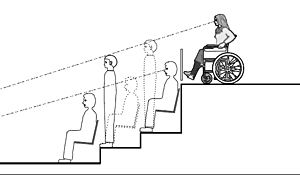
The Americans with Disabilities Act (ADA) requires that at least 1% of seats be wheelchair seating and that this accessible area be an integral part of the floor plan. Also, the law mandates that wheelchair locations be available in all areas of the venue and that each location be next to a companion seat.1 Figure 2 illustrates this second point.2


Is your favorite jazz club truly accessible to people with disabilities? That is a rarely asked question and one that is seldom answered. It is safe to say that the general public does not fully understand what is required to make a venue disability-friendly. To understand more I contacted writer, jazz aficionado and disability advocate Mike Ervin. One of the most obvious things that Ervin pointed out was the bathroom situation. Sometimes even when a venue provides other accommodations for wheelchair-bound customers, it does not have restrooms that these patrons can easily use. The second point Ervin brought up was entrance and exit accessibility. ADA requires 50% of ports of egress and ingress be wheelchair friendly. The law also mandates that a renovated facility be accessible in the new areas. The budget for a building project must add the elements of accessibility as long as it is within an additional 20% of the total construction cost. When it comes to new constructions the law states that they must be 100% accessible without exception. Even when the rules are followed, that may not offer an entirely satisfactory solution.1 Ervin gave a personal example. A very accommodating local establishment has installed a wheelchair lift for patrons unable to navigate its flight of stairs. The owner graciously helps wheelchair bound attendees by operating the lift when they arrive. However, since he lives in Chicago where the weather is not always temperate, Ervin is exposed to the elements (including low temperatures in the winter) while he waits for the owner to arrive and operate the lift.
Another important issue Ervin raised is access for performers with limited mobility. Even at venues where the audience areas are accessible to people with disabilities, the stage may not be so.
It is rare to find a jazz club that meets all these ADA requirements. Why is that? I posed the question to Ervin. He pointed out several factors. For example, the buildings that house them may predate the ADA and may be too old to sustain significant remodeling. ADA became law in 1990 and many older constructions did not meet its criteria. ADA does not exempt these structures. In fact, it makes clear modification recommendations. Yet this remains one of the most misunderstood section of the law. 3
Another reason Ervin mentioned was builders and owners think of ADA as a hindrance and find ways to get around it. Sometimes inspectors also turn a blind eye to these violations. Fixed seating at historic venues makes it hard for modification to be done in a cost-effective manner. Finally, there is also an element of lack of sensibility about the importance of making spaces accessible to people with disabilities
ADA has been the law of the land for 28 years. Following it is not merely an issue of being customer friendly. It is also a matter of civil rights. It is time for all music venues to implement its recommendations so everyone, regardless of mobility, can derive the same amount of enjoyment and satisfaction from live performances.
References
12
3
 FOLLOW Hrayr Attarian
and get notified whenever a new article published.
FOLLOW Hrayr Attarian
and get notified whenever a new article published.
Ancora Imparo
Tags
PREVIOUS / NEXT


Become a Sustaining Member

Since 1995, All About Jazz has championed jazz as an art form and supported the musicians who create it. Over three decades, it has grown into one of the world's leading jazz resources, serving hundreds of thousands of readers, musicians, presenters and industry professionals each month.
Help Build the Future of All About Jazz
Your support helps us continue building All About Jazz for the next generation—expanding our editorial coverage, preserving jazz history, developing new community features and creating better ways to discover the music and the people behind it.
Become a sustaining member for as little as $20 per year and you'll immediately enjoy an ad-free experience along with access to subscriber features and future articles for a full year.
Together, we're not simply sustaining All About Jazz—we're building its future. Thank you for being part of the journey.